
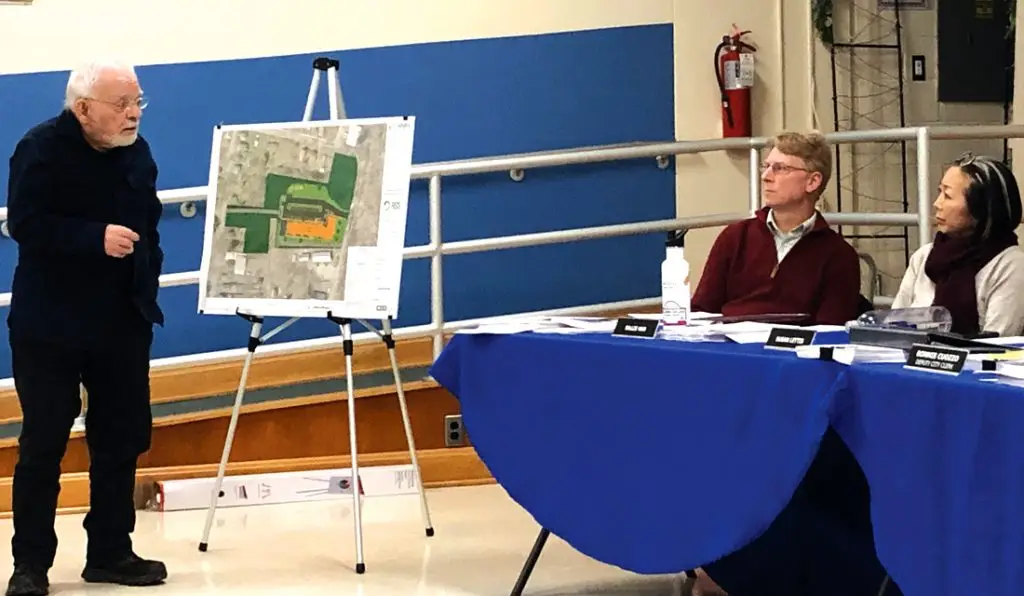
Turnout Strong for Recent Public Hearing on Second RSS Housing Project Proposal
By MONICA CALZOLARI
ONEONTA
Approximately 100 local residents provided feedback for nearly two hours to the City of Oneonta Planning Commission at a public hearing on Tuesday, February 24 regarding the supportive housing complex that Rehabilitation Support Services proposes to build at 164 River Street in the Sixth Ward.
This meeting took place in the Riverside Elementary School cafeteria. Planning Commission meetings on this topic inside City Hall were standing room only and could not accommodate the crowd.
Planning Commission Chair Marcela Micucci, PhD, called the meeting to order just after 7 p.m. and asked the audience to address the Planning Commission and not the crowd. Two Oneonta police officers were stationed in the back of the room.
According to the Planning Commission Meeting Materials web page, “The applicant proposes the construction of a 3-story, ±61-unit, affordable housing project known as ‘Solstice Commons’ to be located at 164 River Street, Oneonta, NY 13820. The building will occupy the northern portion of the ±6.5-acre tax parcel (299.12-2-37). The project proposes to subdivide the southern portion of the parcel (see attached site plan).”
In a memo dated September 4, 2025 from City of Oneonta Code Enforcement Officer Stephen Yerly described the site of the proposed development as approximately 6.5 acres between West Broadway and 164 River Street and the total acreage expected to be disturbed is ±3.2 acres.
“Solstice Commons will include ±31 units for individuals with serious mental illness and ±31 units for individuals at or below 70 percent of the area median income,” the CEO Memo states.
At least 20 residents voiced concerns about the scale and nature of the proposed RSS project. Only five people spoke in favor of the project. Many of the 25 people who spoke read prepared statements. Micucci enforced the three-minute rule when some exceeded the time limit.
Two women opposed to the project gave testimonies of loved ones they lost to addiction. Rachel Dotey of Elm Street said her 36-year-old sister died two weeks ago of kidney failure after abusing alcohol most of her life. Her sister suffered from bipolar disorder, which is considered a Serious Mental Illness.
RSS proposes that 50 percent of the 61 units it plans to build would be reserved for people with SMI; the other half would be for low-income tenants.
Dotey said her sister had family members who loved and supported her locally. They tried to get her the mental health assistance she needed.
“This (RSS) plan is going to kill people,” she said. “It is a death sentence.”
In tears, she described how her sister’s friends who drank and used drugs “pull each other down.”
The level of professional help her sister needed “does not exist in this city,” Dotey said.
Liz Fink of Gilbert Street is also opposed to the RSS project.
“This is so personal to me,” she said with emotion. “I was a single mother when I became homeless.”
“I have mental illness in my family,” she explained.
Both of Fink’s two sons have been in and out of rehabilitation treatment programs. One of her sons died of an overdose in 2021. He had been in rehabilitation six or seven times, she said.
One unidentified woman spoke in support of low-income housing for people with SMI. She said she has had bipolar disorder since she was 15.
“I come from a privileged background,” she said, having had a loving, supportive family and a psychiatrist who prescribed her with the proper medication to treat her condition. She cried when she spoke about people in the community who oppose the RSS project, saying they have said hurtful things about “crazy people.”
Steven Judd, a 13-year resident of River Street, objected to the RSS proposal and summarized the “crux of the issue” this way. He characterized the project as building an apartment complex that “merely warehouses needy people” with “no way to guarantee their needs will be met.”
Ellen Falin of Moore Street asked the Planning Commission, “Will this project lower my taxes or increase my property value?”
Eric Hendrickson of West Broadway asked if this project will house “primarily local residents.” What assurances will prevent Solstice Commons from attracting regional and state level referrals who qualify as low income or SMI, he asked. What monitoring and enforcing mechanism will be in place?
Connie Vagliardo of West Broadway raised the issue of the noise and vibration of the Norfolk-Pacific Railroad that runs directly across the street from the proposed apartment complex. She said noise can be a destabilizing factor that can affect future residents.
One person mentioned that there was an attempted suicide on this portion of the railroad tracks near an encampment of homeless people who live in the woods near the railroad.
Another woman asserted that RSS was short staffed in this area and that a staff training program that included crisis intervention should be a mandatory component of the proposed operation.
Kathy Jalowiec-Stanton, a 42-year resident of the Sixth Ward with two properties on River Street, said, “This is not opposition to affordable housing.” She opposed the RSS proposal as being “fundamentally different than residential housing” based on the definition of SMI as a “disorder that interferes with everyday activities.”
Fran Colone of Duane Street said that the parcel RSS now owns at 164 River Street is zoned R3 for residential and suggested it is not zoned properly for the high-need residents RSS proposes to house there. He also said Solstice Commons would be six times the size of Maple Court apartments in the Sixth Ward.
Nancy Hendrickson, who lives on West Broadway near the proposed entrance to Solstice Commons, expressed “worry that children might get hit by cars.”
One woman, who wished to remain anonymous due to threats she has received since opposing this project, pointed out that RSS needs to build and pay for sidewalks on West Broadway, as none currently exist.
Lorraine Gails of West Broadway said, “This RSS project is a mistake. It is not a good idea.”
Charles Spencer, who also lives on West Broadway, requested deed restrictions on trees as buffers within the six-acre development. He said Solstice Commons is being proposed as a non-smoking facility. He recommended a four-season shelter be built for smokers as well as e-bike storage parking spaces outdoors. He cautioned that an e-bike stored inside an apartment in the proposed complex can combust and cause a fire.
The Rev. LaDana Clark of Lucent Street is not a Sixth Ward resident. She spoke in favor of housing the homeless, saying, “I have been homeless. I have been drug addicted.”
“This is a very important turning point in the city,” she said.
Rev. Clark added “they cannot be there on their own.” She, too, is in favor of supervision on the premises.
Ed Bixley, who lives on River Street, blamed federal, state, and local policies for creating the problems of homelessness, addiction, and lack of good healthcare.
“People are in desperate need of housing and I hope we can do it and make it work,” Bixley said.
He pointed out that work was also needed at the state and federal levels to provide a healthcare system that addresses the root cause of these problems.
Annemarie Hosnedl is a landlord with three properties in the Sixth Ward.
“I have had a lot of drug addicts in my apartments,” said Hosnedl, who spent months fighting in the court system to get them evicted. Stewart’s has a problem with homeless people storing their sleeping bags on the premises—“We have issues in the Sixth Ward,” she said.
Hosnedl spoke in favor of the RSS development, “even if it is not perfect.”
District 13 County Representative Michele Clapperton spoke in favor of the RSS project too, saying, “I am a person in long-term recovery. I got clean and sober 27 years ago.”
Clapperton gave every-one in the audience her phone number, (607) 353-9311, saying she wanted to hear from constituents on this issue.
As requested during the meeting, Micucci granted the public an extension until March 10 to mail or e-mail additional feedback to the Planning Commission. Bill Shue said he heard from snowbirds wintering in Florida and others who work at night or have children who were unable to make the public hearing on February 24. They want to voice their opinions about this project, he said.
Micucci promised a line-by-line SEQR review of the RSS application starting at the next Planning Commission meeting on Wednesday, March 18. SEQR refers to the State Environmental Quality Review required by all government agencies.
Christine Nealon of RSS in Albany attended the meeting with two other project representatives, including the site plan architect who was at previous meetings in city hall. No one from RSS spoke.
Scott Harrington, the elected Common Council person representing the Sixth Ward, expressed concerns over two years of drought-level conditions in the reservoir that supplies the City of Oneonta with water. He did not speak for or against the RSS project. He simply asked the Planning Commission to examine the water levels as part of its SEQR review.