


Gallodoro Stage in Oneonta Pays Homage to Woodwind Legend
By CASSANDRA MILLER
ONEONTA
The gold paint on the interior of the Al Gallodoro Stage is the same shade used on the marquee of the Orpheum Theater in New Orleans, where the legendary woodwind musician performed as a teenager in the 1920s. Gallodoro would have turned 112 on June 20—just one day before the stage’s dedication ceremony in his honor, to be held at noon on Saturday, June 21 in Oneonta’s Muller Plaza.
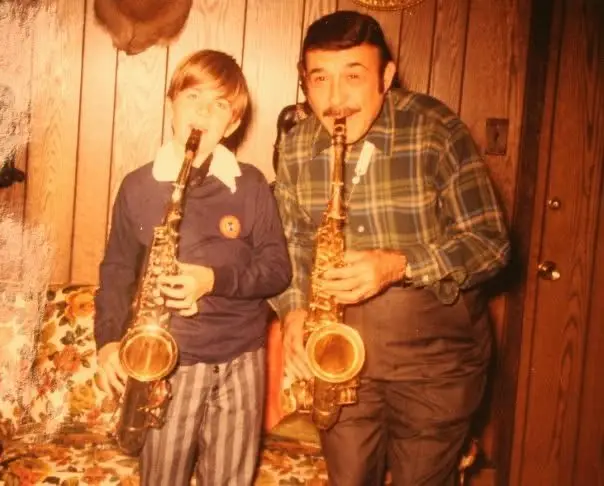
“My grandfather Al was a tremendous talent who played among the best of the best,” said Kevin Wood, Gallodoro’s grandson, who spearheaded the Oneonta stage project.
Gallodoro was a renowned jazz clarinetist and saxophonist, best known for playing lead alto sax with the Paul Whiteman Orchestra for four decades and bass clarinet in the NBC Symphony Orchestra under Arturo Toscanini. That iconic clarinet slide at the start of George Gershwin’s “Rhapsody in Blue”? That’s Gallodoro, who claimed to have performed the piece more than 10,000 times—more than anyone else.
In 1981, after nearly 60 years as a professional musician, Gallodoro moved to Oneonta, where his grandson was studying business and music industry at SUNY Oneonta. Wood’s family and Gallodoro stayed in Oneonta for years. Wood’s mother, Alice, Gallodoro’s daughter, owned Alice’s Restaurant in the Southside Mall and a dancewear store on Main Street.
“Electronics were coming into place, and Al was unsure of his future. He was worried,” Wood said. “He found a whole new career in Oneonta.”
Gallodoro taught saxophone at Hartwick College, where he received an honorary doctorate, and performed with musicians like the Catskill Stompers, who are among the headlining acts at the ribbon cutting and stage dedication on Saturday.
Other musicians who will perform on the new stage all have connections to Gallodoro, including renowned saxophonist Frank Catalano and JoAnn Chmielowski, his longtime manager and friend.
The lineup is a testament to Gallodoro’s enduring influence. He passed away in 2008, with his final performance just two weeks before his death.
“With every opportunity, Oneonta needs to celebrate its history,” said Mayor Mark Drnek. “We are richer than we know.”
On his nationally syndicated blues radio program, Drnek hosted Gallodoro as a guest several times. The musician also taught Drnek’s son how to play saxophone.
“It seems he knew and played with everybody,” Drnek said. “I loved Al. So did a lot of people.”
In 2023, Wood reached out to Drnek to bring the idea of a stage in his grandfather’s honor to life, and the city acted quickly to support the effort.
“As far as projects go, I feel like it didn’t take a long time,” Wood said. “I remember saying to the council, ‘he’s been gone since 2008, I don’t want to be gone before we do something.’ … When we latched onto Main Street as a location, it was full speed ahead.”
The Common Council approved the capital project at its July 2, 2024 meeting, according to Mayor Drnek. Funding included $269,873.00 from the American Rescue Plan Act, $106,481.00 from the Parks and Recreation Reserve Fund, and $3,000.00 from the Community Landscaping Fund. The project involved removing and replacing deteriorated underground electrical conduit, installing new infrastructure, and completing new landscaping. A GoFundMe campaign raised an additional $13,000.00 to support the architectural design and planning.
Muller Plaza was chosen as the site for the stage, which Wood noted is appropriate, not just because Gallodoro used to play there during weekly farmers’ markets, but because of its central location.
“It’s literally the center of the city—having a musical performance stage, you can’t get better than that,” Wood said. “Main Street anywhere is really important. We’re in an Amazon world, and it’s scary what could happen to small businesses. … This stage should—and will—bring economic positivity to Oneonta’s Main Street.”
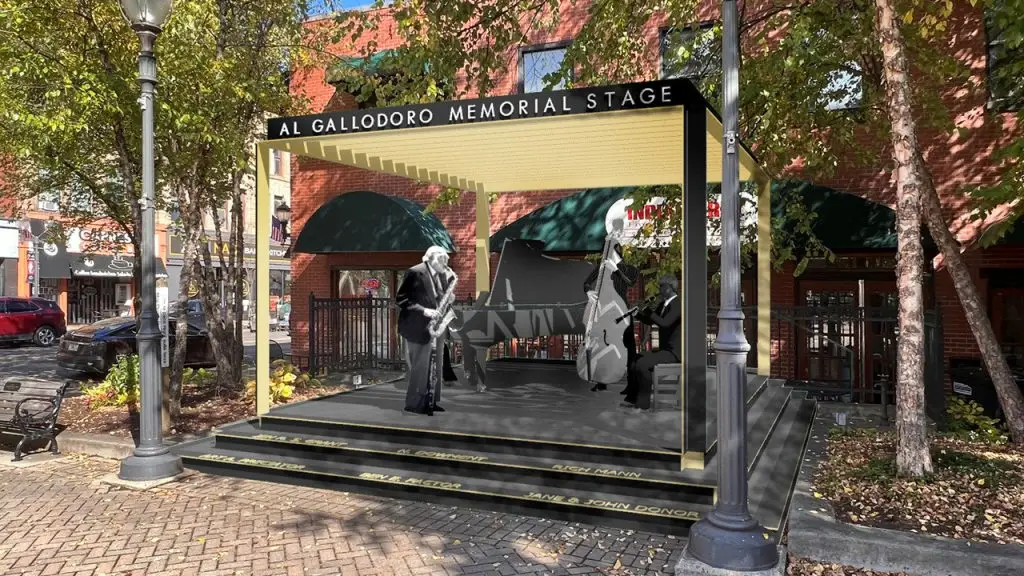
Wood enlisted architect Andrew Thomas to create a meaningful design for the stage. Thomas said he chose to build the stage in the alcove at the east end of the plaza, describing it as “its own little room to use informally when people aren’t playing in it.”
“As public architecture, it should be accessible and usable all the time,” he added. “You could sit up there, eat a sandwich, meet some friends, read a book. It’s supposed to be a public shade structure.”

According to Drnek, one of the reasons the Common Council voted unanimously on Thomas’ contemporary, pergola-like scheme was the meaningful design of the roof, which is an abstract representation of one of Gallodoro’s record covers. It features a saxophone and “Gallodoro” in the corner.
“It’s like a hidden Easter egg,” Thomas said. “When the sun gets pretty high in the sky, it casts the shadow quite effectively from the roof sculpture onto the stage.”
Thomas incorporated other symbolic aspects into the design. Not only does the gold paint color in the stage-facing side of the frame reference the Orpheum Theater in New Orleans, but it’s also meant to register as the shiny brass of a saxophone. The audience-facing side of the frame is a dark gray.
“There’s a more subdued color on the outside and a brighter color on the inside—like a refined object that’s also playful,” Thomas said. “Like a brown suit with a yellow lining, or a black shoe with a red sole.”
Thomas noted that the event coincides with the Summer Solstice, when the sun is highest in the sky—making the stage’s role as a shade structure particularly relevant. The roof’s abstracted curves, which also suggest musical notes on a staff, help block about 40 percent of sunlight.
The stage will host live music Fridays and Saturdays through September 12.
“I’m happy to see the stage is booked throughout the summer,” Wood said. “I’m thrilled that musicians beyond Al will get to enjoy it and perform for many years.”
The dedication will be livestreamed on https://www.facebook.com/AlGallodoro.


