News from the Noteworthy from Sustainable Otsego
The Life of the Land: Delhi’s Birdsong Farm
Twenty thousand years ago, a half-mile thick glacier pushed south from Labrador, crushing and grinding its way through our part of New York State. A few thousand years later the melting ice unleashed torrents of water which formed our valleys and riverbeds, among them the west branch of the Delaware River. As the Delaware swelled and ebbed, it built up an alluvial plain of rich soil deposits well suited to agriculture.
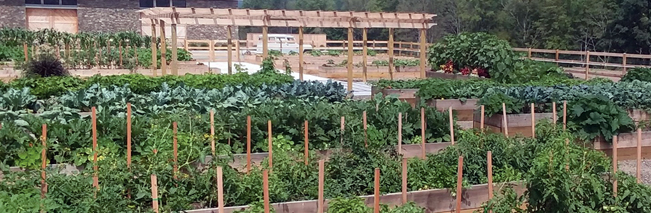
Along that plain, three miles west of Delhi in Delaware County, lies the expansive Birdsong Farm. It contains the Birdsong Community Garden, with more than 4,000 square feet of raised garden beds. These are dedicated to vegetables, some herbs and ornamentals, while an equally large lower garden is dedicated to flowers.
Unlike in allotment-style community gardens, some 30 volunteer Birdsong gardeners plant, weed, and harvest during weekly work sessions and get shares in the abundance. Yet most of the produce is donated to Delaware Opportunities, which distributes the food through local food banks to support community nutrition and senior dining programs. The farm also donates produce to Delaware Academy’s backpack program, which provides food for students to take home for weekends to ensure they eat every day.
Birdsong Farm is the brainchild of Richard Lamson. Along with gardens, the farm includes the owner’s residence, a large horse barn, a dedicated outdoor space for the summer farmers’ market, a greenhouse, an event space where the winter farmers’ market is held, an art gallery, and other working buildings. Passing the farm on New York Route 10, seeing the collection of natural wood and stone buildings topped with shake roofs and multiple cupolas, amid dry-laid stone walls, is a remarkable sight.
Richard has spent more than 25 years building the farm. Originally imagined as an equestrian facility, it evolved into a broader community asset, the purpose of which is to offer hands-on gardening education, add to local food security, and help create community connections. According to Garden Manager Jenine Osbon, “Our purpose is to engage and give back to the community.”
The farm’s practices are designed to protect people, wildlife and pollinators. It uses no chemicals to control bugs and blights; instead, it applies traditional organic practices as well as scientific innovations.
Barrier controls keep voracious pests off plants and add early-season heat. Warm-loving plants like tomatoes, cucumbers, peppers, and eggplants get thicker cover until early July. Cool-loving varieties are protected with fine mesh, which keeps bugs out without added heat. Companion planting uses flowering plants around the garden to draw predatory insects to control garden pests. Crop rotation uses a multi-season planting so different families rotate to maximize nutrient usage and reduce disease and pest transmission. Soil health is tested, and homemade organic compost is added as needed. Trap cropping uses tasty plants to draw pests away from the garden beds.
The goal of Richard, Jenine, the other employees, and the many volunteers is to make a difference locally in our ever more complicated and disrupted world. They clearly enjoy doing so as they ground themselves in the earth they work while helping supply sustenance to those in need.
Birdsong Farm welcomes visitors during its Saturday Farmers’ Market, from 10 a.m. to 2 p.m., May through September. The farm is at 38480 State Highway 10, Delhi. Learn more—including how to volunteer—at birdsongfarmny.com.
“The Life of the Land” is authored by Sustainable Otsego. Since 2007, we have promoted ecologically sound practices—locally, regionally and nationally. We advocate sustainable living, economic independence, and home rule. Visit sustainableotsego.net or facebook.com/SustainableOtsego.