Signs of the Times Enliven Protest Rallies with Many Messages
Each national rally organized to protest the Trump administration has greatly increased in participation. The 1,300 protesters at the “No Kings” rally in Oneonta on June 14 counted more than twice as many people as for the May Day rally, both of which featured speakers, music, chants, and food collections to stem the cruel cuts in food programs. They also offered welcomed fellowship among people of like minds.
But, for me, the signs people carry are always the best part of these rallies. They are by turns pithy, soulful, earnest, humorous, and, yes, sometimes vulgar. Most are homemade; some are more meticulously crafted than others; some are apparently purchased online. Signs at the June 14 rally reflected the issues addressed by the speakers: veterans’ issues, rural healthcare, immigration and the abuses of ICE—and more. Reflecting the theme of “No Kings,” many signs featured a crown with a slash or an “X” through it. Others read: “America—rejecting kings since 1776” or “Trump is a Faux-king fascist.”
Many signs spoke out for democracy: “Protect our democracy!”; “Make America a Democracy Again”; “Democracy doesn’t fear protests, dictators do”; “Democracy Trumps Authoritarianism.” Linda Murray, visiting from Bay Point, Long Island, held up a sign Jeffersonesque in tone: “When injustice becomes law, resistance becomes duty.”
Some signs were mini-history lessons: “Fun Fact: Hitler liked military parades on his birthday, too.” Or, “This is the government our founders warned us about.”
Two young girls, attending separately, bore signs encouraging compassion. One 10-year-old had a sign in each hand—one reading “I am my brother’s keeper,” the other, “Stop the madness.” A 6-year-old girl’s sign read “Help people who need help.”
There were signs aimed at countering the vitriolic, hate-filled rhetoric that Trump has engendered since riding down his golden escalator—and well before then, really. “Be a decent human. It’s not that hard”; “Hate will not make us great.”; “When hate is loud, love must be louder.”
Two attendees came in costume. Sam Goodyear, recycling his John Adams outfit from his long-running one-man show “The Man from Massachusetts,” communicated a succinct message with his sign: “Evict the convict.” Judith McCloskey of Decatur wore a Revolutionary-era-looking dress—bright blue bodice with white collar, apron and bonnet. Her sign read “No kings 1776, No kings now.”
All signs appeal to me on one level or another, but one that stood out from Saturday was a sandwich board worn by Bainbridge resident Lisa Allan-Ziemann. Written in red and blue lettering on a white background, one side read: “Deportation without due process is just called kidnapping.” The other, “UNPAID protester. We hate the chump on principles!”
One senior lady, leaning on her husband’s arm, carried a sign fashioned from a half-sheet of flimsy poster board. Its hand-written message: “Save our democracy.” The sight of her and her simple, straight-forward sign touched me deeply.
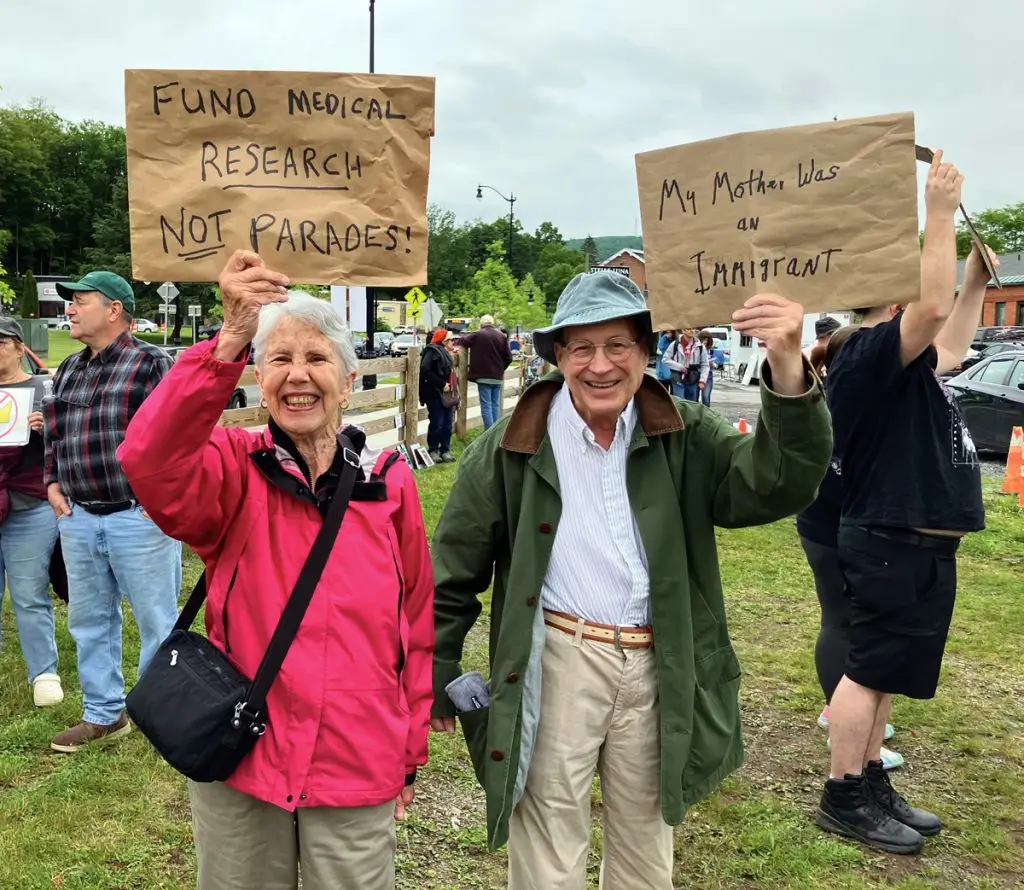
Victor Lidz and his wife, Katharine, 84 and 85 respectively, attended the “No Kings” rally, each holding a sign made from brown paper bags. Katharine’s read, “Fund medical research, NOT parades.” Victor’s declared, “My mother was an immigrant.” When asked afterward via e-mail for more information about his mother, Victor sent the following statement:
“My mother came to the U.S. in early 1937 to take an ill-defined position in the Department of Psychiatry at Johns Hopkins in Baltimore. She had been a medical student at Heidelberg until the spring semester of 1933, soon after Hitler took office. When she tried to register for spring courses, she was rejected for being, by Nazi standards, 37.5 percent Jewish. She soon left Germany, finished her medical education in Switzerland, served as an otolaryngologist in Istanbul for a year, and then, with help from her father, who had been pensioned off at age 60 from his professorship in psychiatry at Heidelberg because he had spoken of Hitler’s hysterics, as a medical diagnosis, to students, she was offered the position at Hopkins. Later she completed a residency in psychiatry at Hopkins, gained training in psychoanalysis, served as an instructor during the war years, then entered private practice. Late in her career she was Clinical Professor in Psychiatry at Yale.
“My mother represents a time when the U.S. welcomed some, but hardly all, immigrants in need. In her case, society benefited greatly from the later career of an immigrant.
“Of course, my brothers and I have long realized that we exist only because of Hitler!”
So much history, from which we all should learn, behind Lidz’s hand-scrawled, brown-paper-bag sign!
Paul Simon’s “Sound of Silence” declares “The words of the prophets are written on the subway walls.” In today’s world, they are written on our protest signs and our politicians should be paying attention.
Teresa Winchester is a freelance journalist living in the Town of Butternuts.