
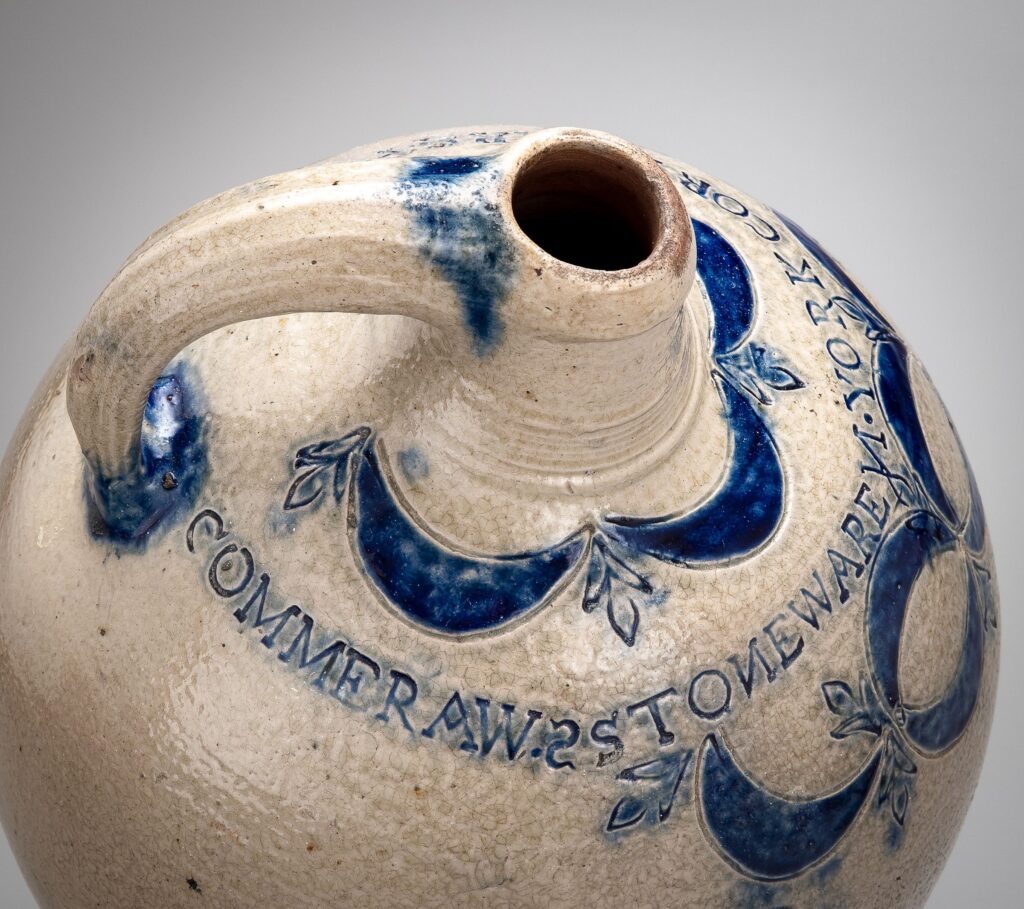
Thomas W. Commeraw (active ca. 1797–1819), Jug, ca. 1800–19.Collection of Joseph P. Gromacki
New Exhibition Reveals Extraordinary Story of a Black Artisan in Post-Revolutionary New York
COOPERSTOWN—Fenimore Art Museum presents “Crafting Freedom: The Life and Legacy of Free Black Potter Thomas W. Commeraw,” the first exhibition to bring overdue attention to Thomas W. Commeraw, a successful Black craftsman who was long assumed to be white.
Formerly enslaved, Commeraw rose to prominence as a free Black entrepreneur, owning and operating a successful pottery in the city. Over a period of two decades, he amassed property, engaged in debates over state and national politics, and participated in New York City’s free Black community. On view Saturday, June 24 through September 24, the exhibition explores Commeraw’s multi-faceted history as a craftsman, business owner, family man, and citizen through approximately 40 pieces of stoneware produced by Commeraw and his competitors between the late 1790s and 1819, in the largest presentation of his work to date. Alongside these pieces are documents that enabled historians to reconstruct the arc of his professional career and personal life, and through them convey a deeper understanding of free Black society in New York in the years between the Revolutionary and Civil wars. The exhibition has been organized by the New-York Historical Society.
The New York City directories first list Thomas “Commerau” working as a potter in 1795, living near Pot Baker’s Hill in the vicinity of today’s City Hall. By 1797, he had established his own workshop at Corlears Hook on the East River. There, he produced vessels in the local tradition, often decorated with distinctive flourishes of swags, tassels and bowknot motifs filled with vivid cobalt. Stoneware vessels were essential kitchenware in that era and stored everything from milk, butter, salted meat, and preserves to molasses, cider, and beer. Commeraw also manufactured oyster jars for the city’s oystermen, who were predominantly from the free Black community. His crocks and jugs traveled on ships to ports along the eastern seaboard and as far afield as Guyana and Norway. Most of the Commeraw vessels that survive today are boldly stamped with his name and the location of his pottery at Manhattan’s Corlears Hook. In addition to signaling pride in his work, Commeraw’s prominent branding helped him attract and retain customers.
In addition to revealing Commeraw’s successes and struggles as a pottery owner in a city riven by racism, the exhibition explores his commitment to securing a better future for the Black community through his work with abolitionist, political, religious, and mutual aid organizations. In 1790, the majority of Black New Yorkers were enslaved. By 1810, six out of seven were free. Businessmen like Commeraw faced daunting challenges, not just raising capital but building civic and religious organizations to support the Black community. Free Black men had voted in New York since the Revolution, but in 1811, the state legislature passed a law to suppress Black voters, requiring them to submit a Certificate of Freedom that included a sworn statement from a third party attesting to the voter’s free status and residency and to pay a filing fee. The exhibition also examines how Black New Yorkers responded to economic and political oppression by developing a lively cultural and artistic community.
The final chapter in Commeraw’s story concerns his effort to promote the emigration of Black settlers to Sierra Leone, as the prospect of full citizenship for Black New Yorkers dimmed. Commeraw traveled there with his extended family in 1820 on the first voyage of the American Colonization Society. He arrived full of optimism and plans to found a Black republic; instead, he experienced unimaginable hardship and tragedy. What began as a venture for political rights ended as a struggle for survival. Many of the settlers died of malaria, including Commeraw’s wife and niece. He returned to the U.S. in 1822 and died the following year in Baltimore.
The exhibition is sponsored in part by Nellie and Robert Gipson, and Dr. Jeffrey Pressman and Dr. Nancy Kollisch. Major support for “Crafting Freedom” has also been provided by the Decorative Arts Trust and Emily and James Satloff.