
Pro Football Hall of Fame Nominees Honored at Luncheon
By BILL BELLEN
COOPERSTOWN
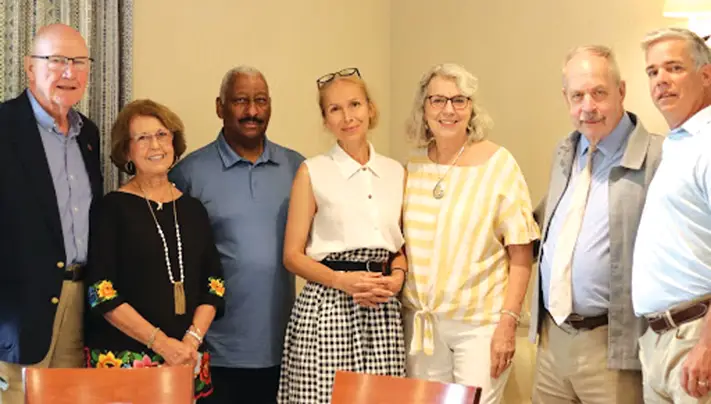
This past Friday, July 11, the Kingfisher Tower Room at The Otesaga Resort Hotel in Cooperstown was bustling with activity. A crowd of roughly 40 people of all ages and backgrounds gathered upon invitation by Army veteran and football enthusiast Andy Hugos to attend this unique ceremony commemorating the nomination of Homer Jones and Jack Kemp to the Pro Football Hall of Fame.
The second luncheon of a now-annual tradition, this celebration was used to highlight the careers of both men, their impact on their families and people across the nation, and the importance such mentor figures have on individuals.
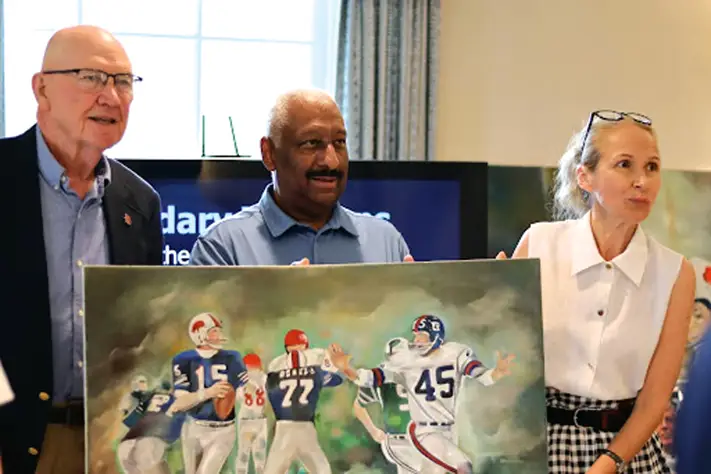
Hugos worked with a closely knit team to put on this event. By his side the whole way was Georgia Meeter, designated cohost of the luncheon. The pair looked to bolster the effort for Jones’ and Kemp’s nominations by employing Patricia Slater’s artistic specialties to create tribute paintings of each player—the same pictures featured in nearly all of the event’s marketing.
Aiding in this publicity push were Ben Berin and Nick Stockwell, two young men Hugos hired as interns to enhance the public outreach of the movement and to put together a presentation on the nominees for the gathering itself.
The nomination process for the Pro Football Hall of Fame is rather unique. Anyone is able to nominate a player or coach, as long as they have been retired from their career for at least five years prior to the nomination. These nominations are then considered by a designated selection committee that whittles down the number of nominations in a series of votes until they reach a final vote on permitting admission of three to five new members to the hall. Hugos nominated Jones and Kemp last year as well, with Kemp reaching the final five but falling shy of the 80 percent approval needed for admission.
Both Jones and Kemp played major roles in professional football history, setting countless records in the wide receiver and quarterback positions, respectively.
Outside of these purely analytical metrics, Jones’ career lasted from 1964 to 1970 and was characterized by his invention of the “endzone spike,” a scoring celebration that has maintained popularity to this day.
Kemp played professionally from 1957 to 1969, with a defining moment being his role in the boycott of the 1965 American Football League All-Star game in protest of civil rights violations faced by African American team members. This moment would leave a lasting impact on Kemp, helping mold the basis for the ideology of his later political career, during which he served as United States Secretary of Housing and Urban Development under President George H. W. Bush among other achievements.
With these monolithic careers in mind, Berin commented, “We’ve compiled a lot of statistics about them that just point them out. Some of these statistics aren’t really followed by the NFL. Just for reference, Homer Jones’ 49 yards per touchdown reception, which is a record, you know? But the NFL doesn’t really count that stat … Jack Kemp had, I think, the second most rushing touchdowns in the AFL when he played, but I’m pretty sure he’s also fifth right now for all-time QB rushing touchdowns … It’s just a testament to [him]. Everybody talks about, these days, about the modern players who are really mobile QBs, and this is a guy who’s been overlooked.”
The luncheon began with a blessing followed by Meeter taking the floor, speaking to the power of mentorship on youth and how Jones and Kemp played that role for so many during their careers. Hugos then shared a short anecdote about his idolization of President John F. Kennedy, connecting it to the impact these players had on his own youth:
“What that young quarterback did was stand under center, call the signals, reassure people, and just hold onto the ball long enough to stem the tide,” Hugos said. “Now, lo and behold, the initials of that young quarterback were the same as President Kennedy’s: JFK was Jack French Kemp. And I remember even [at] 10 years old, I recognized, this guy really knows what he’s doing.”
Following videos recounting key moments of each man’s time in the leagues and some stats detailed by Berin and Stockwell, special guest Ernie Koy shared some remarks on his personal relationship with the game of football as a former professional running back, and the impact of Jones, his former teammate. The sons of both Jones and Kemp were present, with Kemp’s son Jimmy sharing his thoughts on the legacy of the game of football and the “lessons football teaches us about life.”
Charles Dumas, the son of Jones, shared the following:
“I really didn’t see my dad play football at all. I was too young. I just didn’t start realizing how important he was until I saw the accolades he had [at] … the 100 year celebration,” Dumas recalled. “To give you a little background, the Giants have been in the NFL for 100 years [in] 2024 … And before the celebration, they went and they picked 100 of the best football players they had for the Giants in those 100 years and my father was number 27 out of 100. That was a proud moment. I would never have ever expected that.”
Finally, Slater and the rest of the crew unveiled two new paintings she had painstakingly put together, one of which was gifted to Ernie Koy and his wife, Barbara. It provided for a very emotional closure to the ceremony, as family members and advocates for Jones’ and Kemp’s induction to the Hall of Fame shared an exciting moment of anticipation for what comes next.