

Citizen Science #23 by Jamie Zvirzdin
Energy Demystified: Assessing Real, Perceived Risks of Nuclear Energy
I struggled to write this month’s article on nuclear energy, and here’s why: I don’t like risk. Any risk. But the truth is this: To live is to risk. We can absolutely mitigate danger, harm or loss whenever possible, but we cannot eradicate risk. And to assess the risk of nuclear energy accurately, we must recognize the difference between perceived risk and actual risk, without repeating the mistakes of the past.
I clearly remember stories of how, when and why people have been hurt. Like any good human who wants our species to survive, I take great pains to avoid making those same mistakes. I remember learning in school how the United States bombed Hiroshima and Nagasaki in 1945. In June 2023, when I visited the Smithsonian’s Steven F. Udvar-Hazy Center with my family, I stood frozen before the Enola Gay, the Boeing bomber aircraft that dropped the first atomic bomb. I stopped and stared at this grim symbol of what humans are capable of unleashing. How can we safely and productively harness nuclear energy when this is what we did with it?
We even continued testing bombs after the war was over, causing additional environmental damage and human suffering. When my husband and I lived in the Marshall Islands, from 2011 to 2013, I heard firsthand the story of my friend Katner Tima, who was 10 years old when the United States conducted the Castle Bravo nuclear test on Bikini Atoll. The swimming suit we flippantly call “the bikini” was named after the explosion reaction of this bomb, which was detonated on March 1, 1954. I helped Tima publish his story, in which he described how the sun seemed to rise in the west that day, the roar from the explosion was unlike anything he’d ever heard, and the wind, which normally blows from the east, made the coconut trees blow backward.
Radioactive ash from the test then drifted over and fell from the sky like snow onto Tima and his family on Rongelap Atoll, as well as families on Utirik Atoll and 23 Japanese fishermen aboard the Lucky Dragon No. 5. The radiation poisoning caused burns, vomiting, nausea, hair loss, stillbirths, severe birth defects, cancer, chronic illness, and in the case of the Lucky Dragon’s chief radioman, death.
Tima and his whole island were forced to relocate from Rongelap, and as of 2019, a study by Columbia University showed that despite massive cleanup efforts and many U.S. tax dollars, parts of the atoll still show signs of contaminated soil.
Alongside these personal stories about nuclear bombs and their tragic, lingering consequences, I also easily recall other high-profile nuclear disasters like Chernobyl (1986), Three Mile Island (1979), and Fukushima (2011). The word “nuclear” alone has therefore, for many of us, become intimately associated with the primal, legitimate fear of mushroom clouds and glowing, growing nuclear waste.
We may also overly associate the destructive power of a nuclear bomb with the productive power of a nuclear reactor because the underlying physics is the same: Einstein’s famous equation, E = mc². This formula describes how a tiny amount of mass (m) is equivalent to an enormous amount of energy (E) by a factor of the speed of light squared (c²). The universe can convert one to the other and back again through processes like nuclear fission and fusion.
Fission (splitting atoms) is when a large, heavy atom, like uranium-235 (U-235) or plutonium-239 (Pu-239), splits into two smaller atoms after being hit with a neutron. This releases energy and more neutrons. These neutrons can continue hitting other atoms in a chain reaction. Fusion (combining atoms) is when two small, light atoms, like two hydrogen atoms, smash together under extreme heat and pressure to form a larger atom, like helium. Fusion releases even more energy than fission does; it drives the energy output of stars, including light and heat from our own sun.
In a nuclear bomb, Einstein’s formula is weaponized: A small amount of mass is converted to inflict mass casualties. A nuclear bomb is made with highly enriched uranium or plutonium in quantities and configurations never used in power plants. “Highly enriched” means that while natural uranium (which is mostly U-238 and less volatile) has less than one percent of U-235, weapons-grade uranium must be almost entirely made of U-235 to sustain the chain reaction of fission. In other words, the energy release is catastrophic because it is deliberately designed to be so. The Castle Bravo nuclear bomb, the most powerful nuclear device we ever detonated, used both fission and fusion processes to release an estimated 63×1015 joules (63 petajoules) at once. This level of energy could power an average 100-watt light bulb for more than 20 million years.
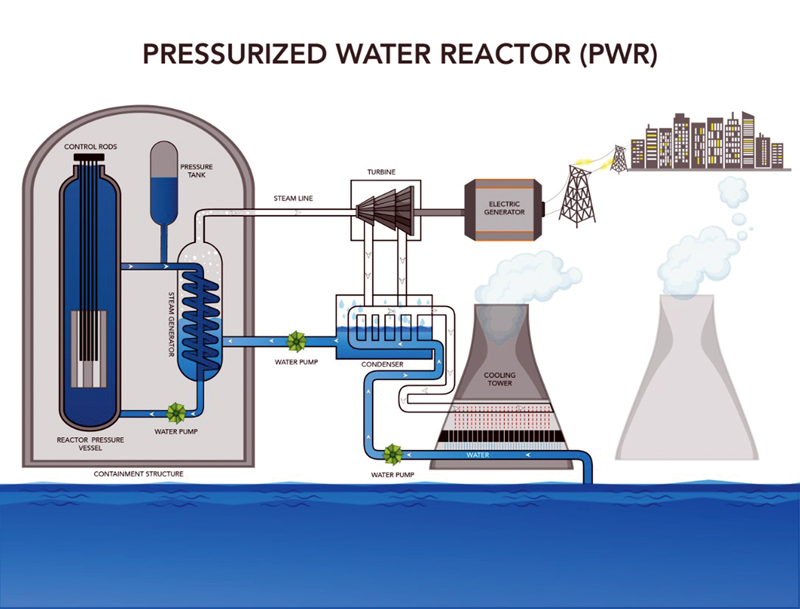
In a nuclear reactor, however, Einstein’s formula is put to work to produce a much-needed public good: reliable electricity that powers our homes, businesses, hospitals and other critical infrastructure. Inside a reactor core, a small amount of mass—in the form of low-enriched uranium fuel rods—is converted to an enormous amount of heat energy (See Citizen Science, No. 20), which heats the surrounding water. This “radioactive” water heats up an adjacent tank of “clean” water. The steam from this clean water then uses kinetic energy (See Citizen Science, No. 15) to drive turbines to generate electric energy (See Citizen Science, No. 22). The radioactive water therefore never touches the turbines and can be recycled.
If that sounds simple, it’s because nearly all forms of power generation—from coal to solar—boil down (pun intended) to finding creative ways to spin a turbine. The key difference is how we generate the heat: burning fossil fuels, capturing sunlight, or, in this case, splitting uranium atoms.
Let’s look at real and recent data on the actual numbers and what those numbers mean. According to the U.S. Office of Nuclear Energy, a commercial nuclear reactor can generate 1 gigawatt of electricity, which means 1×10⁹ joules of energy per second—enough energy to keep that same 100-watt light bulb going for a third of a year.
Even better, nuclear reactors have a fantastic operating capacity of 92.7 percent, meaning it can operate almost continuously throughout the year. (For comparison, the capacity of coal is 49.3 percent, natural gas is 54.5 percent, wind is 34.6 percent, and solar is 24.6 percent.) The energy output for one average commercial reactor working at capacity for one year is therefore around 8,123 gigawatt-hours, which equals 29.24×10¹⁵ joules (about 30 petajoules). Now our 100-watt light bulb can run for 9.27 million years. I think it is important for us to see and understand these numbers.
It’s likewise important to know how far we’ve already come in using nuclear power for our society’s benefit. In 2023, the U.S. Energy and Information Administration reported that across the 93 U.S. nuclear reactors in operation, we generated a total of 774,873,169 megawatt-hours. Again converting everything back into joules, the standard SI unit for energy, this means the total nuclear energy output in 2023 was 2.79×10¹⁸ joules (about 3 exajoules). Now our light bulb can run for 885 million years. By this point, we’ve lost sight of just how much energy this is. We humans are really not good with exponential numbers.
So to put it in emotional nuclear units (enu, a unit I made up to challenge my own risk-averse perceptions of nuclear energy), U.S. nuclear reactors last year produced the equivalent energy of just over 44 Castle Bravo bombs. We are currently and successfully utilizing, not weaponizing, Einstein’s formula of mass–energy equivalence in great and positive ways to power our nation’s energy needs.
But we can do so much better. The nuclear energy we’re currently producing is just a small fraction (less than 3 percent) of the total energy consumption of the United States. In 2023, our energy consumption was 94 quads, or 94 quadrillion British thermal units. Converting again to joules (as we’ve done in this series all year), this is 99.17×10¹⁸ joules (about 99 exajoules). We need the light bulb to run for 31.4 billion years, not 885 million years. In emotional nuclear units, this is the equivalent of just over 1,574 Castle Bravo bombs. In other words, we have an immense, astounding energy need: nuclear energy can fill it, but we are reacting to reactors because we are fueled with fear.
Here is the core question I want us to ask other risk-averse people like myself: Given the current climate change trajectory (which really does not look good when we look at it honestly), can we afford to let fear and a terrible track record prevent us from further developing nuclear energy as a consistently reliable, carbon-free energy source?
After doing a significant amount of research this month, even as much as I detest risk, I think it is vital we do not throw out the radioactive baby with the radioactive bathwater. In fact, don’t throw out the radioactive bathwater either—there are now new methods to reuse it!
From all I have seen and read, we are learning from our mistakes. The track record is being taken seriously. For example, unlike Chernobyl, which had a design flaw and poor safety standards, modern designs now have fully enclosed cores and are built to avoid dangerous feedback loops. Small Modular Reactors designs are safer and more efficient for smaller cities. They’re easier and faster to build and have fewer costs.
From Three Mile Island, we learned that active safety systems alone are not enough when human error compounded the situation, so now passive systems are also in place. Heat can be removed and the reactor can stabilize even if there is a power loss or if the operator fails to act for whatever reason.
After Fukushima, modern reactors are now built to withstand extreme natural disasters like earthquakes and tsunamis. Backup generators and elevated cooling systems are now the standard.
These are just some of the many new changes that significantly reduce the chance of these accidents happening again. We use low-enriched uranium so there aren’t runaway reactions; better containment structures with multiple layers of barriers; better sensor technology; new fuels that are more heat-resistant; enhanced cooling systems; better emergency protocols and infrastructure. I learned so much that I would actually feel comfortable working at a nuclear power plant myself. This realization surprised me.
As for improved waste management, I learned that countries like France have been successfully reprocessing spent nuclear fuel for decades, reusing radioactive material to make new fuel. Emerging technologies can convert radioactive waste into less harmful isotopes, making storage and management safer.
I find it very interesting that I knew so little of these developments. Part of my ignorance can be attributed to the complexity of nuclear technology, plus negative legacy perceptions caused by Chernobyl and the other high-profile accidents. But I do think the general lack of public awareness and support for nuclear reactors is also caused by insufficient advocacy: fossil fuel lobbyists and well-intentioned but under-informed environmental groups drown out the positive progress with negative stories.
The memories and stories I’ve shared myself feed our natural survival biases. We remember that which is talked about frequently (this is called the availability heuristic), we remember negative events more than positive events (this is called negativity bias), and we especially remember negative events in which whole groups of people were hurt or killed at once (this is called the dread risk bias).
We are not as good at remembering continuous risks—relatively frequent events that kill many more people over a longer period of time. This includes air pollution, poor water supply, smoking, drug and alcohol abuse, car accidents, untreated mental health disorders, and climate change impacts.
So while fears of nuclear accidents loom disproportionately large in our collective imagination, we must get better at assessing risk and recognize that actively supporting nuclear energy production, with all needed safety standards in place, can seriously mitigate the continuous risk of a warming planet, the consequences of which we already see and are affected by: acidifying oceans, flooding coasts, drying rivers, withering crops, bleaching reefs, folks sick with heat and pests, burning forests, driving storms, and families forced from their homes.
We face risks and costs with every energy source. Coal and gas pollute our air and contribute to climate change. Solar and wind, though clean and renewable, depend on the whims of weather and require vast amounts of land and rare-earth materials for storage and infrastructure. Hydropower disrupts ecosystems, causes methane emissions, and is more vulnerable to climate change. Nuclear power absolutely has risks and costs too, including upfront capital costs, fuel supply, waste management, etc. But it provides a steady, carbon-free energy supply and is already a proven technology capable of scaling to meet global demands. The physics of E = mc² and the process of fission ensures that a little goes a long, long way. It is literally the most bang for our buck.
So let us advocate for new investments in modern reactors, especially Small Modular Reactors. Let us call our representatives and ask them to support legislation that incentivizes advanced reactor development with modern safety protocols. Share this article with others to spread awareness. Push for clean energy policies at the local level that include nuclear as part of the solution, and diplomatically challenge misinformation when you hear it.
Finally, consider joining or supporting organizations, like the Nuclear Energy Institute (https://www.nei.org/take-action), that promote safe and sustainable nuclear energy. By demystifying nuclear energy and properly weighing its risks alongside its benefits, we can learn from the past without being imprisoned by it. This is how we help protect our future.
Jamie Zvirzdin researches cosmic rays with the Telescope Array Project, teaches science writing at Johns Hopkins University and is the author of “Subatomic Writing.”


Jamie,
Nice article. Thorough and cogent thoughts and observations.
I grew up with the promise of nuclear energy. Hyperbole like too inexpensive to meter. The watched as corporate powerhouses like Westinghouse designed said reactors and watched in horror as TMI unfolded. As I continued to follow nuclear power development it occurred to me that the real problem wasn’t nuclear power per se – it’s the for profit model of business that led to large, complex reactor designs primarily in the name of maximizing profits. I became one of the many anti-nuclear protestors.
I am ever more convinced more than ever that big business, motivated by big profit motives alone, will inevitably lead to taking dangerous risks. It’s happening all round us everyday.
However, having said that I have softened my anti nuclear stance. I’ve followed the development of SMR’S, as well as MSR’s and other inherently safer designs that I do believe offer hope. But in my thoughts we must move away from the “bigger is better”, profit primary business model if we are to really minimize risk and truly derive the incredible potential of nuclear generation.
Bill, thank you for your thoughtful comment. I agree with you that SMRs are really promising. I don’t know what it would take to work with a local city and their power grid, but I for one would actually be willing to move to wherever it was in New York and work as a nuclear physicist, operator, or health physicist. I am very particular with little details and with safety . . . and I love the physics and the chance to seriously reduce carbon emissions.
I genuinely did not expect to have this reaction to this topic. Nuclear energy was simply the next on my list of the 12 different flavors of energy to study and write about this year in this column. It was a nice surprise to see how far we’ve come with advanced, small reactors and their drastically improved safety features. But no positive change in this direction will happen until enough of us can make space for nuance and reassess the actual risks of nuclear energy. Thanks for reading and sharing! I appreciate it.
Some indigenous tribes in the central Midwest consider uranium bad luck and were familiar with uranium prior to nuclear technology. Critics of nuclear power state that there have been few advances, and it is still 1960s old technology. How come hydrogen power is not more developed? It is safer and cleaner. Nuclear power is not clean because the waste has to be buried, and often it gets dumped in the oceans, that could raise the ocean temperatures. It seems immature to not develop hydrogen power more.