
Life Sketches by Terry Berkson
Hemingway Ships on Banana Peel
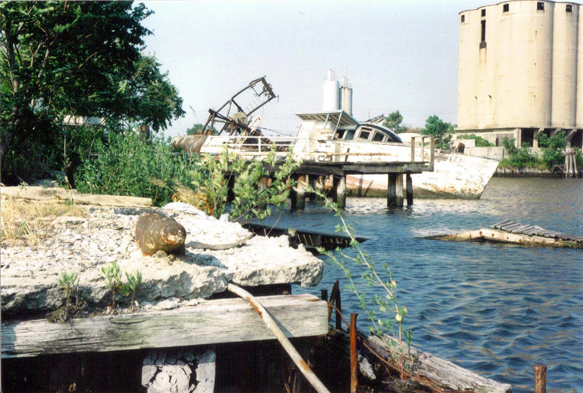
When I was a kid I kept a 12-and-a half-foot skiff in Harry Silvers’ boatyard, which was situated on the shores of the Coney Island Creek, a polluted waterway that connected Gravesend Bay to Sheepshead Bay and at the same time made Coney truly an island by separating it from the main land of Brooklyn.
Having a boat in the city might seem like an expensive luxury, but Harry ran what one might call a poor man’s boatyard—run by a guy who had dragged a sea-weathered barge onto a sandy, wreckage-strewn shore, making it a home that eventually evolved into a business. The rent to store my salvaged 12-and-a half-foot was eight dollars a month which I was able to pay by collecting deposit bottles and making food deliveries for a local grocery.
Harry really roughed it, not having running water and a bathroom on the barge, which rested awkwardly on the beach. Eventually, his complexion reflected neglect and locals got to tag him with the handle “Dirty Harry,” inspired by the name of a movie in which Clint Eastwood starred. Somehow, through a relative in government, Harry got to be the official caretaker of a 50-yard strip of shore along The Creek.
I kept my boat down at Harry’s for several years and got to know him pretty well. He even helped me fix my ancient outboard when it threw a rod. One rainy day while sitting on a crate in his barge he told me how he had arrived at his then current life style:
“I was on my way to meet her with a ring in my pocket when I passed the glass-door entrance of a nearby building and spotted her sprawled out on the steps making out with some guy.” That was it for Harry. He was crushed. His planned proposal was done for and he never saw her again. He took the ring to a hock shop and with the money he got, to cheer himself up, he went out to dinner and took in a Broadway show. Later, he saw no reason to hold a steady job and wound up buying the barge with the last of his money.
“What’d you live on?” I asked.
“I collected junk and salvaged stuff from wrecks along the shore,” was his answer.
One time, he had so much scrap metal on board that the boat he was using got swamped by a rough wave and it and he sank to the bottom of the Creek—in January! He kicked off his rubber boots, rose to the surface, swam to shore, and ran barefoot and soaking wet all the way back to his barge. Time passed and Harry started fixing boat motors, and renting out slips and moorings that he made available. He didn’t even have to advertise. Word of his cheap rent and mechanical skills just got around. Eventually, people regarded him with the reverence due a doctor when it came to fixing boats and motors.
“There are some nice boats down here,” I observed while sitting in his barge.
“People look for bargains” was Harry’s response. “All kinds of people. Even a big shot writer like Ernest Hemingway found his way down here to Cropsy Avenue on the Coney Island Creek.”
“You mean Ernest Hemingway stopped here?”
“Just across the street, at Wheeler’s Boatyard. He was havin’ one built, a 38-footer.”
“The Pilar?” I guessed.
“What’s that?” Harry asked.
“The name of his boat,” I answered.
“I don’t know what he called it, but Wheeler’s built it. He came down here in a taxi to see it under construction—I helped them out a little, you might say.”
“What do you mean helped them out?”
“Well, when it was time to launch the Pilar as you call it, it was painted black like Hemingway requested and to put it into the Creek they had to slide it down these wooden rails. There was some concern about screwing up the paint. Grease was mentioned. I happened to be around at the time and put my two cents in. Why don’t you use banana peels? I suggested.”
“Did they listen to you?”
“They sure did. They bought the bananas at nearby Phil Pepper’s fruit stand—and they worked. Phil gave me a watermelon—for recommending him.”
“How’d Hemingway make out with the boat?” I asked.
He must have loved it,” was Harry’s answer. “Caught record-breaking fish. I read that he took a lot of famous people out fishing. Actors like Gary Cooper and Ava Gardner.”
I was sure the boat Harry described was the Pilar, named after a feisty woman in the novel “For Whom the Bell Tolls.” The boat is now on display at Finca Vigia, the place where Hemingway lived in Cuba.
On a recent trip to Coney Island, I saw that Wheeler’s and the boatyard where Harry lived and carried on his business were long gone, replaced by a Pathmark and a Home Depo store. I looked to see if by chance Harry’s barge had been somehow put on display, but found no sign of it. It would have been fitting if “Dirty Harry” Silvers’ vessel, which had been the center of activity serving and affecting the lives of so many people, had been on display, like the Cuban-celebrated Pilar, somewhere—along the shores of the Coney Island Creek.
Terry Berkson’s articles have appeared in “New York” magazine, “Automobile” magazine and many others. Reviews on his critically-praised memoir, “Corvette Odyssey,” can be found on TerryBerkson.com.