

News from the Noteworthy from Hyde Hall
At Hyde Hall, ‘the Best Is Yet To Come’
Hyde Hall has come a long way from the wrecking ball.
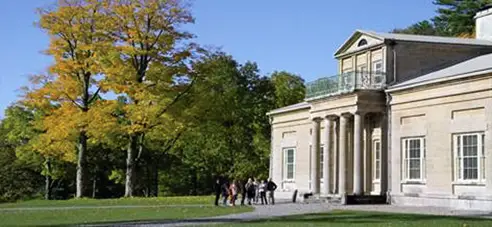
Anyone who’s followed the steady progress of restorations at Hyde Hall—the National Historic Landmark in Cooperstown renowned for its neoclassical architecture and scenic views of Otsego Lake—can testify to the fact that this is a museum and cultural site that has truly reinvented itself.
The estate was built for George Clarke in the early 1800s and enjoyed by his family for five generations. By the early 1960s, however, the house faced demolition, and by 1970, the interior was empty and crumbling—a ghost of its former glory.
But today when you visit Hyde Hall, you step into its elegant yet practical past.
With roughly 70 percent of its original contents and accurate reproductions of the carpets, curtains, and bed-hangings (most created in Rabbit Goody’s Thistle Hill Weavers textile mill in Cherry Valley), Hyde Hall looks like a well-preserved Regency-era country house that survived nearly intact.
“In everything, we take pains to be as authentic as possible,” said Jonathan Maney, Hyde Hall’s executive director.
New rooms now open to the public include the back kitchen (or scullery), which received a herringbone brick floor in August; the kitchen, where work continues on the hearth and stew stove; and Mrs. Clarke’s suite, which was given a striped Venetian carpet and finishing touches including donations from the Cooper Family of Cooperstown—Chelsea ceramic figurines on the mantelpiece.
Maney says that some visitors come back yearly to track the work progress at the site.
“It’s a game for them to spot what’s new,” he said. “We give them plenty to find.”
On the outside, visitors will note that the servants’ wing has just been lime-washed in the original yellow color. Working with a New York State Office of Parks, Recreation, and Historic Preservation paint analyst, Hyde Hall’s staff found an English lime wash that duplicated the original color and composition.
While much has been accomplished, several projects remain. Next year, Maney’s plans include raising a barn on the site of one that was taken down in the 1970s.
“We located a wonderful English threshing barn in Middlefield, New York,” Maney said. “We took it down and will raise it in the spring and use it to teach young people basic timber framing skills.”
The back kitchen will be painted the original colors and the water closet (the first flush toilet west of the Hudson River) will also be restored.
“We plan several smaller projects, too, including getting a part of the bell system to function.”
Carpeting projects will also continue.
“Most of the house had wall-to-wall carpeting,” Maney said. And “it will again be an oasis of comfort and gentility.”
Preserving this heritage of beauty involves more than just the house, however.
“We received a matching grant of $25,000.00 to restore the rose garden that was planted during the 1830s on the south lawn,” Maney said. “We have the bills showing what the Clarkes ordered and the roses will add color and interest here.”
But Maney points out that what matters most is not what Hyde Hall has.
“It’s what we do with it,” he said. “We’ve built a stage and now we have to put on great plays.”
Not literal plays, he explains (though they are being considered), but a variety of events and activities that relate to the house’s history and are meaningful to the community.
Maney mentions that he and Hyde Hall’s new events manager, Verna Everitt, will be offering programs he’s wanted to do for years, such as a lecture series, movie screenings, and other attractions that will build on the dinners, dances, and musical entertainments featured in the past.
“Hyde Hall has a great history,” Maney said, “but the best is yet to come.”
If you want to visit Hyde Hall again or for the first time, you won’t want to miss its Halloween-themed Hyde and Shriek tours in October or its magical Victorian Candlelight Christmas Tour in December, Maney pointed out. Go to HydeHall.org/events2025 to learn more.


