On Stage: Performing Arts at our Oneonta Campuses by Rachel Frick Cardelle
‘Stupid F***ing Bird’: Chekhov Made Modern, and Funnier
The next play to be staged at SUNY O, “Stupid F***ing Bird,” written by Aaron Posner and directed by Andrew Kahl, has become one of the most produced plays in the country since its premiere in 2013 at D.C.’s Woolly Mammoth Theatre Company. An adaptation of Anton Chekhov’s “The Seagull,” “Stupid F***ing Bird” follows roughly the same plot as Chekhov’s play, yet turns it into a modern, irreverent, metatheatrical dark comedy.
When I was in sixth grade, I became enamored of live theater and started sneaking into play rehearsals at the local college. Some very kind college students took me under their wings and got me a spot on the lighting crew for their production of Chekhov’s “The Seagull.” I loved the work and hanging out with this group of super cool grown-ups, but the play itself seemed depressing and silly. Yes, a play that is considered one of the most important plays ever written, ushering in modern realism to the theater, my 12-year-old self brushed off as boring naval-gazing.
Since then, I have never seen the play again and was stunned when I first began doing research for this article and I read about the “quiet, ironic humor” of the play. Even more interesting, though, is that when “The Seagull” premiered on October 17, 1896 in St. Petersburg, it was a complete disaster. The audience (actual grown-ups, not an uneducated 12-year-old, may I point out) hated it, booing and heckling the actors. The lead actress became so rattled she lost her voice during the performance, and Chekhov left the theatre during the performance, swearing he would never write another play. (Which, if you ask me, is a bit like a captain leaving a sinking ship with the crew and passengers all still aboard!)
Fast forward two years and Konstantin Stanislavski (and Vladimir Nemirovich-Danchenko) directed a production of “The Seagull” again (gutsy move!) at the newly formed Moscow Art Theatre. This time it was such a triumphant success that the Moscow Arts Theatre began using a seagull as its logo. In fact, this production is widely cited as one of the key events that led to Stanislavski creating a system of acting that was the foundation for method acting, which has shaped modern acting techniques.
At this point in my research, I have to admit, I fell down an Internet rabbit hole exploring the history of “The Seagull,” Anton Chekhov (who did end up writing three more brilliant plays, all premiering at the Moscow Art Theatre), Stanislavski and how he made the second production so much more successful, and the evolution of acting. None of which is anything but tangentially related to the topic at hand here, and since “Stupid F***ing Bird” and its cast is a very interesting and fun topic, I’ll leave that all behind and get to it. (Still, it occurs to me that I could have used more of this thirst for knowledge when I was a college student myself.) But, if you’re ever looking for a rabbit hole to explore, I recommend you try this one.
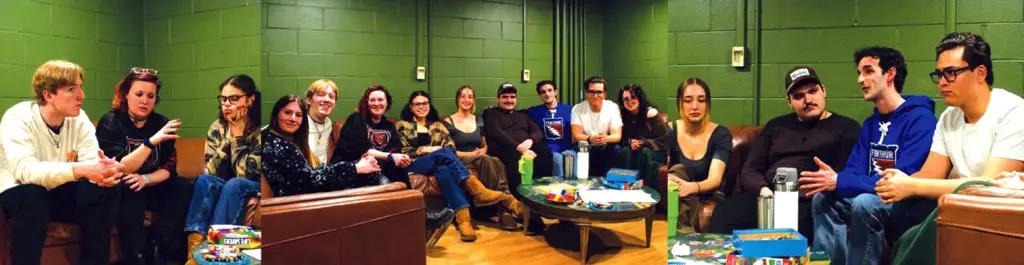
I also went to a rehearsal of the show and the next night I sat down with the cast and some of the crew to talk. One thing that struck me as I watched the rehearsal was that when the play is called “metatheatrical,” it truly means “metatheatrical.” The fourth wall isn’t only broken, it’s shoveled off to the side and ignored for many parts of the play. The metatheatrical aspect came up in our interview when I asked the students what they hoped the audience takes away from this production.
“This is going to sound bizarre, but I hope that it reiterates and reteaches theater etiquette, because I feel like that’s been lost over the years,” Elyssa (who plays Emma) began. “Connie [played by Dan], does a really good job of calling the audience out…he has a line, like, ‘You can see me, so let’s assume I can see and hear you’…”
“I call out people, but in a fun way, where I’m not attacking them fully,” Dan (Connie) added. “It’s an indirect…Hey! Be aware of what you’re doing. Because even though at the moment we’re just characters, we’re also actors behind the characters who can see you.”
There are challenges for the actors with how the fourth wall is broken, too, as Zoe (Nina) pointed out. “I think it makes it more intimidating for the actors. Dan, who plays Con, literally relies on what the audience is going to respond to in order for him to navigate where he goes next. That’s a little intimidating, but it also is kind of nice because there’s a strong connection with the audience…We know that they’re a part of it.”
Becoming comfortable with their characters and where they took the script was another topic all performers spoke about, with a special emphasis on how their director, Drew, had helped them shape their characters.
“The cast has done such a beautiful job of taking in the characters, and for some people here, it’s their first time in a college production. I could not be prouder of all of them, just because they’ve done a fantastic job,” Brianna (assistant stage manager) glowed. “I think they’re all amazing actors!”
“One thing I’ve noticed about Drew every time I worked him is he’s so good at explaining the play in enough detail to make you understand it, but not so much as to sway your opinion on it,” Sophia (stage manager) shared. “And I feel like he’s done a really good job at teaching what the show means but has allowed everyone to take that interpretation and figure out what your character means to you.”
“Reading the play for the first time was one thing, but Drew really introducing us to the play was a whole other thing,” Jadyn (Trigorin) agreed. “I really learned my character. It’s not like I came day one and I was like, ‘I know this guy is.’ I had to learn it over time.”
“The thing that Drew does very well is get into every little detail in a scene,” Chris (Dev) continued. “If someone’s saying a sentence and they get cut off, he’ll ask you, ‘What do you think the rest of that sentence is?’ So, you act out what you were going to say because he wants us to get behind the eyes of the character, rather than just make it through the scenes.”
“At the beginning of the process it was difficult, and I was doubting myself on how I can play a character who’s 40 years older than me. I haven’t lost my parents. I haven’t been married and gotten divorced,” Sean (Sorn) elaborated. “But Drew’s been trying to get out of me some of my real-life experiences that I can bring to this character. If it wasn’t for Drew’s direction, it would be a whole lot tougher for me to portray this character.”
I wish, as always, that I had more space. One of my favorite parts of the interview—because it showed how much into the inner emotional life of their characters they had gotten—was when the actors told me about the social media accounts their characters would have. I will share one with you, although I could have written a whole article on just this answer.
Lindsey (Mash) felt she’d have two separate accounts. “She would have one that she posts all of her music to, but she would never post her face on it, and none of her friends would know it. She wouldn’t let any of them follow it. And then she has her own account, where she would post once a year and it would be super-edited photos of the landscape, super introspective, and she’s like, I was writing here. Or a picture of a black cat. She’s like, this crossed my path on my way to work this morning. Must be a bad day.”
As we talked, I realized my rabbit hole adventure was paying off, because I could see a direct line descending from what Stanislavski had done as director for “The Seagull” and Drew’s directing style in this production of “Stupid F***ing Bird.” Stanislavski had realized something that at the time was revolutionary in the theater: “The Seagull” was not about the plot, it was about the inner emotional life of the characters. I am a half century older as I watch “Stupid F***ing Bird” than I was when those cool theater students let me work on lighting with them. Now I can empathize with the inner emotional life of many of the characters, understanding and enjoying both the humor and the angst in the show. I love seeing a glimmer of Stanislavski’s work as it has impacted how these SUNY O students are able to portray their roles so that I can see that inner life.
I’ll end here with one thought. As much as my life experiences have changed my perceptions of the world since I was 12 years old, hanging out with students involved in college theater is still the coolest.
You can watch “Stupid F***ing Bird,” directed by Andrew Kahl, at the Hamblin Theatre in the Fine Arts Building on SUNY Oneonta’s campus March 5-7 at 7:30 p.m. or March 8 at 2 p.m. You can reserve tickets online at https://oneonta.universitytickets.com/ or in person at the Hunt Union information desk. The cost is free with a SUNY Oneonta student ID or $5.00 for general admissions.
Next up: “The Shape of Things,” written by Neil Labute and directed by Stephanie Lynne, at SUNY Oneonta’s Hamblin Theater, March 26-28.