
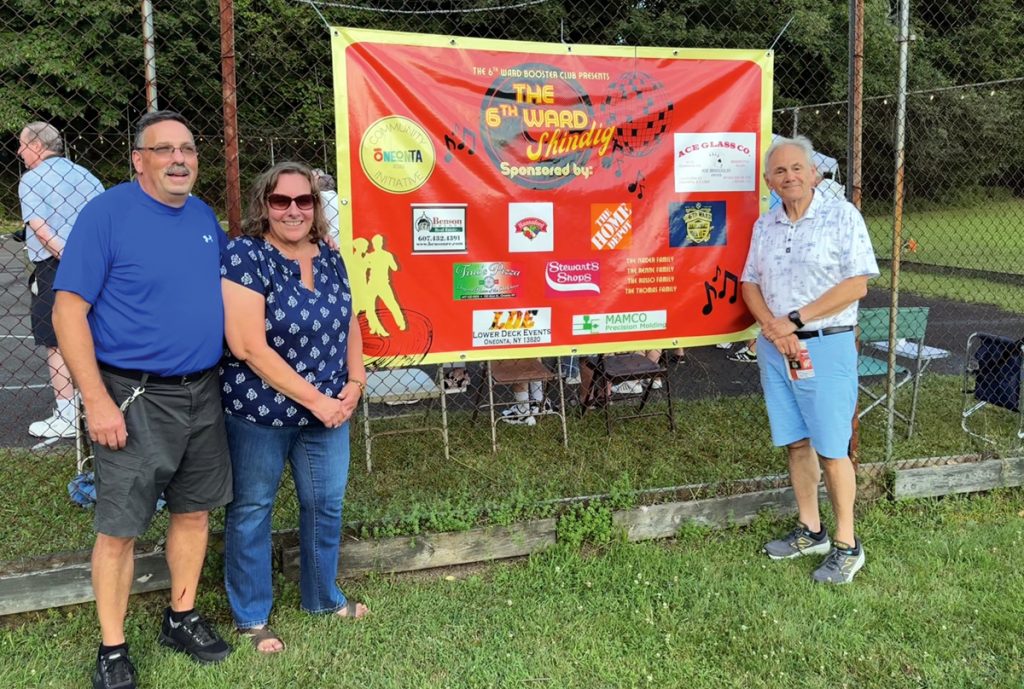
Sixth Ward Prepping for Friday’s Tennis Court Dance
By PEYTON CARTER
ONEONTA
For one evening each summer, the tennis court in Oneonta’s Sixth Ward becomes more than just a playing surface in need of repair, bringing together generations of current and former residents to celebrate the neighborhood’s history and the community spirit that has defined the enclave for decades.
The annual “Sixth Ward Shindig”—set for Friday, July 24 and now in its second year since being revived in 2025—traces its roots back to the 1960s, when neighborhood volunteers organized dances to raise money for community projects.
Those events helped fund the construction of lights for the softball field and supported the creation of the Sixth Ward Athletic Club. According to organizers of the revival, proceeds from those early dances also contributed to the purchase of the former River Street School property, which was later sold to help finance the athletic club.
The original series of tennis court dances ended in July 1967, becoming a cherished memory for generations of Sixth Ward dwellers.
Nearly 60 years later, modern-day organizers Becky Thomas, Frank Russo and Dr. John Nader—all members of the Sixth Ward Booster Club and lifelong ward residents—say the overwhelming response last summer confirmed that the neighborhood’s sense of identity remains as strong as ever.
“We’re all natives of that neighborhood and wanted to bring everyone together,” Nader said, noting that the trio’s desire to reconnect the community is what continues to motivate their efforts.
“The Sixth Ward is the most distinctive neighborhood in Oneonta,” Nader added. “There’s a great neighborhood pride and spirit.”
On July 25 of last year, the City of Oneonta’s first historical marker recognizing the historical significance of a neighborhood was unveiled by the Greater Oneonta Historical Society, recognizing the Sixth Ward’s history and diverse ethnic community.
“This marker is the first we have commissioned for a neighborhood in Oneonta, and for great reason,” Dr. Marcela Micucci, executive director of the Greater Oneonta Historical Society, told AllOtsego when the marker was placed.
“The Sixth Ward has a rich history, rooted in Oneonta’s emergence as a railroad town. By the late 19th and early 20th centuries, Oneonta’s immigrant community settled this neighborhood and created a wide array of social and civic institutions, businesses, and clubs,” Micucci explained.
“Many of Oneonta’s D&H employees and trolley line workers lived and worked in the Sixth Ward. The ethnic enclave was largely self-contained, and self-sufficient, with their own schools, shops, gardens, dairies, grocery stores, churches, and industries,” she continued. “By 1915, nearly half of Oneonta’s 635 Italian, Russian, Polish and Lebanese residents lived in the Sixth Ward.”
The descendants of many of these diverse families from the early 1900s still call the Sixth Ward home today and refer to themselves as the “Lower Deckers.”
Donations from last year’s event helped pay for tennis court upgrades to improve the staging area for this upcoming celebration. This year’s shindig will feature new additions including contributions from Golden Guernsey Ice Cream and Stewart’s Shops, which are graciously donating ice cream and supplies for complimentary root beer floats, Nader said.
Despite the event drawing hundreds of attendees last July, organizers said planning remains relatively simple.
“There are only three people” organizing the dance, Nader said, noting that the event continues to be offered free of charge and that he, Thomas, and Russo do what they do out of love for the community.
The biggest challenge, the trio admits, has been making sure people know about it. “Getting the word out” has been the primary obstacle, Nader told AllOtsego.
Organizers believe the dance resonates because it offers people an opportunity to reconnect with the neighborhood they grew up in.
“Mostly older people are in attendance, or people that return to show their neighborhood pride,” Nader noted. “People that used to live in the Sixth Ward come to show their support for their current or past neighborhood.”
For Nader, Thomas and Russo, watching those reunions unfold each summer has become the most rewarding part of the Sixth Ward Shindig.
“My favorite thing is seeing people come back and take pride in their roots,” Nader said. “It’s getting harder to get people together and we wanted to continue the tradition so people still felt a sense of the community coming together.”