Ag and Markets Meets To Discuss Spotted Lanternfly Concerns
By MARIA GRISWOLD
NEW YORK STATE
On the morning of Thursday, August 14, the New York State Department of Agriculture and Markets held an advisory meeting on the status of the invasive pest known as the spotted lanternfly.
The virtual meeting was conducted by AGM Associate Director of Public Information Hanna Birkhead. Two speakers were present: Christopher Logue, the director of the Division of Plant Industry at AGM and Brian Eshenaur, educator and researcher at Cornell University in the Integrated Pest Management Program.
The spotted lanternfly is an invasive insect originating in parts of southern Asia, such as China and Vietnam.
The pest was first discovered in the U.S. in 2014, in Berks County, Pennsylvania. Logue elaborated on this, saying “Our first New York detection was on Staten Island during the late summer of 2020.”
This is not to say there were no SLF in the state before 2020, as Logue also shared that “the insect is very cryptic and hard to detect at low levels.”
The large concern stemming from the introduction of this insect here in New York is the weakening of plants through feeding off their sap, causing many plants to wilt or even die. The SLF feeds on a large range of crops, meaning their presence poses a threat to different agricultural businesses. The meeting was held to inform the general public and educate on how these pests can be managed and reported.
Logue began the presentation with his slideshow of information on the background and current status of SLF. Logue detailed how inspectors are actively engaging in survey activities all around the state. They are currently monitoring SLF and other insect diseases. He also mentioned the Slow the Spread Program, which is an initiative the AGM took on in an effort to delay the SLF from devastating New York agriculture.
Logue also discussed which counties have reports of SLF sightings, and where AGM officials still need reports from. Counties that have established SLF populations no longer need public reports or samples collected. These counties include Dutchess, Nassau, New York City counties, Orange, Putnam, Rockland, Suffolk, Sullivan, Ulster, and Westchester. Counties not mentioned in this list, such as Otsego, should report SLF if spotted, officials said.
In Chautauqua County, there has been one report, but no confirmed population.
“You will get a report like this,” Logue explained, “and oftentimes it will be a period of time and some intense survey to actually find the population.”
A factor in the rapid spread of SLF is the Interstate Highway System. Logue men-tioned that there have been a great deal of reports of SLF sightings in Binghamton, which is along a major transportation route. A map shown later in his presentation illustrated the locations where SLF DNA has been found, the bulk of which were along I-87, I-86 (formerly State Highway 17) and other major transportation routes. SLF can be moved in any life stage, from egg to adult. Eggs can be laid on any material, including items commonly transported, such as firewood, pallets and lawn furniture. Adult SLF could be anywhere on a vehicle, Logue said.
“We’ve seen them in the wheel wells of automobiles, vents along the windshield, where the intake for the climate control system is—all kinds of locations in commercial vehicles [and] railroad equipment,” Logue elaborated.
Eshenaur presented next, with more information on the SLF lifecycle and management of the insect populations. Eshenaur shared that he got involved with this program before the SLF arrived in New York.
“After we heard from Pennsylvania that this was affecting vineyards, we were concerned about other crops at the time as well, and we’re also concerned about homeowners and their use of pesticides to manage SLF,” Eshenaur said.
With his expertise in integrated pest management and knowledge about SLF, Eshenaur explained that at this point in the summer, mostly only adults will remain. At this stage, the small adults are feeding off of the many plants in their diet to grow, and once September comes to an end, they will lay eggs. SLF can lay eggs from September all the way to the first hard freeze of the season, which in some cases could extend into December, Eshenaur pointed out.
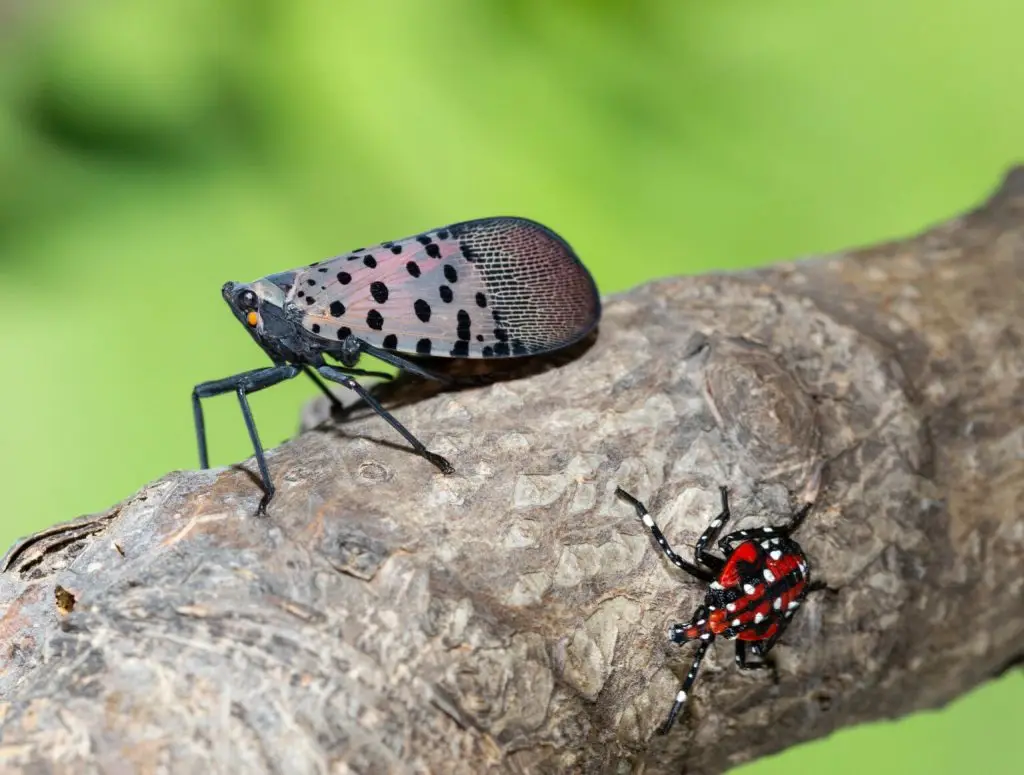
SLF egg masses often look light white in the beginning, and then turn into a gray color. The eggs remain inactive until the springtime, at which point the leaves come out and the nymph has something to feed on. SLF start out as tiny insects that look nothing like the adults; black with white spots soon turn red as nymphs transition to the adult stage of life.
Another aspect Eshen-aur touched on was the ability of SLF to hitchhike, specifically instances where farm equipment was moved across multiple states and present egg masses went unnoticed. This introduced new populations to different areas that had not yet been exposed, he said.
A major concern for farmers in New York is trying to protect the state’s grape growing regions. As stated earlier, New York State agencies had warnings from Pennsylvania a few years earlier, which allowed them to take preventative measures.
Eshenaur talked about future preventative measures, including the possibility of bio-control. At the moment, there is a lot of research underway on fungi that feed on SLF naturally, he explained. Investigations are being done on whether these can be cultivated and released into the environment as a successful way of decreasing the SLF population. There are some instances where predators have been brought to SLF native areas in an attempt to lower the number of inhabitants. AGM staff is researching those predators to see which ones may be appropriate to release in the U.S., keeping in mind other environmental impacts they may have.
Eshenaur also talked about SLF trapping strategies. The types of traps he discussed were circle traps and sticky traps. Neither trap has bait in it, as a successful baiting tool has not yet been found. Eshenaur described the circle trap as a reverse funnel shape that relies on the SLF habit to climb trees. As the insects climb, they get funneled in and trapped in the bag at the top. The circle trap also has a lightweight screen material, which is wrapped around the tree. The sticky trap is essentially just sticky material attached to a tree in some way, with a protective netting around it. The netting allows the SLF to still go through, but assures that other animals, such as birds or chipmunks, won’t accidentally get stuck on the trap. Eshenaur also mentioned that Cornell has a Spotted Lanternfly Management webpage, which includes information about the SLF lifecycle and management techniques.
“They don’t bite [or] sting and are harmless to most landscaped trees, unless you happen to have a tree of heaven, which is a tree that is native to the locations where SLF is native to,” Eshenaur said. “The tree of heaven [or ailanthus tree] is also invasive, which means you won’t find it in a nursery, because it is self-seeded.”
Additionally, it was noted that the SLF is not a structural pest. This means that they will not survive inside houses, like other pests could. Studies have shown that SLF cannot survive at room temperature, and will generally die within 24 hours or, in some cases, up to 48 hours.
A question and answer period followed the presentations. Birkhead facilitated incoming questions for Logue and Eshenaur during this time. An important question asked was how to make the circle trap. Eshenaur fielded this query, explaining that the traps can be purchased, with some vendors selling circle traps for under $15.00. He said the trap is simple to make with screening and planks of wood, and Penn State has created an instructional video on how to build one [https://extension.psu.edu/how-to-build-a-spotted-lanternfly-circle-trap].
Another attendee asked if there were any state or federal dollars available for farmers facing crop loss. Logue said that there is federal funding for surveys through the U.S. Department of Agriculture, and that those have come through various state agencies, but he was not aware of specific funds for losses as a result of SLF.
For more information on reporting spotted lanternfly sightings, visit https://agriculture.ny.gov/spottedlanternfly. Visit https://agriculture.ny.gov/reportslf to report a sighting.