
Bad Bunny Super Bowl Performance Sparks Cultural Dialogue at SUNY Oneonta
By ESTEPHANIE GOMEZ
SUNY Institute for Local News
ONEONTA
Following Bad Bunny’s much talked about performance at the Super Bowl LX halftime show on February 8, Puerto Rican culture has taken center stage globally. For local SUNY Oneonta faculty and student leaders, the “Benito phenomenon” is more than a musical trend; it is a catalyst for visibility and a tool for education.
The Hispanic and Latino population in Otsego County sits at only 4.7 percent, according to data from the U.S. Census Bureau. In a predominantly white area of New York State, the impact of the spotlight on Puerto Rican culture is felt most strongly on the SUNY Oneonta campus, where data from the Office of Institutional Research shows that 18.2 percent of the currently enrolled 5,300 students identify as Hispanic or Latino.
“The reaction around the world has been spectacular,” said Dr. Raúl Feliciano Ortiz about the 13-minute set at the Apple Music Super Bowl LX Halftime Show. A lecturer of media studies at SUNY Oneonta, he described Benito Antonio Martínez Ocasio—the musician better known as Bad Bunny—as a “transformative phenomenon” who refuses to make his music more palatable for English-speaking audiences.

“It wasn’t just the language; it was the imagery, the symbolism, the focus on the problems that affect our island,” Feliciano Ortiz said, noting the globally televised performance included references to anti-gentrification and anti-colonialism. Feliciano Ortiz was born and raised in Mayagüez, Puerto Rico.
Melissa Reyes, a SUNY Oneonta student and president of the RITMO Latin Dance Club echoed this sentiment.
“I notice more questions about the island, more people wanting to learn how to dance, and more engagement at Latin-centered events,” she said.
A senior majoring in psychology, Reyes noted that seeing a Puerto Rican artist on such a massive stage validates Caribbean artistry and reggaeton—a style of dance music dominated by Puerto Rican artists since the early 1990s—on a global scale.
While New York State has an estimated Puerto Rican population of over a million, representation requires active effort in a region like Oneonta where the Puerto Rican population is relatively small. Reyes carries her culture through language, music, and food, while leading campus organizations that bridge the gap between performance and education. She explained that “speaking Spanish, listening to artists like Bad Bunny and cooking traditional dishes keeps me connected to home even when I’m away.”
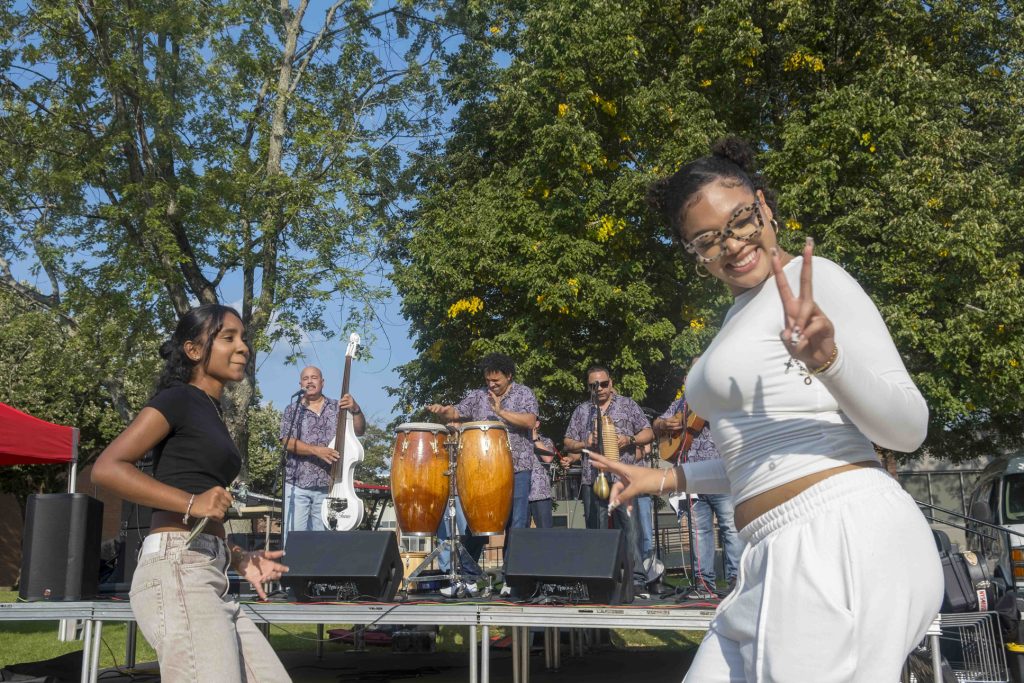
RITMO describes itself as “a Latinx-Afro infused dance club that focuses on embracing, honoring, and appreciating Latin culture through the beauty of dancing and its history.” The Student Association-sponsored club hosts events such as “Noche De Ritmo” and “Jeopardy with RITMO” to create spaces for students to learn traditional dances and cultural history.
“It’s not always mainstream, but when it shows up, it’s intentional,” Reyes said.
She emphasized that while interest in the commonwealth of Puerto Rico is growing, it is vital that people understand that the island’s culture is deeper than music trends and encompasses history, resistance and identity.
For Feliciano Ortiz, being “unapologetically Puerto Rican” is a daily practice. He speaks Spanish publicly whenever possible and shares stories of his upbringing in Mayagüez during his classes.
“I always try to convey my experience as a brown man in a university campus of rural New York,” Feliciano Ortiz said.
He views his role as an educator as a way to create a safe space for Latinx students, often responding in Spanish to those who approach him—a gesture born from a “terrible experience” in graduate school where another Latinx professor refused to speak the language with him.
While the Super Bowl performance brought celebratory energy, both individuals noted what Feliciano Ortiz described as the “bittersweet” nature of sudden popularity. He pointed to the 2019 protests in Puerto Rico that forced the governor’s resignation, noting the “deafening” silence from the U.S. during that period of struggle.
“Puerto Rico has gone through a lot of pain and suffering that has never, ever garnered this level of attention,” he observed.
Looking forward, both hope to see the conversation evolve into deeper topics, such as Puerto Rico’s colonial status and its relationship with the U.S.
“It is a vibrant island, full of people who are talented, warm and have learned how to survive. Our history is multilayered, rich and very complicated,” said Feliciano Ortiz.
“Puerto Rican culture is not just a trend—it’s resilience, creativity and history. It’s joy in the face of struggle,” Reyes added. “I would want people to understand that Puerto Rican pride isn’t about exclusion; it’s about honoring ancestry, language and lived experience. When you celebrate Puerto Rican culture, do it with respect, curiosity and a willingness to learn, not just consume.”
This story was created by student reporters through the OnNY Community Media Lab, a program of SUNY Oneonta and the SUNY Institute for Local News.