
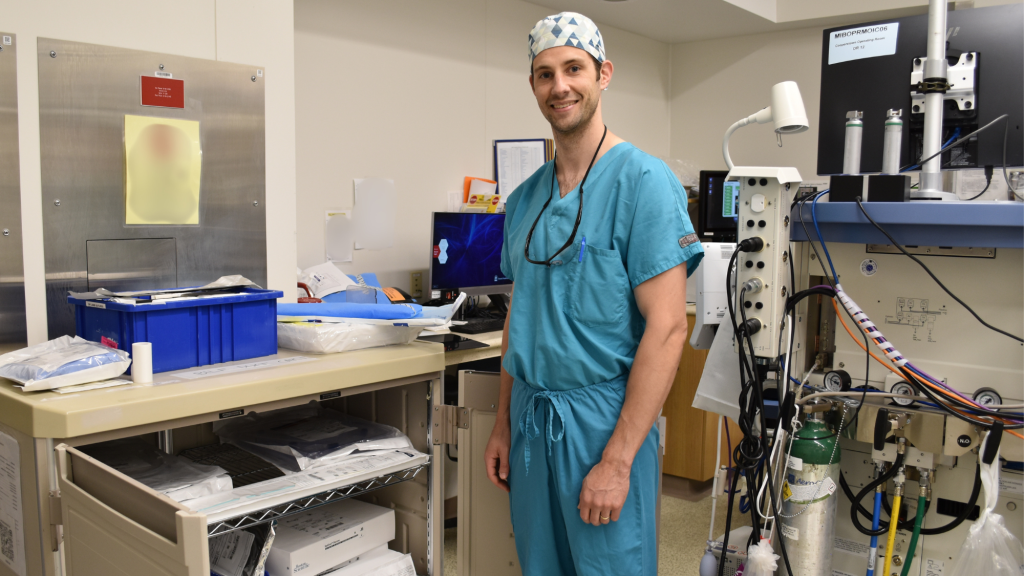
Bassett Launches Laparoscopic Common Bile Duct Exploration Program
COOPERSTOWN—Bassett Healthcare Network is investing clinical expertise and funding into an emerging method to treat patients suffering from gallbladder issues. Laparoscopic common bile duct exploration is a process through which gallstones that have traveled into the common bile duct are removed during the same surgery in which a patient’s gallbladder is removed.
The gallbladder is part of the digestive system. This small organ stores bile that is released when we eat. Bile travels through bile ducts from the liver to the small intestine where it mixes with food to aid in the breakdown of fats and vitamins. Gallstones are pebble-like objects that can develop in the gallbladder. They are often harmless, but if they block the flow of bile this can cause pain, nausea, and inflammation of the gallbladder known as cholecystitis.
Both gallstones and cholecystitis are common. According to the Cleveland Clinic, about 15 percent of the world’s population has gallstones and about 20 percent of those people will have complications from these gallstones. Gallstones are the cause of 95 percent of all cholecystitis cases.
Most patients who experience complications from gallstones have surgery to remove their gallbladder, since a gallbladder that has produced gallstones is more likely to produce them again in the future. In otherwise healthy patients, the gallbladder is not essential for digestion, so a patient who has had their gallbladder removed can lead a full, healthy life after surgery.
If gallstones have traveled into the largest bile duct in the body, the common bile duct, they must also be located there and removed. Recently, surgeons at Bassett Medical Center have begun completing this process using a process known as laparoscopic common bile duct exploration.
“To explain this procedure in a basic way, during the surgery to remove the gallbladder, we perform an X-ray study where we put contrast down the bile duct to see if there are any stones in there. If there are stones, we use a wire and various instruments to clear those stones out,” explained Casey Lamb, MD, surgeon at Bassett Healthcare Network. “Everything is done in one stage, so patients do not have to have a second procedure done,” Lamb said.
Prior to LCBDE being utilized, a patient would have a procedure called an endoscopic retrograde cholangiopancreatography to analyze the bile ducts and remove stones followed by a surgical procedure to remove the gallbladder. Both would be necessary before the patient could fully focus on recovery.
“Combining and condensing everything into a single-stage procedure can allow for a shorter stay for the patient at the hospital. That can reduce costs for the patient, reduce costs for the healthcare system, and the outcomes are equivalent or sometimes even better in terms of stone clearance and the risks associated with the procedures,” said Dr. Lamb.
When Dr. Lamb joined Bassett Healthcare Network in 2024, he brought expertise in this technique to the network and has since used his knowledge to train fellow Bassett surgeons. Four Bassett surgeons are currently utilizing the LCBDE method and more than 30 patients have benefited from it.
“Laparoscopic common bile duct exploration has emerged as an effective alternative to preoperative or postoperative ERCP that can offer advantages to the patient. I am pleased that our Bassett surgeons are beginning to embrace it and thankful to Dr. Lamb for championing it,” said Ethan Talbot, MD, chief of the Division of General Surgery for Bassett Healthcare Network.
In some cases, a patient experiencing issues with their gallbladder may not be eligible for surgical intervention. If they are elderly or infirm, removal of the organ could pose undue risks. Bassett Healthcare Network is also investing in techniques to provide these patients with high-quality gastrointestinal care. Click here to read more about how Axios stents are being utilized in some cases.
This release is from Bassett Medical Center.