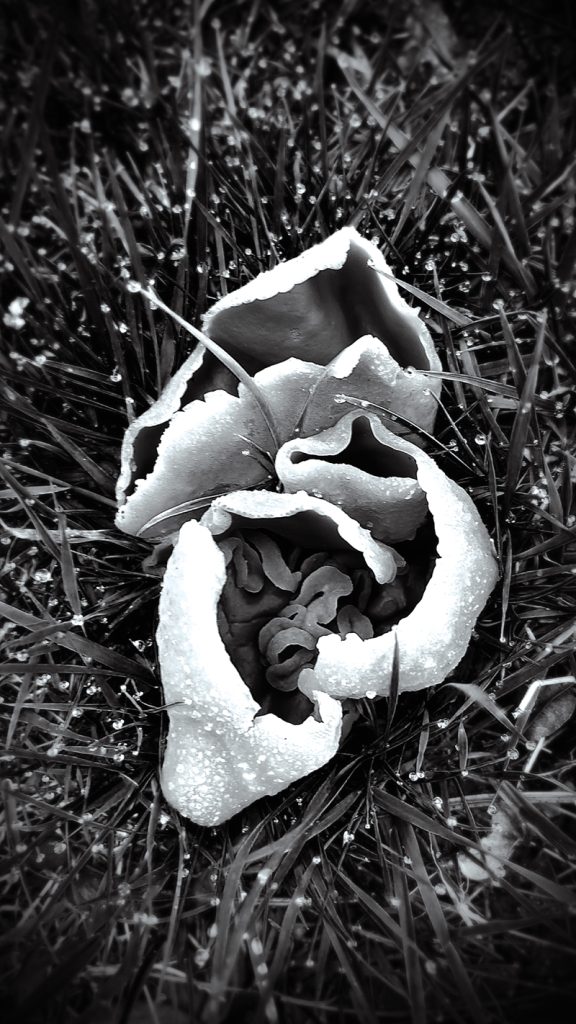
Citizen Science #32 by Roberta McLain
Order in a Constantly Changing Microbial World
The first warm afternoon of spring sends many of us outside. A few minutes stacking wood, clearing branches, planting seedlings, or any of the other things we do outside in March or April and it’s easy to come home with dirt under our fingernails.
What’s hard to see is that the soil is alive with billions of microscopic organisms, such as bacteria and fungi. These microbes are not intruders or invaders; they are essential to the health of the soil and plants.
Something similar is happening inside us.
Most of us think of our bodies as a single organism—just us. But the story is more complicated.
Trillions of bacteria, fungi, and other microbes live on our skin, in our mouths, and in our gut. Together, they form what scientists call the human microbiome.
They arrive during and immediately after our birth and they shift from day to day, month to month and year to year. A meal, a walk in the woods, a course of antibiotics and even the changing seasons can change which microbes are present.
At first glance, this microscopic world may look chaotic: trillions of microbes growing, competing and constantly replacing one another. But in science, chaos does not mean disorder. It describes systems that are always shifting and competing but are shaped by underlying rules.
Systems like this, where millions of small interactions produce surprising order, are one of the puzzles this column hopes to explore this year.
For the past three years, this column belonged to Jamie Zvirzdin. She chased down mysteries and she reminded us, frequently with humor, that nature doesn’t always act as expected. We’re grateful to inherit this column that uses science as a tool for understanding. As the column moves forward with new voices, our mission remains the same: Ask good questions, follow the evidence, and share thoughts about what science can and cannot tell us.
Three of us, whose interests overlap, will carry the column forward. Tammy and I work primarily in the biological, neurological, and chemical sciences, where Trisha’s background is physics and astronomy. Together, we hope to explore how order and uncertainty coexist.
The microbiome seems a fitting place to begin.
The human microbiome helps us digest food, trains our immune system, produces essential vitamins and, in short, plays an important role in our health. We are not simply hosts to these microbes. We live in partnership with them, a relationship scientists call symbiosis.
Bacteria compete for nutrients. Some release chemicals that slow their neighbors’ growth, while others produce compounds that feed them. Some helpful microbes thrive when we eat foods rich in fiber, breaking down the plant material that our own enzymes cannot. Working together, they release molecules that nourish our gut lining while maintaining conditions that benefit the microbes themselves. (Keep eating those fruits and vegetables.)
No single organism controls the system. Instead, order emerges from millions of small interactions among microbes that compete and cooperate.
For much of modern medicine, microbes were viewed as enemies. That perspective was not entirely wrong. Some bacteria and viruses can cause serious disease. But the full story is more complicated. Not only do our bodies tolerate many microbes, but some are also essential to keeping us alive and healthy.
Researchers estimate that each of us is composed of more than 30 trillion human cells. And we have at least that many microbial cells living on our skin and in our guts. We are complex communities of more than 60 trillion cells, comprising as many microbial cells as human cells.
But like any ecosystem, the microbiome can be disturbed. Antibiotics can save lives when infection strikes, but they can’t discriminate between helpful microbes and harmful ones. Other things like diet, illness, stress and medications can change the balance. The system can typically rebuild itself if our diets and environment support microbial diversity.
Ecologists have a word for this: resilience. Resilient systems reorganize rather than collapse. The microbes in our bodies do this constantly. New research suggests the process is even more dynamic than scientists once believed. Studies examining thousands of microbiome samples found some bacterial strains persist for years, some are shared within families and others are more common in certain geographic regions.
Some microbes remain long-term residents, while others come and go as our diets and daily interactions change.
The microbes in our bodies do this quietly and efficiently every day. Our microbiome is both stable and dynamic.
This kind of system may appear chaotic, but as Jamie reminded us in her final column, chaotic systems follow rules even when they appear unpredictable. Tiny differences in starting conditions can produce surprisingly different outcomes.
Our microbiomes behave much the same way. Small choices such as what we eat, where we go and what medicines we take impact which microbes thrive.
A handful of dirt in the garden contains countless microbes that exchange and compete for nutrients, moisture and space. Together, their activity helps plants grow, recycle nutrients and sustain the garden.
The microbes living inside us are doing the same.
Roberta McLain is a science writer and educator specializing in neuroscience, evolution, and the life sciences.