
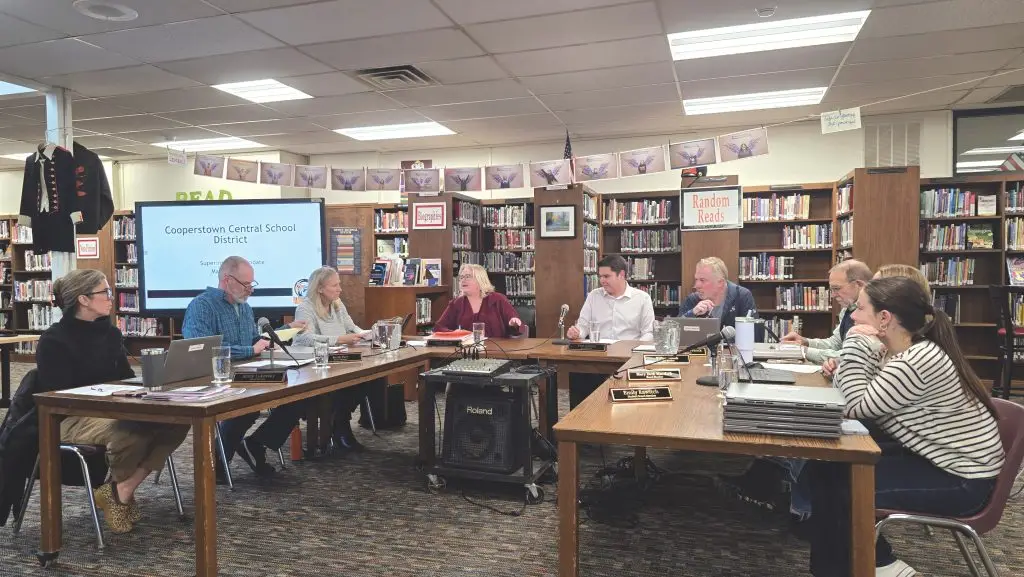
Coop Teachers Union Calls Out District
Board Discusses Regionalization and Emergency Notifications
By ERIC SANTOMAURO-STENZEL
COOPERSTOWN
At the March 18 regular meeting of the Cooperstown Central School School Board, faculty members raised criticisms of district administration and called for more responsiveness. School board members also discussed emergency notification procedures for board members and regionalization discussions with other local school districts to share resources.
Rebecca Burk-Sciallo, a Junior-Senior High School teacher and co-president of the Cooperstown Faculty Association, rose during public comment on behalf of the union “to express our frustration at what seems like intentional silence to questions, follow up, and clarification from our district office leadership.”
CFA representatives have raised criticisms of district administration at multiple board meetings in recent months.
Burk-Sciallo said, “Clarity makes fertile ground for growth commitment and strategic planning for our district” and that the CFA is “begging for clarity to questions asked, and we are seeking a commitment to timely responses from our district leadership.”
Another teacher, Brian Murphy, said that a new teacher evaluation plan was being developed for two years by faculty members. But by this past December, he said, the planning was drawing too much time from their classrooms and they handed the task back to the district.
“We were under the impression that the plan just needed a few more tweaks,” but Murphy alleged the administrative team did not communicate with teachers until March 11, when they were sent a plan that had already been submitted to the state and which was “unrecognizable compared to the plan teachers originally designed.”
Murphy said, “We are concerned that the plan as it is written now does not fairly evaluate teachers in a meaningful way.”
“The district remains committed to transparent communication and values the input of our faculty and staff,” Superintendent Sarah Spross responded to the criticisms in a statement to AllOtsego. “We continue to address response timelines, while ensuring comprehensive and consistent communication moving forward.
“Regarding the teacher/principal evaluation plan, we appreciate the significant time and effort contributed by faculty and administration. While the plan has not been submitted for final approval, the shared draft reflects required state considerations alongside prior input, and we recognize there is still work to complete regarding alignment. We are committed to continued dialogue to ensure the evaluation system is fair, meaningful, and supportive of effective teaching and leadership,” Spross said.
Among other topics, the board discussed regionalization and the process of emergency notifications to board members.
Regionalization is a New York State Department of Education initiative that is “a collaborative regional planning approach for local districts to communicate what they need in order to ensure equitable educational opportunities for all students,” according to the DOE website.
In the Otsego Northern Catskills BOCES region, the student population has declined by nearly a third over the last two decades, Spross said during a presentation to the school board. That has created resource pressures on many districts, making it difficult to fund a wide range of classes and extracurriculars.
“All districts have to take a hard look at things they can control on the revenue side,” Board Member Christopher Franck said. “Regionalization has a way of sharing resources across school districts.”
Franck, who since December has served as a representative to a group of other school districts discussing regionalization, said the around 19 districts’ first meeting was focused on “idea generation.” Among the ideas that bubbled up, he said: distance learning for certain courses; an Advanced Placement class “hub” location; and development of a common bell schedule for schools.
At the second meeting, Franck said, the group focused on finances. Potential ideas for some districts included tuitioning-out students to other districts and district consolidation. No final decisions were made at either meeting, and the process will continue for some time.
Separately, Board Member Keith Parr suggested the district clarify its policies on notifying board members of emergency situations. Currently, the superintendent informs the board president, who then informs the rest of the board. The school board is not involved in day-to-day management of the district.
“In light of a couple emergency situations that happened at the school, I don’t understand a clear process where the board is informed of certain things or when they’re not,” Parr said.
Parr said that there had been recent emergency situations that he was still unclear on what happened and about which he was seeking additional information.
Board President Pete Iorizzo said he would follow the board’s wishes on notifications.
Spross said she could not share too many details, but that, “What I can share with everybody in the public is that whenever—whether it’s a drill and a practice or a live event that we go through— there is a considerable debrief process.”
Spross said a February 6 evacuation drill and a “secure lockout slash lockdown” on February 13 have been “debriefed by the district wide plan, the building level team plan members.” The lockdown, she said, involved “agencies outside the district” who were also incorporated into the debriefing, and that overall the debriefings led to some changes to district practices in emergency situations.
The board also discussed hiring practices for coaches and athletics staff.