
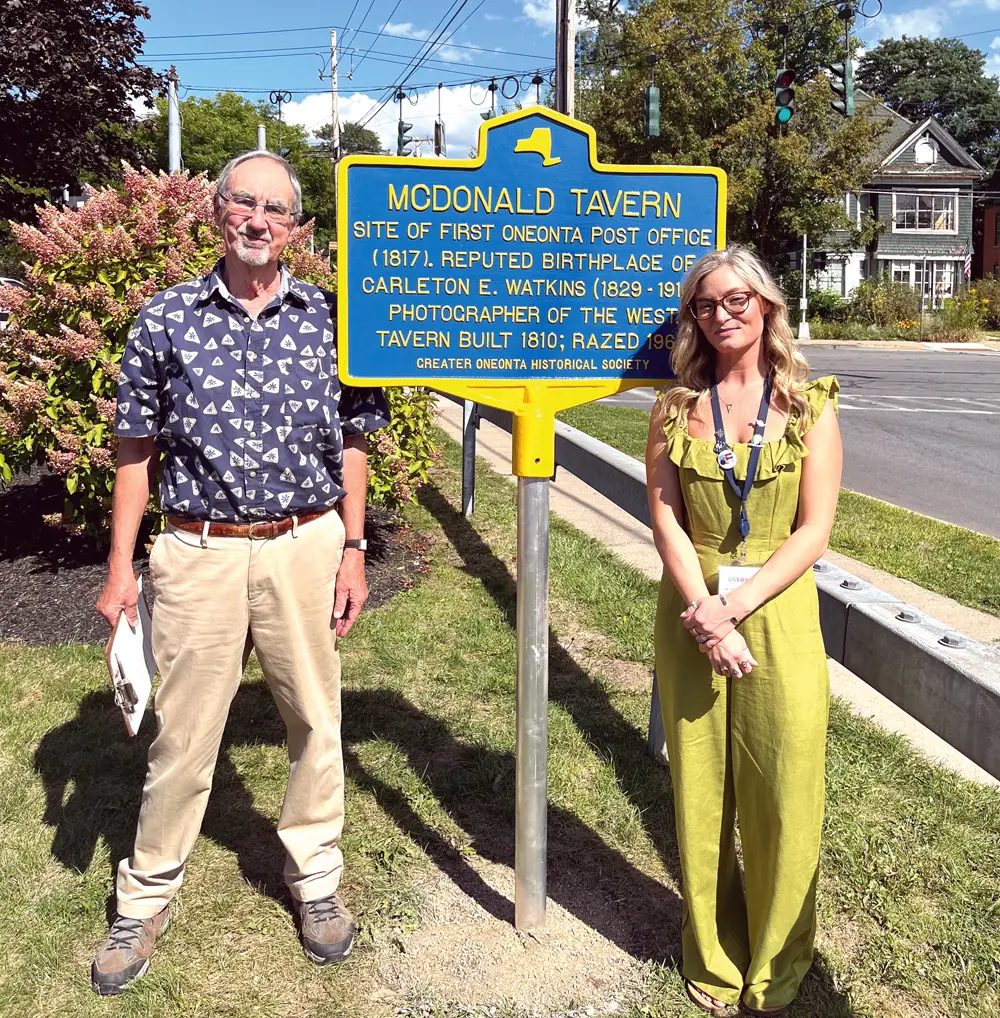
Final Marker of the Season Commemorates McDonald Tavern
By BILL BELLEN
ONEONTA
At 3 p.m. on Thursday, August 28, crowds gathered for the fifth and final historical marker unveiling of the summer in the City of Oneonta. Following the Greater Oneonta Historical Society’s gradual unveiling of markers commemorating the Center Street School, the Red Caboose, the Sixth Ward, and the Ford Mansion, GOHS staff welcomed viewers to the unveiling of the McDonald Tavern historical marker.
Located on the corner of Main and River streets, where Stewart’s Shops now stands, the McDonald Tavern was built in 1810 and served as one of Oneonta’s earliest operating taverns. Seven years later, in 1817, it saw the opening of the first post office for the area. In 1829, the location even reputedly served as the birthplace of Carleton E. Watkins, who would go on to become famed for his western photography.
Unfortunately, this rich and important local history came to a close when the tavern was razed in 1961. Because of this, this historical marker was once again ineligible for funding by the William G. Pomeroy Foundation, a group dedicated to financing markers for still-standing structures. After extensive research into primary sources and documentation from throughout the tavern’s existence, the Unitarian Universalist Society of Oneonta Community Fund stepped in to cover the brunt of the expenses incurred.
“This marker is meaningful to me, as it helps document a much earlier period of Oneonta’s history,” Dr. Marcela Micucci, GOHS executive director, wrote in an e-mail. “Taverns in the late 18th and early 19th centuries were often used for many purposes—as post offices, polling places for local, state, and federal elections, and gathering places (and housing) for the local community. McDonald Tavern, in particular, was reportedly a focus of community social activity in the 1830s and 1840s. The tavern and its owners (the McDonald and later the Watkins families) each played an important role in helping to develop Oneonta socially, culturally, and economically. It is also one of the few markers we have that commemorates a notable historical figure from Oneonta, Carleton Watkins.”
With research complete and funding secured, GOHS positioned the marker as the final installment in its very full summer line-up. The event itself immediately offered a pleasant change of pace from those that came before, with blue skies instead of rain for the unveiling. Bob Brzozowski—GOHS board trustee as well as a Carleton Watkins and Watkins family researcher—spoke at the event and helped to unveil the marker. Brzozowski recounted the early history of the tavern and the family of the owners and their foundational role in what would become the City of Oneonta.
Among many other achievements, Brzozowski said “The McDonalds built a sawmill, a grist mill and a bridge across the Susquehanna. James [McDonald] was one of the most influential and wealthy men in the tiny village that he helped found. The village was informally known as McDonald’s Bridge, and then McDonald’s Mills, and then Milfordville…In 1832, Milfordville became Oneonta.”
Brzozowski went on to explain the role of the Watkins family, and how their intertwining relationship with the McDonald family spawned the conditions necessary for Carleton to be born in the tavern.
With remarks by Micucci and Brzozowski complete, the black tarp was removed from the marker—the second one to not only have been placed in the Sixth Ward this year, but on Main Street as well.
With this, a nearly three-month span of historical commemoration was brought to a close. The unveiling events this year saw many important landmarks recognized, the roles of important people acknowledged, and the living history of Oneonta vastly expanded upon. However, the work of a historian is never complete.
“As this was our final historical marker unveiling of the season, we look forward to the markers we plan to unveil in 2026!” Micucci wrote.
Future updates on unveilings for next summer will be found on the GOHS website at www.oneontahistory.org or on any of their social media pages with the username @oneontahistoricalsociety. Those interested in the history behind the other four markers placed this summer can review coverage on AllOtsego.com.