Ichiro’s Induction, Yakyu Exhibit Opening Highlight Weekend of Japanese Culture
By CHARLIE VASCELLARO
COOPERSTOWN
The highly anticipated induction of the first Japanese-born Hall of Famer, Ichiro Suzuki, brought an Orix Blue Wave of Japanese culture to Cooperstown during Induction Weekend, July 25-28. Ichiro hit .356 for the 1996 Japan Series champion Orix Blue Wave of the Japan Pacific League five years before becoming the first position player from Nippon Professional Baseball to join the major leagues in 2001.
In the ensuing decades, Ichiro looked more like a Hall of Famer every day.
In his first major league season, Ichiro won the Rookie of the Year Award and the American League Most Valuable Player Award, leading the league with 242 hits, 56 stolen bases and a .353 batting average, and lifting the Seattle Mariners to a major league record 116 wins in a season.
In 2001, Ichiro was named to the first of 10 straight All-Star teams. It was also the first of 10 straight seasons in which he had more than 200 hits, and the first of 10 straight Gold Glove Awards.
For many years it has been a foregone conclusion that Ichiro would be a first ballot Hall of Famer. Since the day he officially retired—wearing a Seattle Mariners uniform in a specially scheduled final curtain-call game at the Tokyo Dome in Japan on March 21, 2019—fans have been counting the days until Ichiro’s induction to the National Baseball Hall of Fame this past weekend on July 27, 2025.
With 2,199 days to plan, Cooperstown, the National Baseball Hall of Fame and Museum, and fans from around the world had plenty of time to prepare for the weekend.
In conjunction with Ichiro’s impending induction, the “Yakyu | Baseball: The Trans-pacific Exchange of the Game” exhibit made its official debut in a series of events last week at the Hall of Fame. A panel discussion on U.S./Japan baseball relations on Thursday, July 24 included Hall of Fame President Josh Rawitch, former MLB player and manager Bobby Valentine, who also managed in Japan for seven years, and Hall of Famers Jack Morris, Cal Ripken Jr., and Ozzie Smith, each of whom participated in exhibition series in Japan in the 1980s and 1990s.
During the discussion, Valentine was asked about the factual accuracy of the 1992 film “Mr. Baseball,” starring Tom Selleck as a former U.S. major leaguer who signs with a Japanese major league team to resurrect his fading career, encountering a world of cultural differences along the way.
“At the time, it was correct,” said Valentine, adding that the game in Japan has evolved in many ways since then.
Jack Morris then raised his hand and asked if the assembled media remembered Paul Harvey.
“I have the rest of the story,” said Morris. “I was in that movie. Tom Selleck was a big Tigers fan. He called and asked if I would be in a scene with him at Yankee Stadium. I had to join the [Screen Actors] Guild. He wanted me to play the pitcher who strikes him out while his major league career is fading. He asked me not to hold back. So, I gave him everything I had. There were about a thousand people there, but the camera angles made it look like it was a full house,” said Morris.
Months later, during the off-season, Morris received a call from the film director asking him to come back to Los Angeles to re-shoot the scene. On vacation with his family in Yosemite, Morris said he couldn’t make the trip on such short notice. The scene was reconfigured with another actor’s face superimposed over that of Morris, but it was still Morris’ body striking out Selleck.
At the conclusion of the panel discussion, our group was given access to the new Yakyu exhibit, where we were joined by Valentine and representatives of the Hall of Fame.
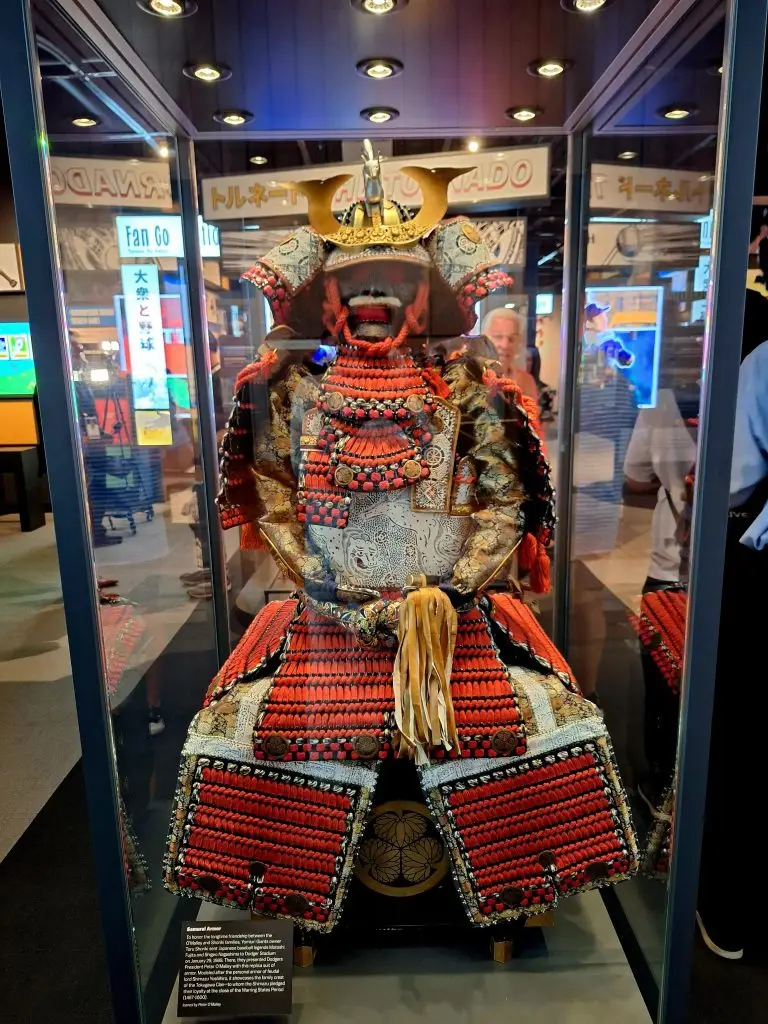
More than two years in the making, the Yakyu exhibit is the first of its kind dedicated to telling the story of the cultural exchange between Japan and the United States and the countries’ shared national pastime. Visitors to the exhibit are greeted by a samurai suit of armor gifted by Yomiuri Giants owner Toru Shoriki to Los Angeles Dodgers President Peter O’Malley in 1988.
The exhibit occupies an approximately 1,800-square-foot space on the museum’s third floor, with a dramatic entrance at the top of the stairs (the third floor is also accessible by elevator).
The narrative content of the story is presented in both Japanese and English, divided into four chronological subject quadrants:
- Japanese university teams touring America in the early 1900s.
- American All-Star exhibition squads touring Japan and stories of ambassadors of the game like major leaguer “Lefty” O’Doul, who made more than a dozen trips to Japan as a player, coach, and manager in the 1930s and 1940s. O’Doul was the first American without Japanese heritage to be inducted into the Japanese Baseball Hall of Fame.
- Players born in the United States playing in Japan, including Wally Yonamine, brothers Leron and Leon Lee, Warren Cromartie, Tuffy Rhodes and Randy Bass. The collective experiences of American “gaijin” players formed the basis of the movie “Mr. Baseball.”
- Japanese-born players in the United States, beginning with “The Dean of the Diamond” Kenichi Zenimura, a.k.a. “The Father of Japanese Baseball,” who arranged exhibition games between Nikkei teams and barnstorming major league squads led by the likes of Babe Ruth and Lou Gehrig. While Japanese Americans were incarcerated at Gila River, Arizona during World War II, Zenimura constructed his own “Zenimura Field” and was a founder of the 32-team incarceration camp league. The story of Zenimura and “Barbed Wire Baseball” is also featured on the Nikkei Baseball panel.
The recovered wooden home plate from Zenimura Field is prominently displayed in the Yakyu exhibit and was part of the inspiration to create the entire installation in conjunction with Ichiro’s induction. The Zenimura Field home plate is an archeological artifact with a complicated and lengthy back story:
The plate was donated to the Arizona chapter of the Japanese American Citizen’s League in 1996.
Dedicated to preserve the history of Japanese American baseball and educating the public about WWII incarceration through the prism of baseball, the Nisei Baseball Research Project was founded by Kerry Yo Nakagawa in 1996, where the Zenimura plate was incorporated into the NBRP exhibit “Diamonds in the Rough” in Fresno, California, and in museum exhibits across the country and world, including stops at the NBHoF and the Japanese American National Museum in Los Angeles. 2002-2005, it was part of the Hall of Fame’s “Baseball as America” national touring exhibit. It returned to Cooperstown in 2006 and remained in the hall’s possession, occasionally on display until 2022. It was included in the NBRP “Rebuilding Home Plate” exhibit at Dodger Stadium in Los Angeles for the Japanese American Heritage night and the 2022 All-Star Game.
More recently, the home plate moved to the Arizona Heritage Center in Tempe, Arizona, and was on display at the All-Star Game Fanfests in Seattle, Washington, and Arlington, Texas. It returned to Cooperstown in time to be included in the Yakyu exhibit this year.
“The wooden the plate from Zenimura Field, revered as ‘sacred,’ serves as a powerful touchstone for Pima Indians, Japanese Americans and all Americans. It’s a stark reminder of a time when the U.S. government unjustly imprisoned its own citizens based solely on their race,” said NBRP founder Kerry Yo Nakagawa. “In the camps, baseball was their lifeline, providing hope, inspiration and a sense of normalcy amidst the trauma.”
Other exhibit highlights include stand-alone displays focusing on the three most successful players crossing the Pacific from the Nippon Professional League to Major League Baseball.
Pitcher Hideo Nomo was not the first Japanese born major leaguer, but he was MLB’s first Japanese star, making his debut with the Los Angeles Dodgers in 1995. Nomo Mania soon ensued.
A life-size uniformed mannequin of Ichiro Suzuki also occupies a piece of prime real estate in the exhibit and contains an array of significant milestone artifacts from his career.
The Shohei Ohtani “Sho-Time” display depicts Ohtani, baseball’s only current two-way player, in a series of revolving images, showing highlights of his career as a member of the Los Angeles Angels and Dodgers and the Japanese WBC national team. It is perhaps the biggest display for an active player created at the Hall of Fame.