
Invasive Species: Pesky Plants by Chris Kjolhede
Beware the Gift of Bishop’s Weed, aka Goutweed
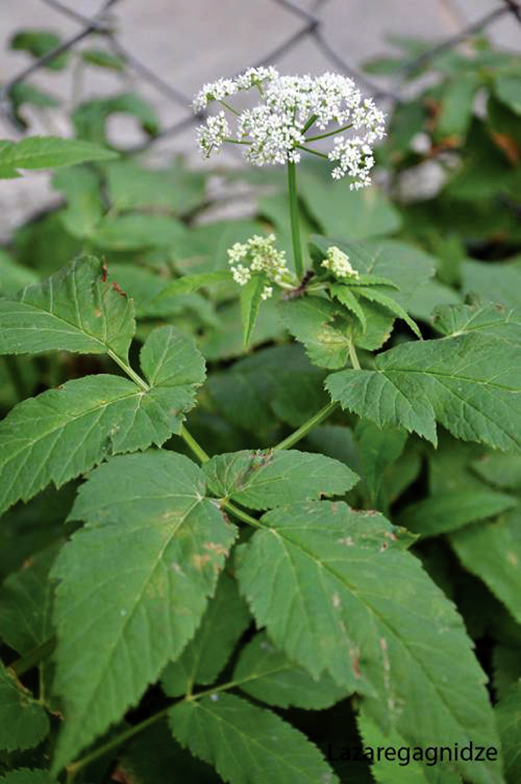
Gardeners everywhere love to give starts from their garden to friends and relatives. It’s a great way to thin your flowerbeds and to populate new beds. But beware! Some of those “gifts” may come with a rider. They may include a Trojan horse, of sorts.
Bishop’s weed (Aegopodium podagraria) is a designated invasive species in some areas and is noted as a “weed of concern” or “aggressive” in other areas. For our area of Upstate New York, we would call this “invasive.” Do NOT be fooled into thinking that it is a useful ground cover. It can spread by its seeds or more likely via underground runners called rhizomes. It has three leaves which can be found as an all green or a variegated, white-edged variety. The latter is sometimes commonly called “snow-on-the-mountain.” Bishop’s weed has a complex flower that is white and looks very much like Queen Anne’s lace.
The United States Forest Service reports that Bishop’s weed was introduced to North America from Europe and Asia in the 1800s. It was soon noted to be invasive in Rhode Island, where it quickly spread and smothered other plants. It has been deemed “unstoppable” by some gardeners. Nevertheless, it continues to be sold by some nurseries. (I would not buy it; besides, I have plenty of my own!)
Bishop’s weed (also known as goutweed) has been recommended as an herbal treatment for asthma, chest pain, kidney stones and psoriasis. This may be the reason it was transported to North America. The data on this use is very limited. And reviewers rate its effectiveness with one star out of a possible five stars.
Eradicating this scourge is nearly as difficult as getting rid of Japanese knotweed or purple loosestrife (see previous columns).
One method, where the infestation may be limited, is to dig up your prized perennials and remove all soil and plant matter other than that you want saved. This can be particularly difficult with clumps of iris tubers or peony roots. Sift the soil in your flowerbed. Once all plant matter is gone from this section of your garden, you may return your favorite plants. This might best be done in the fall.
Another recommended method, where the infestation is thick, is to remove all flowers (and weeds) and cover the area with black plastic for a year or two. (This is similar to suggested knotweed eradication). Key to any method is complete removal of all Bishop’s weed roots or rhizomes; any and all removal is essential to this step.
So why not accept gifts of perennials from friends? There may be a lurking rhizome or a few seeds mixed in with that clump of garden phlox or bearded iris. Start by asking whether the giver has any Bishop’s weed in their garden. If they do, beware. You can limit your risk by removing all soil and all unattached plant matter before planting these gifts in your flower bed. Don’t take the risk of just putting those peony or daylilies starts in your garden. You might live to regret it.
Chris Kjolhede, MD, MPH, is an emeritus pediatrician at Bassett Healthcare Network.