Column by Adrian Kuzminski for December 14, 2018
Public Banks, ‘Greenbacks,’ Might
Close Gap Between Rich And Poor
I brought up the Green New Deal in my last column as the only political agenda I’ve seen which, whether we agree with it or not, at least tries to measure up to the magnitude of the two biggest problems we face: climate change and economic insecurity.
Let’s take a closer look.
The Green New Deal, supported by many progressive Democrats, calls for “real financial reform” to address both problems.
This includes some of the standard proposals we regularly hear, such as restoring the Glass-Steagall Act (separating commercial and investment banking), breaking up the big banks, ending bank bailouts, reducing debt burdens, regulating derivatives, and taxing bank bonuses.
These are serious proposals, and would likely provide some relief, but they are partial measures subject to rollback and evasion.
The “real financial reform” the Green New Deal calls for goes further.
It promises radical change with two new proposals: One is to “democratize monetary policy to bring about public control of the money supply and credit creation,” and the other is to “support the formation of federal, state and municipal public-owned banks that function as non-profit utilities.”
First, some background.
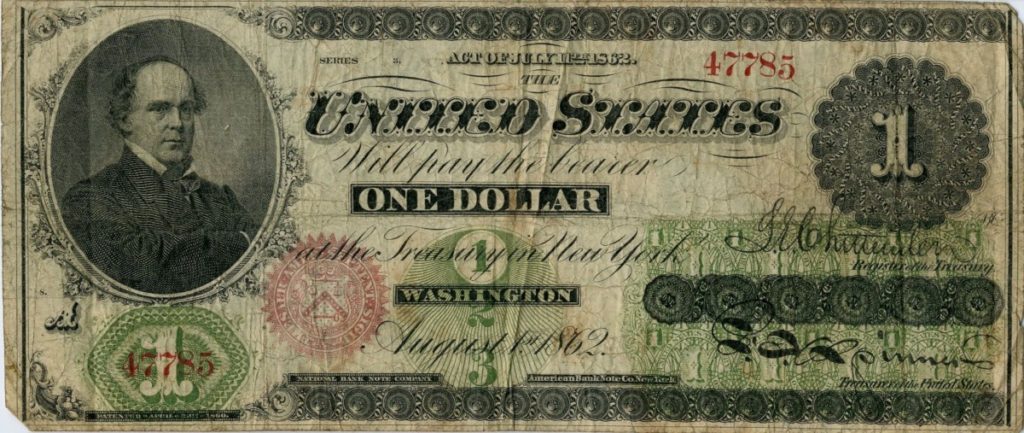
Most people don’t realize that the government does not issue money; the private banking system does, by issuing loans at interest. The last time the government issued money in any quantity was during the Civil War, when so-called greenbacks were printed by the Treasury Department to pay for the war.
Greenbacks were very successful; issued responsibly, only as needed, they made it possible to finance the war without onerous debt or inflation.
After the war, however, private banks fought hard to eliminate greenbacks, and finally succeeded.
They did not want their near-monopoly over the issuance of money undermined by public control of the monetary system.
Today, well over a century later, it’s again become an issue.
Private banks create money by issuing loans to individuals and companies; their profit comes from charging interest and, if necessary, foreclosing on the assets of delinquent debtors.
That works for borrowers as long as they can make more profit on borrowed money than the interest that must be paid on it.
Since the 1970s, however, and especially since the 2008 crisis, return on investment has lagged behind borrowing, with government, corporate, and individual debt levels now higher than ever and harder to sustain.
When the 2008 financial crisis hit, the federal government and the Federal Reserve bailed out private banks and some corporations (like GM) to the tune of trillions of dollars in taxpayer held debt, mostly by purchasing their non-performing (worthless) assets.
That got large investors off the hook, while leaving individuals and small businesses in the dust – crushed by debt and foreclosed mortgages.
The Green New Deal aims to neutralize the private banking system by which – good times or bad – the rich seem to get richer, while everybody else gets left behind.
By issuing its own currency, the government would not have to borrow in order to spend what is necessary. It could directly purchase goods and services (infrastructure, health care, free
education, transition to renewables) by issuing “greenbacks,” whose value would be sustained by the public benefits they would bring.
The other leg of its financial reform – establishing non-profit, public banks – would provide credit to ordinary people at zero or nominal interest for vital, long-term personal investments: housing, education, or starting a small business.
Banks should be public utilities, in this view, not profit-making enterprises.
Imagine being able to borrow on decent collateral the resources you need to improve your life, without having to pay back a fortune in interest.
Sound too good to be true? Maybe, but without some similar rearrangement of our monetary system, advantage will continue to lay with the investor class, increasing the economic insecurity of everyone else.
Too many people will continue to be denied access to capital except on the onerous terms offered by the current financial system, leaving them heavily indebted if not bankrupt.
Adrian Kuzminski, retired Hartwick College philosophy professor and Sustainable Otsego moderator, lives in Fly Creek.