
Life Sketches by Terry Berkson
Moon Glow over Allen Ginsberg
For several years, my wife Alice and I have been attending a summer concert that takes place at the Windfall Dutch Barn in Salt Springville, New York. There’s always a different group that comes to entertain, but musician and composer Carlton Clay usually enthusiastically presides over the event. One year, conductor and pianist Charles Schneider, accompanied by four singers, came to explain and then demonstrate how Leonard Bernstein almost mathematically put together “West Side Story”—not to mention words by Stephen Sondheim. The result was both ear opening and entertaining.
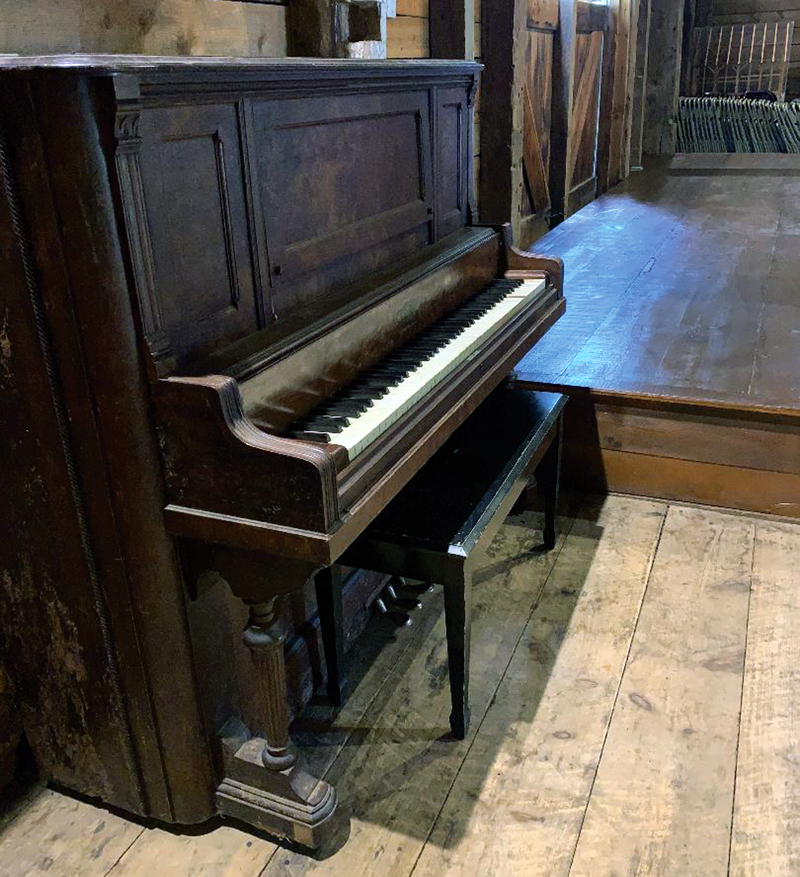
A bring-a-dish pot luck dinner always follows the show, so that a voluntary setting-up—by the audience—of chairs, tables and food is routine. The result is a great social exchange during the feast that follows the music. At the end of the day, everyone helps to stack the furniture so that the dance floor will be left available for future events. That’s when the frustrated musician in me comes out and, after doing some stacking, I can’t resist sitting down at a lonely upright piano that’s set off in a corner, where I begin to play old songs like “Deep Purple,” “Million Dollar Baby” and “My Blue Heaven.” I picked up these songs mostly by ear and osmosis from my father, who had a piano repertoire that would take days to exhaust.
So, the first song I begin with this time is a beautiful tune called “Moonglow.” I’m surprised when Carlton Clay rushes over with trumpet in hand and begins to accompany my playing. I’m thrilled. To me, coming from Carlton Clay, this is a real validation of my “pianistic” abilities—a pro wanting to play along with me! But, when I get to the bridge in the song, which amounts to a musical move in a different direction, I skip it and Carlton stops short. I go back to the main part of the song and he begins to play. When I get to the bridge again—I skip it. Carlton stops in mid note and looks at me as if to say, ‘Are you kidding?’ When it happens a third time, he puts his instrument down in frustration and walks away. I continue with a new song, but the pro doesn’t come back and I’m really feeling wounded. Later, I bump into Carlton outside the barn and explain to him that I play mostly by ear and never bothered to memorize the bridge in “Moonglow.”
“That’s okay,” Carlton says, but I can hear disappointment in his voice.
So, in preparation for the next year’s concert, I learned the bridge and practiced playing it for months. Again, at the end of dinner after the concert, I found my way to the upright in the corner. Not to be obvious about my intentions, I didn’t play “Moonglow” right away. Instead “Moonglow” was about the fifth song I played, but Carlton Clay was nowhere in sight and I felt that I had missed the opportunity to show him what I’d learned. I was now resigned to think that I’d never get to play with the pro again—and that all those months of practice were for naught—but that’s not really true, because it is a beautiful song and knowing it completely can’t be bad.
At the following year’s concert, we heard an interesting and exotic mix of jazz and music out of India played by Steve Gorn and Narendra Budhakar. The routine of setting up and breaking down the food tables followed, but before I found my way to the upright, Carlton Clay came over to me and declared, “You know who used to own your piano?” (He called it my piano!)
“Who?” I asked, inflated by the “your piano” business.
“Allen Ginsberg!”
“The poet who lived in Cherry Valley?”
“None other,” Carlton answered.
“Wow, I didn’t know he played the piano,” I said, while wondering if the bard wrote songs as well as poetry. Learning to play a Ginsberg song might be a good way to team up with Carlton Clay—again. But, I must admit, with trepidation, that I looked up the poet’s work and—with beautiful music and the harmony of sweet instruments in mind—regretfully found that the title of Ginsberg’s most famous poem is unfortunately called…“Howl!”
Terry Berkson’s articles have appeared in “New York” magazine, “Automobile” magazine and many others. His memoir, “Corvette Odyssey,” has received many good reviews: “highly recommended with broad appeal,” says “Library Journal.”