Life Sketches by Terry Berkson
Remembering the River Keeper
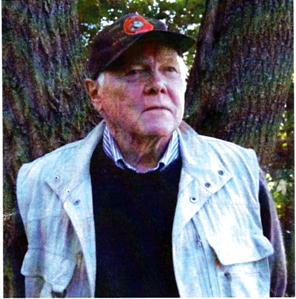
(Photo by Katya Boyle)
Several years ago I attended a memorial service for Robert Boyle (August 21, 1928-May 19, 2017), who succumbed to a long battle with cancer in his 88th year. The celebration of his life was held at the Boscobel (beautiful woods) House and Gardens overlooking the Hudson River near Garrison, New York—a spectacular location just north of and overlooking West Point.
Boyle was a leading founder of what eventually evolved into an organization called “Riverkeeper,” dedicated to preserving and revitalizing the Hudson River which, according to Boyle back in 1970, was already contaminated with PCBs. He was also involved in several other environmental campaigns. The pending termination of the Indian River nuclear plant in 2020 is largely due to Boyle’s efforts. He took on big corporations like Con Edison and General Electric that were literally poisoning the river. Boyle’s efforts resulted in a major cleanup. He was instrumental in stopping the super highway, Westway, with its proposed use of a road built on a land fill in the Hudson which would have decimated the striped bass population.
Robert Hamilton Boyle was born in Brooklyn, attended Trinity College and later Yale, where he majored in history. When drafted by the military, he served as an officer in the Marine Corps during the Korean War. Later, he did a brief stint as a pitcher in professional baseball. His success while working as a writer and reporter for Time Inc. eventually led to his joining the staff of a then-new magazine called “Sports Illustrated,” where in one article he coined the nickname “Broadway Joe” Namath and interviewed athletes like Mohammad Ali. He eventually became a senior editor and remained at the magazine for 38 years. Boyle authored several books. His tome on the Hudson River has been described as definitive.
After leaving Riverkeeper because of a conflict of interest concerning a staff member hired by Robert Kennedy Jr., Boyle continued to hear complaints from people about environmental abuses and violations. He had never received compensation for the many battles he fought. Inundated by whistleblowers while no longer connected to Riverkeeper, he decided to leave his beloved Hudson and move with his wife, Katya, to a farm in East Springfield, New York. There he continued to write, tie flies for fishing, and cultivate a garden—and unavoidably fight to protect the local environment.
The fact that Boyle was not only an avid fisherman but also a wild bird enthusiast prompted one of the speakers at the memorial, John Lipscomb, who captained Riverkeeper’s patrol and research vessel, to tell the following story:
A flock of noisy grackles had landed in Boyle’s back yard. They were making such a racket that he couldn’t work, so he got his 12 gauge shot gun out of the closet and headed outside, where he discharged a shot into the air. The grackles took off but when Boyle looked down, a robin was lying dead in the grass. It had apparently been perched on a branch of the maple which he was under. He picked up the bird and said, “That’s what you get for keeping bad company.” Feeling a bit guilty, he later dressed and ate the bird.
Besides his interest in saving the environment, Boyle, also a scholar, was chosen to present his thesis on James Joyce’s enigmatic novel, “Finnegan’s Wake,” to a literary society in Dublin where he related much of the book’s content to waterways and angling. He was truly a renaissance man. May the memory of the original Riverkeeper continue to flow.
Terry Berkson’s articles have appeared in “New York” magazine, “Automobile” magazine and many others. Reviews on his critically-praised memoir, “Corvette Odyssey,” can be found on TerryBerkson.com.