New Marker Commemorates Anti-Slavery Heritage
By BILL BELLEN
ONEONTA
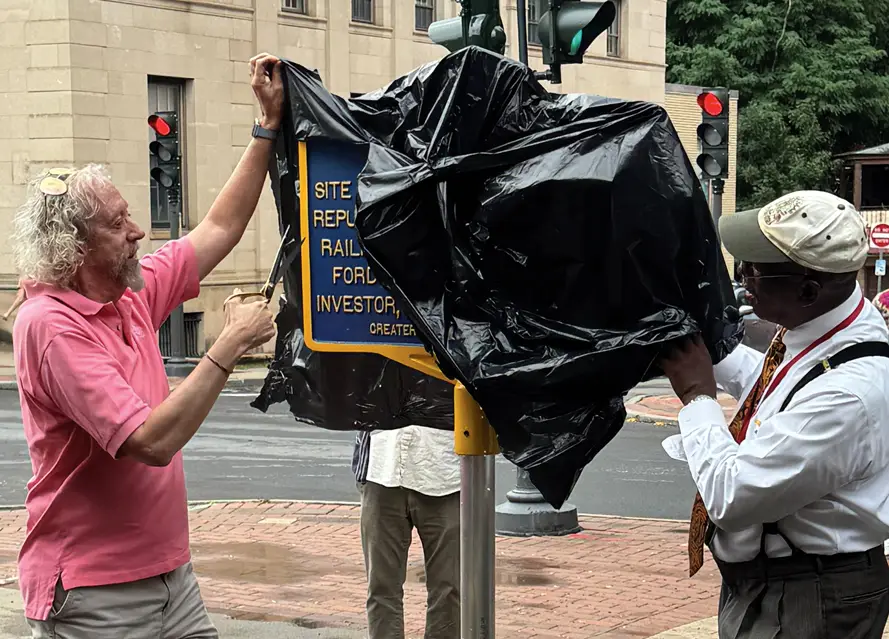
As Dr. Marcela Micucci, executive director of the Greater Oneonta Historical Society, quipped, it really does seem like rain only comes to town when there is a historical marker to unveil. In contrast to the poor weather, a crowd of jubilant onlookers stood beneath the awning of the Community Bank on Main Street on Wednesday, August 13, conversing about the legacy of the historical marker that stood before them under a black tarp.
The fourth marker of the season, it represents the culmination of a rich history of Oneonta and extensive, time-consuming research. This marker commemorates the role of the Ford Mansion as a safe house for slaves utilizing the Underground Railroad on their journey to freedom. Built in 1841, the mansion was home to Eliakim Reed Ford, an early investor in the railroad that would go on to define Oneonta’s legacy. Ford was noted for being a staunch abolitionist and proponent of the antislavery movement that was rapidly expanding throughout the northern United States at the time.
“This marker helps bring to light Oneonta’s role as a central location in New York of anti-slavery activism and a site on the Freedom Trail in the 19th century,” Micucci wrote via e-mail. “As a historian, it makes me incredibly proud to be able to commemorate and celebrate Oneonta’s significance and the many abolitionists, like E.R. Ford, who challenged and advocated for an end to slavery and helped those escaped enslaved people in need.”
This knowledge of Ford’s role in the Underground Railroad was not always so cut and dry. Due to the intentional obscurity of those involved in efforts to free slaves, there were very few historical records to connect the Ford Mansion directly to this nationwide effort. The extensive research required to uncover this information was discussed at length by guest speaker Harry Bradshaw Matthews, who unveiled the marker. GOHS Board of Trustees member and founding president of the United States Colored Troops Institute at Hartwick College, Matthews has committed untold hours to piecing together Oneonta’s role in the fight for freedom and the Underground Railroad.
Matthews detailed the story of eight escaped slaves that reached Oneonta, but whose names and places that helped them were kept obscured both in their time and throughout history through deliberate secrecy. He acknowledged the powerful role of anti-slavery activists throughout Oneonta and the surrounding county, and how Frederick Douglass recognized their roles in the fight through the New York State Anti-Slavery Society and local anti-slavery societies as some of the fiercest fighters of the movement. Matthews went on to explain via a historical timeline the process of research that led him and his associates to realize the true role of Ford and his home in the Underground Railroad.
“There’s gonna be a major exhibit in Hartwick College, starting by the end of August through mid-December,” Matthews shared. “It’s going to be called ‘Memorializing the Underground Railroad: The Harry Bradshaw Matthews Collection.’ So, for the first time, there will be major primary [source] items that will be on display.”
Matthews then wrapped up his address and passed things back over to Micucci, who went on to welcome second guest speaker David Schumann. Micucci detailed Schumann’s role as an advisor for the Robert F. Schumann Foundation and his status as a descendent of the Ford family.
“I am his great-, great-, great-grandson,” Schumann explained. “When my father passed, he started a foundation in his name. And I’m on the board of that foundation, and the foundation has paid for the marker to be placed. Marce and I got to know each other because I have been spending years doing research on the Ford family, and I’ve produced four books so far. Those books are with Marce at the [Oneonta History Center], and also at the library. And I deposited all of the family heirlooms with the historical society.”
Schumann gave a short address about his relation to the Fords, after which an excited John Nader connected with him as a fellow descendent of the family. Schumann explained how he developed an interest in his family’s genealogy, and how a picture of Frederick Douglass in a box of heirlooms handed all the way down from Eliakim Reed Ford himself sent Schumann down a path of generational exploration.
“That’s another connection!” Matthews exclaimed upon hearing this development of yet another piece of evidence showing the Fords’ deep connection to the abolitionist movement.
As the rain finally began to break, Schumann was handed the golden scissors and, together with Matthews, cut the tarp off the historical marker, unveiling the first marker to be placed directly on Oneonta’s Main Street. The crowd enthusiastically applauded as Schumann, Matthews and Micucci posed for pictures alongside the sign.
The fifth and final historical marker reveal of the season will be on Thursday, August 28 at 3 p.m. for the unveiling of the McDonald Tavern marker, located at the corner of River and Main streets, where Stewart’s Shops is now located.