
The Myth Busting Economist by Larry Malone
Is the American Dream a Myth?
The idea that each successive generation of Americans is better off than the one before is the American Dream. Our Declaration of Independence proposed America as a place where individuals could rise from effort instead of birthright. As we near its 250th anniversary, let’s recall the first words the Declaration:
“We hold these truths to be self-evident, that all men are created equal, that they are endowed by their Creator with certain unalienable Rights, that amongst these are Life, Liberty and the pursuit of Happiness.”
The pursuit of happiness meant unshackling our obligations to a king. That freedom lifted expectations that children would surpass the well-being of their parents as a core value in our national identity.
The historian James Truslow Adams popularized the notion of the American Dream in his book “The Epic of America” (1931) by describing the U.S. as a place where life should be “better and richer” for each generation. The Dream has been fading as wealth inequality rises and the middle class shrinks, making it harder for families to get by, even with two incomes. The economic divide between rural and suburban and urban America is also widening.
The collapse of the American Dream has been ignored by every politician but one. President Trump’s Make America Great Again mantra acknowledged the disconnect between myth and reality and used it to come to power.
Each successive generation is now poorer than each previous generation, and the policies being pursuing by the president are worsening that prospect instead of reversing it.
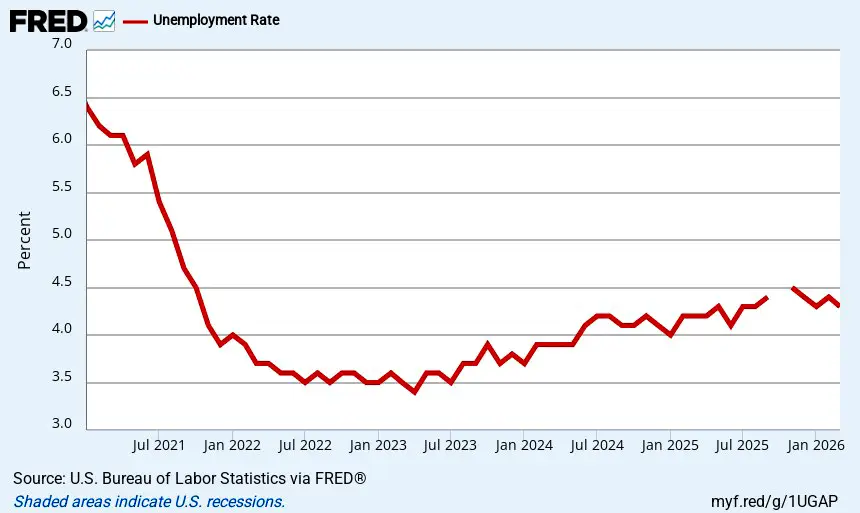
The chart above shows changes in the unemployment rate over the past five years of recovery from COVID with a current rate of 4.3 percent. That’s low by historical standards, and normally a sign of a thriving economy. But digging deeper into other employment evidence gives a different picture.
The U.S. Labor Force consists of 172 million workers. But the U.S. economy created just 15,000 new jobs on average for each month in 2025. Last year was one of the worst in our history for job creation. That’s why the unemployment rate for college graduates seeking their first full-time job was 8.2 percent. So why did the overall unemployment rate remain so low?
The answer is UNDERemployment, which is when your job requires less skill than your training and work experience. A recent study by the Federal Reserve Bank of New York found that 42.5 percent of all 2025 college graduates are underemployed.
The labor market experience of Gen Z (born between 1997-2012) is defined by underemployment in what they have taken to calling the “Gig Economy.” And the adoption of artificial intelligence in workplaces is starting to displace older workers. This makes for rising underemployment in Gens X (born 1965-1980) and Y (born 1981-1996). In simple terms, when your job is eliminated by AI, it becomes more likely that you can only find work that requires less skill at lower pay.
Rising underemployment among all workers goes hand in hand with the war on immigration. As recent immigrants are deported or driven into the shadows, first time workers and workers displaced by AI will be shifting into jobs previously held by immigrants. This is touted as a positive development by the president because he thinks immigrants take jobs away from law abiding Americans. He also thinks that you and I don’t pay the cost of tariffs, and that inflation is imaginary.
What are those jobs? The top seven occupations with the highest share of foreign-born workers are: 1) food preparation and service; 2) building and grounds cleaning; 3) construction; 4) transportation, warehouse and materials handling; 5) healthcare support and aides; 6) production workers; and 7) agricultural workers. These hands-on occupations are less vulnerable to the adoption of AI. If underemployed workers replace recent immigrants in these jobs, it creates the false impression that things are great because the overall unemployment rate remains low.
People who know me well have always been struck by my “glass half full” optimism, which is unusual for an economist. But the workplace reality facing our children, their children and our grandchildren makes me pessimistic. We are rapidly falling into the abyss of a national crisis of permanent underemployment.
Chronic underemployment means a lifetime of work that requires lower skill and offers lower pay. That translates into lower Social Security and 401 retirement contributions, and an inability to afford healthcare and housing. Far from greatness, we’re facing instead a steeper and irreversible decline in our standard of living and the end of the American Dream.
Larry Malone is professor emeritus of economics at Hartwick College.