News from Cooperstown Central School
Bridging Languages, Cultures through the NYS Seal of Biliteracy
By JACOB JOHNSON
COOPERSTOWN
The New York State Seal of Biliteracy recognizes students who demonstrate high proficiency in English and one or more world languages. The yearlong process involves student research in both English and their chosen language on a topic of their choice.
The seal can validate language skills, which can be used by employers seeking multilingual candidates. In my case, I conducted a research project about the role of women and the philosophes during the French Revolution in French. Following my year abroad as a sophomore in France, Mrs. Michelle Hitchcock brought a unique opportunity to my attention: the New York State Seal of Biliteracy. Although I did not know what the seal entailed, I was immediately intrigued.
The whole process started in my junior year, when I opted to challenge the College Board’s Advanced Placement French Language and Culture Exam. Although Cooperstown hadn’t offered the course for years, I knew that with my exchange under my belt and continued study of French, I would be able to succeed on the exam. So, I began studying on my own and preparing for the written essays required by the exam throughout my junior year. In July of the summer before my senior year, I discovered I had passed the exam with flying colors and could put the credit toward my Seal of Biliteracy.
During my senior year, I met with Mrs. Hitchcock, the school librarian, to begin researching and outlining the research project that I would present to a panel of judges in May. I figured since I was giving my culminating presentation in French, I should choose a topic that was uniquely French, the French Revolution. Through a series of organized meetings, I met with my two advisors—Mrs. Hitchcock for help with my research, and Mme. Schleining, the French teacher at Cooperstown. Through the sessions, I continued to develop my research and express my thoughts in proper English and French.
One of the greatest challenges I encountered was finding reliable French sources. I had no trouble finding many English sources; however, when it came to looking for those in French, the process became more complex. Most of the French sources I used were primary sources and videos. I had trouble finding research databases and secondary sources because I had limited access to library media sources in France. However, the primary sources and videos still helped me gain an understanding of the French perspective and to properly name key events. In the end, I found enough sources to support my arguments to the panel.
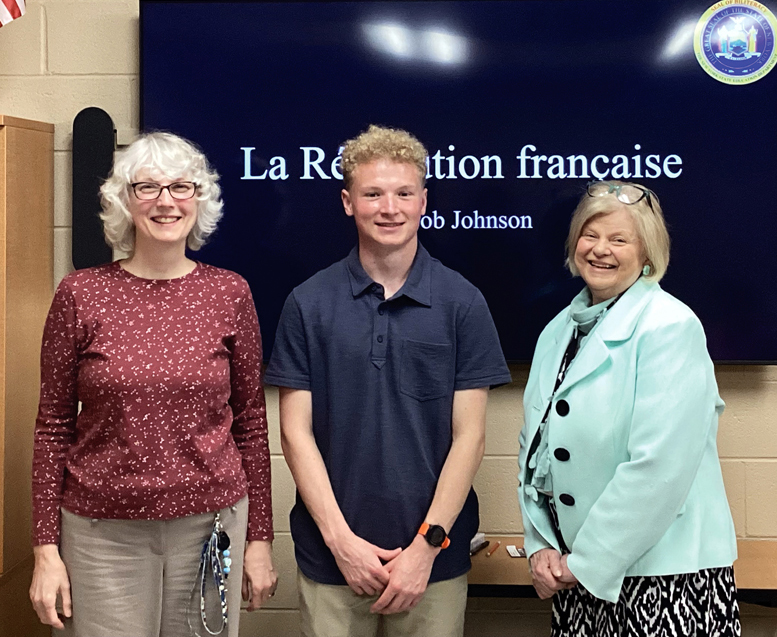
The day of the presentation, I presented my research project to Mme. Schleining’s French I class and a panel of six judges. The presentation consisted of both a French and an English part, so I was graded on my skills in both languages. Afterward, students and panelists had the opportunity to ask questions, allowing me to demonstrate not only my language abilities but also my understanding of the historical topics I researched.
Overall, completing the Seal of Biliteracy project was one of the most rewarding academic experiences of my high-school career. Not only did it strengthen my French speaking, writing, and research abilities, but it also taught me how to think critically and communicate complex ideas across languages. Presenting my research in both English and French pushed me outside of my comfort zone and demonstrated how much I had grown and learned since studying abroad in France. I could not have pursued the seal without my experiences abroad in France, and I would like to thank the Rotary Club of Cooperstown for sponsoring my year abroad. It was truly a life-changing opportunity that opened so many doors for me. Earning the Seal of Biliteracy represents more than proficiency in another language; it reflects curiosity and a deeper understanding of the world beyond Cooperstown.
Jacob Johnson is a student at Cooperstown Central School.