

Cooperstown School District Proposes 4.7% Budget Increase
By ERIC SANTOMAURO-STENZEL
COOPERSTOWN
The Cooperstown Central School District has proposed a 4.7 percent increase for its 2026-2027 budget, with a 2.7 percent tax increase. The deficit budget will draw on the district’s reserves, with district officials saying rising costs are outstripping the district’s current ability to raise revenue or make cuts. The budget increase primarily comes from a 17.85 percent increase—$926,252.00—in the cost of benefits, mainly health insurance, under existing contractual obligations.
The total proposed budget is $24,877,283.00. Last year’s adopted budget was $23,760,273.00.
The board unanimously approved the budget to go to the public for a vote on Tuesday, May 19. A public information hearing will be held on Monday, May 11 at 6 p.m. in the Junior-Senior High School library.
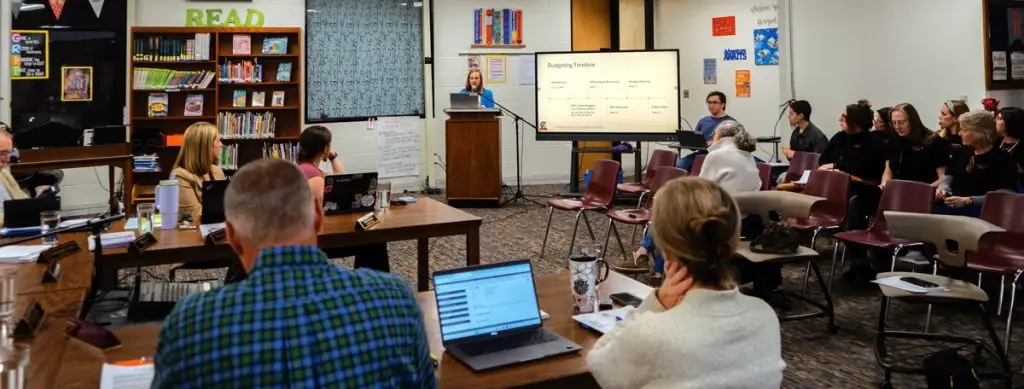
“I’m glad that over the past few years, the district has carefully managed its finances and built up a rainy day fund,” School Board President Pete Iorizzo said after a budget presentation at the Wednesday, April 22 board meeting. “But the bad news is it is now raining, and the forecast doesn’t look so hot for the next little while.”
District Business Manager Elizabeth Rickard presented details of the budget, which were developed over months of collaboration between the district office and school board Facility and Finance Committee members Chris Franck and William Streck.
Rickard said that similar to the past, 80 percent of district costs are people related.
“Health plan costs are rising. Workers comp is up 37 percent. Debt service and transportation have stayed stable, as has general services, which is down slightly,” Rickard said. “Fixed costs per student are high and continue to rise with declining enrollment.”
She added that BOCES services and utility costs also increased by 11 percent each.
“These increases are being offset by cost reductions: not filling six vacancies for approximately $600,000.00; we’re not replacing certain vehicles and equipment totaling $150,000.00; and the district has a long list of smaller things that we’ve cut affecting everything at our school district,” Rickard said.
Maintaining a “fairly flat” revenue structure, Rickard said that local property taxes account for 66 percent of revenue and state aid 31 percent. She said revenue has only increased by around $350,000.00.
To raise necessary revenue, the district is considering regionalization initiatives that partner with other districts to provide certain services, tuitioning in students from other areas, and fundraising.
“An important consideration is the community’s willingness to support tax increases above the cap in 2027,” Rickard said.
Reserves will help address the shortfall this year.
“We were fortunate, because those funds stabilize the situation for a period of time, and without them, we would have reached this point sooner,” Rickard said.
The district is budgeting for drawing down as much as $3 million from its reserves in 2027.
“So we have to look at solutions, both on the revenue side and on the expense side, because we can’t manage ourselves out of this by reducing expenses,” Franck said. “We have to look for sources of revenue.”
One former school board member, Tim Hayes, expressed some disagreement during public comment. He asserted that Cooperstown’s cost per student is not really high, urged a reduction in administrative staff, and doubted the efficacy of collaborating with other districts or tuitioning in students to cover the impending $3 million gap.
“So I come back to the issue of personnel and remind people that on my last day here, I spoke very passionately about curriculum, and starting every conversation about curriculum,” Hayes said.
Representatives of the Cooperstown Faculty Association, the union representing the district’s teachers, told AllOtsego that the organization supports the budget.

That comes to about $31,000 per student. That is quite high for an upstate public school.