

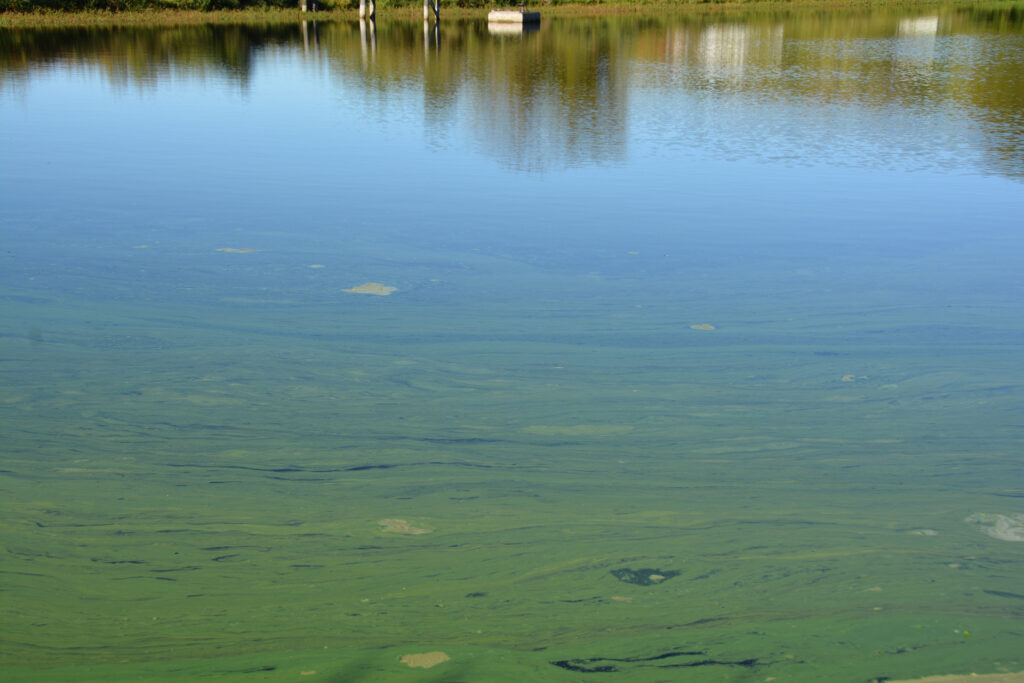
Do Blooms Also Like it Cold?
Lake Superior Researcher, International Team of Scientists Help Communities Better Understand Harmful Algal Blooms
By DARLA M. YOUNGS
SUPERIOR, WI—Kiyoko Yokota, certified lake manager and associate professor of biology at SUNY Oneonta, co-authored a report released last week that challenges current understandings of harmful algae blooms and may help communities better prepare for them. The results of studies led by scientist Dr. Kait Reinl, research coordinator at the Lake Superior National Estuarine Research Reserve in Superior, Wisconsin, were published on February 17 in the scientific journal, “Limnology and Oceanography Letters.”
Cyanobacterial blooms, also known as harmful algal blooms, are an environmental and public health threat around the globe. Blooms can produce unpleasant tastes and odors, deplete oxygen in water, produce toxins that are harmful to people and animals, and impact water treatment systems. Researchers’ current understanding is that blooms occur largely when water temperatures are warm or hot, but there is evidence that blooms also occur in cold water, including under ice.
“Cyanobacterial blooms are analogous to fever in human health. Cyanobacteria are part of natural lakes, found even in the most pristine waters of the world as well as in polar ice and even air. They have important ecological roles, just like we need to maintain a certain amount of body heat. Some lakes naturally have more or less cyanobacteria, just as the ‘normal’ body temperature varies among individuals,” explained Yokota.
“When humans run fevers, it is a symptom of something going wrong in the body. Cyanobacterial blooms are the same—they are a manifestation of ecosystem changes that are allowing cyanobacteria to thrive abnormally. There are fever-reducing medications, but they can only do so much and should not be taken for too long without finding and treating the root cause of the fever instead of just monitoring it. Otherwise, the fever will come back after you stop the medication,” she continued.
The study, called “Blooms also like it cold,” was developed with 27 co-authors through the Global Lake Ecological Observatory Network. The research documents wide-ranging cold-water cyanobacterial blooms and identifies physical and biological drivers that may promote blooms under cold conditions. This is an important step toward understanding the full scope of conditions that could lead to blooms so that communities are better prepared for sustainable lake stewardship now and in the future.
“The power of networked science was most surprising,” said Yokota. “We started this project because cyanobacterial blooms in cold waters have traditionally been treated as rare phenomena caused by cold-adapted species (Type A in the article), while as individual limnologists we each had felt that it was not the whole story and that cold blooms have important connections to the warm season blooms.
“As we began to gather data from all around the world through the Global Lake Ecological Observatory Network, it became clear that cold blooms can also be caused by species that thrive in deeper water (Type B) or earlier blooms in warmer water that carry into or resurface in the cold-water season (Type C),” Yokota continued.
According to Yokota, many upstate New York lakes have started to experience recurrent cyanobacterial blooms in the last decade, and scientists from both the regulatory agencies and the research community have been working hard to address the changes in lake ecosystems that are causing cyanobacterial blooms.
“We have a network of highly trained limnologists around the state who regularly interact through GLEON and Northeast GLEON, a local group within GLEON. Equitable collaboration is key to successful study of complex lake ecosystems, as no one lab has all the expertise and equipment to address all aspects of a lake ecosystem,” Yokota said.
Regarding the importance of the study, Dr. Reinl said, “Cyanobacterial blooms are complex and a major challenge. Current thinking regarding blooms is that they like it hot, and in many cases, they do. However, we’ve been seeing more evidence that blooms can also occur when it’s cold. When this happens, we feel blind-sided because it goes against what we’ve previously heard. This paper highlights the need for understanding cold-water cyanobacterial blooms. It is a reminder that lakes can be very active when temperatures cool. This work is a powerful example of coordinated team science and provided a unique opportunity to collaborate with an international group of experts.”
The paper is available without cost from “Limnology and Oceanography Letters” at https://aslopubs.onlinelibrary.wiley.com/journal/23782242.
Dr. Yokota’s comments for this article do not reflect the opinions of SUNY Oneonta, the SUNY Oneonta Biological Field Station or the North American Lake Management Society.


The first HABs identified in the US were in Alaska. The question is what are we doing about it at Lake Otsego ? Where is the DEC approved mitigation plan ?
The first HABs identified in the US were in Alaska. The question is what are we doing about it at Lake Otsego ? Where is the DEC approved mitigation plan ?
i’m glad we are beginning to understand the blooms. i hope in the near future there is a specific plan created by local organizations that will possible save the economy, and the health of people and animals. Is the drinking water in the village safe to drink? i know it is a complex problem, one that includes pesticides, phosphates, fecal matter; under the big umbrella of Global Warming. What can we do to help?
i’m glad we are beginning to understand the blooms. i hope in the near future there is a specific plan created by local organizations that will possible save the economy, and the health of people and animals. Is the drinking water in the village safe to drink? i know it is a complex problem, one that includes pesticides, phosphates, fecal matter; under the big umbrella of Global Warming. What can we do to help?