
Beetles Released in Cooperstown To Control Invasive Insect
COOPERSTOWN—It’s not as spectacular as releasing a hawk or bear back into the wild after an injury, but the release that took place in Cooperstown on Thursday, March 26 may be more important.
According to a press release, the Otsego County Conservation Association and Mohican Farm/The Clark Foundation released 236 predatory beetles at Fairy Spring Park last week to control the population of hemlock woolly adelgid.
The release was the culmination of a process that began when the invasive insect was first found at Fairy Spring Park in December 2021. Hemlock woolly adelgid is a tiny insect native to the Pacific Northwest, Japan and eastern Asia. Once an infestation takes hold, the insects can kill healthy trees in as little as 10 years, making early detection and treatment critical, OCCA officials said.
The beetles, Laricobius nigrinus, were sent to Cooperstown by the New York State Hemlock Initiative, based at Cornell University. NYSHI researches the integrated pest management of hemlock woolly adelgid, and has released Laricobius at more than 20 sites in the state since 2008. Recently, NYSHI announced that the beetles had successfully established breeding populations in the Hudson Valley. The beetles released in Cooperstown had been collected in the Pacific Northwest.
At just three millimeters long, the beetles are easy to overlook, barely bigger than the insect they feed on exclusively throughout their lives.
“Biological control methods are probably the best chance we have for slowing down the spread of hemlock woolly adelgid,” said Devin Merkley of The Clark Foundation and Mohican Farm. “We are grateful to the Hemlock Initiative for providing the beetles, and are happy to participate in the effort to save what James Fenimore Cooper described as ‘Rembrandt-looking hemlocks.’”
“Eastern hemlocks are considered a foundation species,” said Jeff O’Handley, program director for OCCA. “They basically create their own ecosystem, protect water quality and aquatic habitats, and support a great variety of wildlife.
“It’s also one of the most common trees in our forests. Losing them would not only disrupt the natural function of our ecosystems, it would pave the way for invasive plants to establish in the forest,” O’Handley explained.
Soon after the adelgid was discovered, OCCA and Mohican Farm convened a meeting that included representatives from the Village of Cooperstown and SUNY Oneonta Biological Field Station to discuss how to handle the appearance of the destructive insect.
The village was committed to saving the trees at the park, said Cooperstown Mayor Ellen Tillapaugh.
“We recognize the importance of hemlock trees, both to the environment and the scenic beauty of Otsego Lake and the park, and we wanted to protect them,” Tillapaugh said. “Our preference was for a biological control agent. Unfortunately, none were available at the time.”
The village opted instead for a combination of selective thinning to improve the health of the remaining trees and insecticides. The Catskill Forest Association treated hemlocks at the park in 2022, 2023 and 2024.
“We’re pleased to report that the treated trees are doing well,” Tillapaugh said. “Unfortunately, the insect has been found elsewhere in the park, as well as on neighboring properties.”
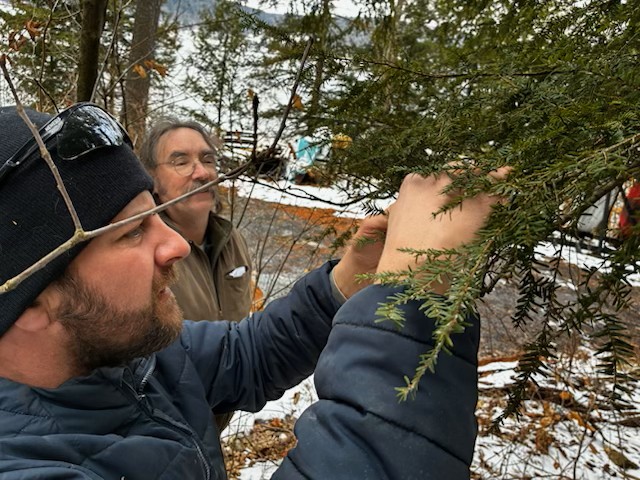
The beetles intended to fight this invasion came packed in two plastic vials filled with wood shavings. Instead of an explosion of wings and a thrilling flight, balls of wood shavings were carefully nestled amongst branches brimming with the only food the beetles will ever eat in their lives: hemlock woolly adelgid. Within minutes, the beetles began disappearing into the dark green hemlock needles.
Hemlock woolly adelgid is native to Japan, eastern Asia and the northwest coast of the United States, where it has a number of predators—including Laricobius nigrinus—that checks its population. HWA was introduced to the eastern United States in the mid-20th century. It has been making its way slowly up the east coast, reaching New York State around 1985, and was first found in Otsego County in 2011.
HWA has a complicated life cycle that includes two generations per year. One generation feeds throughout the winter. It protects itself from winter temperatures by producing a woolly mass around itself that looks a little like a tiny cotton ball.
Laricobius beetles feed exclusively on hemlock woolly adelgid in all stages of its life. Adult beetles are active from October through April. They tear through the wool and feast on developing and adult adelgids. The beetles lay eggs in late winter and the larvae go to work, eating HWA eggs and the early stages of its second generation. After a few weeks the beetle larvae pupate in the soil beneath the hemlocks. Adults emerge in autumn and the cycle continues.
OCCA and Mohican Farm have been working together to promote awareness of HWA and train community scientists to survey for the insect since 2018.
“Unfortunately, we’re never going to get rid of the adelgid,” O’Handley said. “But the beetles will help keep it under control and will bring about a balance so that we don’t lose our hemlocks, and that’s the important thing.”