Gilbertsville Relives Signing of Declaration of Independence
By TERESA WINCHESTER
GILBERTSVILLE
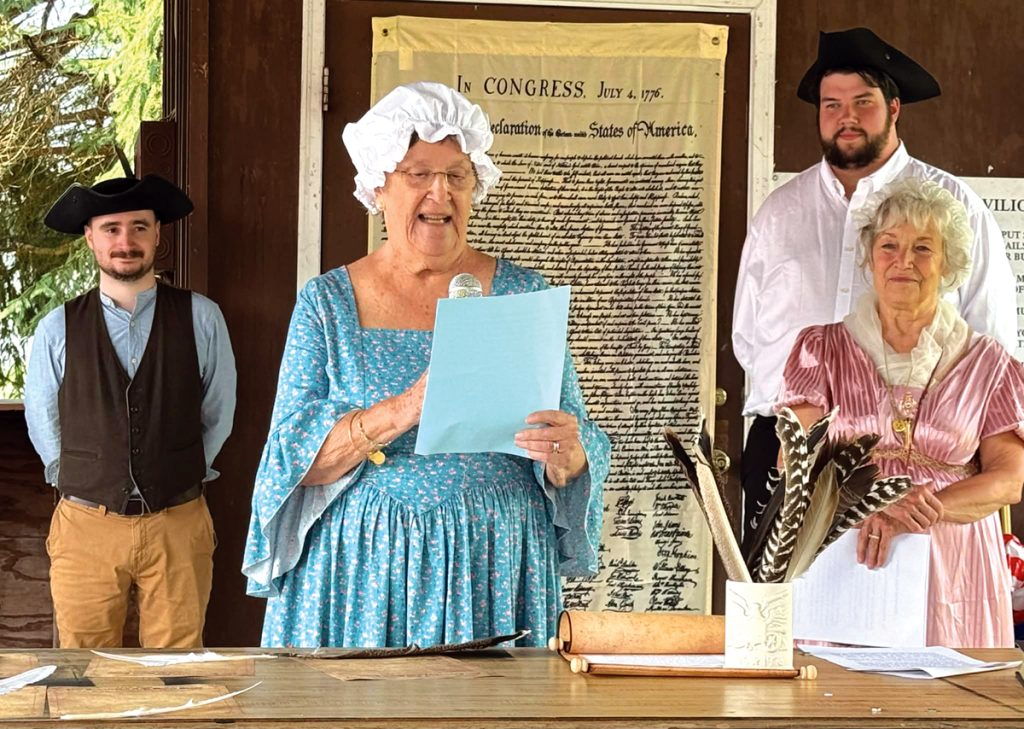
A reenactment of the signing of the Declaration of Independence took place in Gilbertsville’s Centennial Park immediately following the village’s annual July 4 parade, which featured approximately 45 entries. The reenactment was produced by the Town of Butternuts 250th Committee.
Leading off the proceedings was Liam Herbert, who impersonated John Adams, Massachusetts’ delegate to the Second Continental Congress. It was Adams who insisted that Thomas Jefferson pen the Declaration approximately one year prior to its signing.
Herbert read from a letter written by Adams to his wife, Abigail, in which he reaffirmed the rightness of declaring independence from Britain, writing, “The hopes of reconciliation, which were fondly entertained by multitudes of honest and well-meaning, though weak and mistaken people, have been gradually and at last totally extinguished.”
Adams was prescient in his vision of future July 4 celebrations, further musing to his wife, “I am apt to believe that this day will be celebrated by succeeding generations as the great anniversary festival. It ought to be commemorated as the Day of Deliverance by solemn acts of devotion to God Almighty. It ought to be solemnized with pomp and parade, with shews [sic], games, sports, guns, bells, bonfires and illuminations from one end of this continent to the other from this time forward and forever more.”
Prominently featured in the Gilbertsville program were women of the Revolution.
Martha Washington, portrayed by Valerie Haynes, underscored the vital and largely overlooked support roles women played: providing a strong presence at military encampments, obtaining food and medical supplies, cooking meals and even acting as surgeons and nurses. The women also sewed and laundered both clothing and bedding. They organized collections of funds and goods and often drew on their own resources to aid the war effort, with Martha Washington herself donating significant funds and supplies from Mount Vernon.
Transforming domestic duties into political acts was a notable women’s contribution. They initiated boycotts of British goods, such as tea and cloth, making up for shortages of cloth by holding spinning bees.
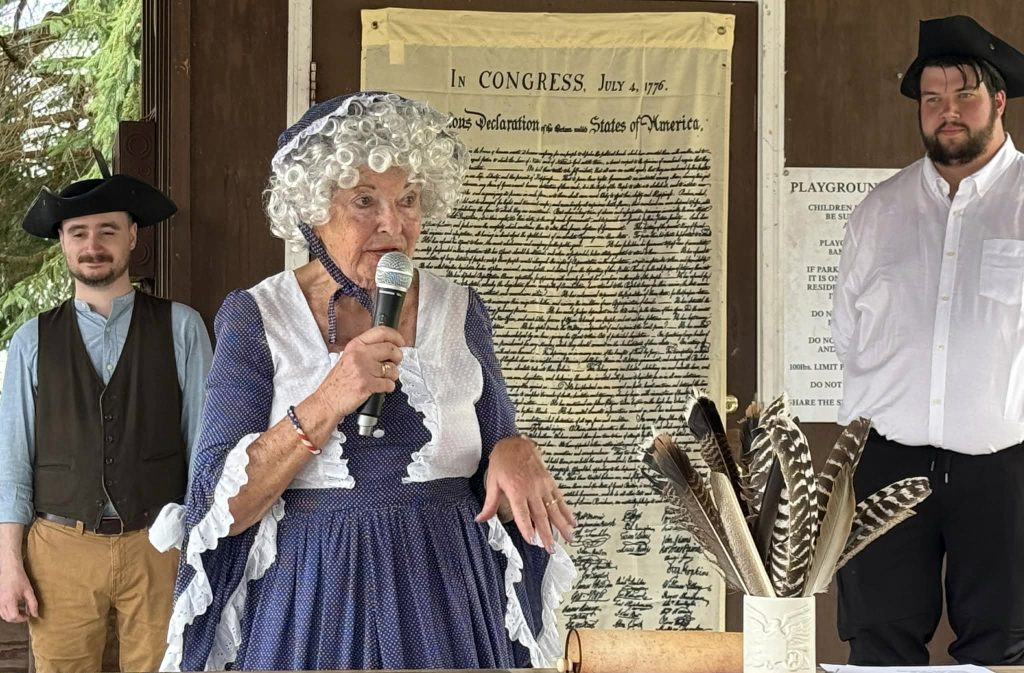
Anne Sebeck was the reincarnation of Lucy Flucker Knox, wife of Henry Knox—a leading officer in the Continental Army. She was disowned by her Loyalist family for marrying Knox as well as for her Patriot sentiments. Lucy accompanied Henry, living in military camps and, like her good friend Martha Washington, supporting the troops in various ways during the war.
Marcia Foote of the Tianderah Chapter of the National Society Daughters of the American Revolution represented Sarah Bradlee Fulton, leader of the Daughters of American Liberty, formed in 1765 to protest the Stamp Act. The term came to apply to all women who participated in revolutionary activities. Bradlee was known as “The Mother of the Boston Tea Party.”
Besides carrying a message through enemy lines on behalf of General George Washington, Fulton demonstrated incredible courage when the British, in violation of laws regarding confiscation of personal property, retrieved a supply of wood the British had taken from her family. As read by Foote, Fulton recounted, “Infuriated, I pursued the British soldiers until I caught up. I grabbed the oxen by the horns and turned them around, leading them away even as the British prepared to shoot me. I simply told them to ‘shoot away,’ and the British, astonished by my defiance, surrendered the wood to me without resistance.”
Mercy Otis Warren, depicted by Carla Hall, cut the figure of a woman of considerable intellectual prowess who greatly influenced political thought of the era and contributed to the radicalization of public opinion against British rule. She published a series of scathing political plays and poems which galvanized colonial resistance. Her home was a central meeting place for revolutionaries. The protest meetings she hosted helped lead to the establishment of the Committees of Correspondence, a collection of American political organizations that sought support for American independence.
After the war, Warren was a prominent voice against ratification of the U.S. Constitution due to its lack of explicit protections for individual liberties. Her 1776 essay titled “Observations on the New Constitution” argued strongly for the inclusion of such. Warren has been credited with influencing the ultimate adoption of the Bill of Rights in the U.S. Constitution.
The youngest woman represented was Sybil Ludington, age 16, whose experience was read by Lexie VanDusen. Known as “the female Paul Revere,” her ride was 40 miles long, or, as recounted, “approximately three times longer than Revere’s.” After learning that British troops were attacking the Continental supply depot in Danbury, Connecticut, Ludington volunteered to alert her father’s militia, scattered throughout Putnam County, New York. Riding through darkness in a driving rain, she knocked on shutters with a long stick, alerting farmers to report to the Ludington farm by dawn. The nearly 400 militiamen who subsequently gathered could not save Danbury, but joined with other forces to harass the British retreat at the Battle of Ridgefield, thus contributing to a strategic American victory.
Valerie Elbrick read from a letter written by Abigail Adams to her husband in March of 1776, in which she strongly advocated for women’s rights, asserting, “I long to hear that you have declared independency—and, by the way, in a new Code of Laws, I desire you to remember the ladies, and be more generous and favorable to them than your ancestors. Do not put such unlimited power into the hands of the husbands. Remember, all men would be tyrants if they could. If particular care and attention is not paid to the ladies, we are determined to foment a rebellion, and will not hold ourselves bound by any laws in which we have no voice or representation.”
The program concluded with a signing of the Declaration of Independence by those present. Among them were four descendants of original signers. Carla Hall, her son Matthew Friedman and grandson Henry Lewis Friedman represented respectively the eighth, ninth, and tenth generations of descendants of Lewis R. Morris. Samuel Hager, descendant of signer William Williams, also offered up his “John Hancock.” In all, approximately 100 signatures were left on the Gilbertsville document, which will become a part of the town’s historical collection.
Gilbertsville Mayor Aidan Woishnis summed up the day by stating, “Watching our neighbors fill these streets to honor our heritage and reaffirm one of the greatest documents ever written, I saw what makes this community strong. The spirit of 1776 still belongs to the people who show up for each other.”
Members of the town’s 250th Committee are: Vikki Cates and Valerie Haynes, both of American Legion Post 1339; Bruce Giuda, Town of Butternuts supervisor; Aidan Woishnis, Gilbertsville mayor; Liam Herbert, local Revolutionary War researcher; Sean Herbert and Lynne Talbot of the Village Improvement Society; AnneMarie Hill, local history and genealogy resources; Penny Klingman, Town of Butternuts historian; Barbara Lilley of the Daughters of the American Revolution; and Anne Sebeck of the American Legion Auxiliary, Unit 1339.