On Stage: Performing Arts at our Oneonta Campuses
by Rachel Frick Cardelle
It Isn’t Just Who’s in the Spotlight, It’s Who’s Aiming It, Too
Every spring, the SUNY Oneonta student club, Mask & Hammer, produces a play that is put on by students. While there is a faculty advisor assigned, all aspects of the entire production are in the sole hands of students. This year, Mask & Hammer is producing “The Shape of Things”a 2001 play written by Neil LaBute and directed by Stephanie Lynn, a SUNY Oneonta junior majoring in communications.
“The Shape of Things” is an intimate drama set in a college town that follows two couples (Adam and Evelyn, and Jenny and Phillip) whose relationships become entangled in unexpected ways. It brings up issues of ethics and art while asking a lot of questions, including: What are we willing to change about ourselves for the people we love? What does it mean when someone tries to change us? And, why do we try to change those we love?
Often when writing these articles, I interview the cast and director, but when Stephanie told me they were doing a cue-to-cue rehearsal (which I learned theater folk shorthand as “Q2Q”), I decided to use the opportunity to see the unique rehearsal and interview some of the crew.
A Q2Q is a technical rehearsal focused entirely on the transitions between cues—lighting changes, sound cues, scene shifts, or special effects. Unlike other rehearsals, the focus isn’t on the cast and their work, but rather the crew members and their work. The goal is to make sure every technical element lands at exactly the right moment, and that all the departments are in sync with each other and with the action onstage. For a play like “The Shape of Things,” where mood and atmosphere do a lot of storytelling work, the Q2Q is where the design stops being a concept on paper and becomes a living part of the performance. A lighting shift that happens two seconds too late, or a sound cue that bleeds into the wrong scene, can undermine a moment the actors have been building for weeks.
Watching the rehearsal felt like turning a colorful, hand-knit sweater inside out to see how the knitter had managed all the different yarn transitions and seam construction. If you’ve ever done this, you know that it is often impossible to decipher the pattern of colors seen when someone wears the sweater and it can look like a hot mess to the untrained eye used to only understanding the “right side.” If you are a knitter, you know that those yarn transitions and seam constructions represent hours of slow, deliberate work, and you understand that how those yarn transitions and seam constructions are handled will make or break the success of the right side of the sweater. Interviewing the crew and watching the Q2Q also helped me to understand how the construction and transitions—often invisible to the audience—is critical in making a play come to life.
The rehearsal began with a check making sure everyone who needed an operational headset had one, and the stage manager going over with some of the stage crew how the four movable platforms on the set moved and where they should go for different scenes. After some initial scurrying around in what could look like a hot mess, with a half dozen smaller groups of cast and crew set on various tasks, there was a call over the speaker, “Please talk on xx channel. Love you!” and the play began to run.
The cast and crew then proceeded to go from cue to cue, moving through sections of the script in stops and starts. The cast performed a few lines that were the cues for different transitions until the stage manager halted them, then conferred, often via headset, with the crew about the lighting or sound or set and set dressing transitions, how they should happen, what issues arose, and whether any needed to be adjusted. Then the actors would rerun the few cue lines again and again, stopping when instructed, while the crew tweaked and checked to make sure each transition worked as needed. Sometimes the stage manager would confer with the sound or lights person, occasionally the director would make a suggestion or question how a transition would impact the actors or audience. It was a long, tedious process, and yet fascinating to watch. Especially given that I had just come from interviewing the same crew I was watching do the Q2Q.
I interviewed six of the crew members, including the set, costume, props and sound designers, as well as the director and assistant stage manager. They were very engaging and had each obviously spent significant time thinking and working through the myriad elements of the production.
Stephanie, the director, began by explaining what had drawn her to this script.
“When I read the play, I think at first what drew me to wanting to direct it is it took place in a small Midwestern town that reminded me of Oneonta. It’s about relationships as well, so this is something college students here can relate to. The characters are relatable. And then I really loved the ending. I thought the ending was so unique and so cool. And I was like, ‘I just would really love to direct that.’”
The biggest challenge was yet to come, she predicted.
“We just started our tech week on Sunday, right after “Birds” finished their strike, we started, and now we have spring break coming up, and then right after we come back and we start our tech week again. So that’s going to be a whole process. Cramming in our tech week is going to be very interesting.”
Other crew members talked about the reality of that cramming. Nicole, who serves as technical director, set designer and one of the four cast members for this show, described her process for set design.
“I’m an English literature major, so a lot of what I’m doing day-to-day is analyzing text and pulling different themes. So being given the opportunity to create a visual representation of what the story means has been amazing,” Nicole said. The story is a little bit based on Adam and Eve, and so I took a lot from that. My vision is the Garden of Eden… There’s going to be a large tree of knowledge in the background, and then the floor is like the rings of a tree, because there’s a line in the script that says they are the rings of a tree. I’ve been geeking out the entire time.”
Ava, the costume designer, has been developing costumes based on “…the stereotypes of the characters and what each kind of person wears. Evelyn, she’s an insane artist, but you don’t totally know that [at first]. So I tried to make her outfit seem normal, but a little bit more on the attention-grabbing side. She wears a lot of reds and a little pink, too. She is acting as if she’s normal, because she’s putting on this character. But I did incorporate parts of her real self in our costumes, like patterns and distressed clothing.”
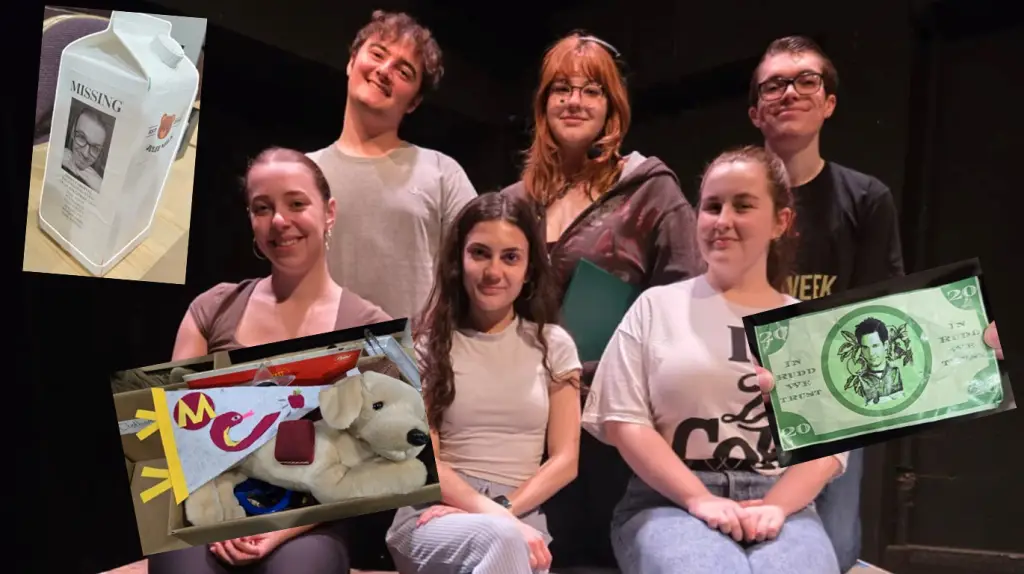
Then there was the props designer, Matt Manna. And, like Nicole, I think it is fair to say that Matt loves to geek out on props. For example, one of the props is supposed to be some cash that Adam pays Evelyn with, and the prop has a picture of Paul Rudd on it in a nod to the film version of this play [which none of the crew recommended watching.] Also, on the back of a milk carton prop used in one of the scenes, a “MISSING” photo of the play’s stage manager with some very funny details has been put on the prop. Not that either of these bits will come to the audience’s attention, yet each detail lends itself to the story of the show.
Matt’s favorite prop? “Optimus Prime,” he told me. “For the last scene, there’s a bunch of boxes with Adam’s old stuff in it [including the transformer Optimus Prime] because of the transformation that Evelyn put him through. I wanted to imply that she made him get rid of that because she’s evil. I’m a big Transformers fan. I have a tattoo.”
(At this point, Matt showed me his tattoo, which was stunning, so you can imagine how hard it was to ask my follow-up question: Who in the Sam Hill is Optimus Prime? Matt responded, “Optimus Prime is the leader of the Autobots within the transformers. He’s the main character. Okay, so to everyone reading the article right now, I think you should watch “Transformers One.” It’s an excellent film.”)
Between the conversations I had with the crew and watching the Q2Q rehearsal, I was struck by all that goes into making an excellent theatrical production. Evi Sevastakis, the assistant stage manager and only freshman in the group, put it best.
“This is my first time being on a production team. I’ve always been on stage, so taking a step back and seeing what theater is like from the other side of things has been very interesting,” Evi said. “How much that goes into it. Being an actor first, it’s very easy to get caught up in the glory of being the one the audience remembers the most, or so you think. But there’s so much more that goes into it.”
There is much more, and I got to get a glimpse into the passion these students bring to making the production successful. I learned much spending time with the crew about what goes into a production. Not to mention that I need to go watch “Transformers One” so I don’t embarrass myself again.
I look forward to watching the full production—seeing how seamlessly all this work comes together. Know as you watch the performance moving from one scene to the next that, like a swan gliding gracefully across the lake, underneath there is a whole crew paddling like hell.
You can watch “The Shape of Things,”written by Neil LaBute and directed by Stephanie Lynn, at the Hamblin Theater in the Fine Arts building on SUNY Oneonta’s campus March 26-28at 7:30 p.m. and on March 29 at 2 p.m. Tickets are $8.00 general admission, $3.00 with a SUNY Oneonta student ID, and are available online (oneonta.universitytickets.com) or at the Hunt Union Information Desk.
Next up: “Proof,” written by David Auburn, at Hartwick College’s Lab Theatre, April 15-18.
Rachel Frick Cardelle covers performing arts at SUNY Oneonta and Hartwick College.