Painted Screens Depict Baltimore’s Rowhouse Art, History
By SARAH ROBERTS
COOPERSTOWN
Elaine Eff began her career as a professional folklorist in Cooperstown at the Cooperstown Graduate Program. She learned how to conduct oral histories. She learned how to document communities. She learned how to dig out the hidden stories of the past. She saw 19th-century painted screens in the collection of the then New York State Historical Association and she compared them to the vibrant painted screens of her native Baltimore.
Eff’s study of painted screens began in 1975. She and the late screen artist Dee Herget founded the Painted Screen Society of Baltimore and, in 1988, a documentary film was produced about Baltimore’s screens, documenting the screens, the artists and bringing to national attention this little-known art form, unique to working class Baltimore neighborhoods.
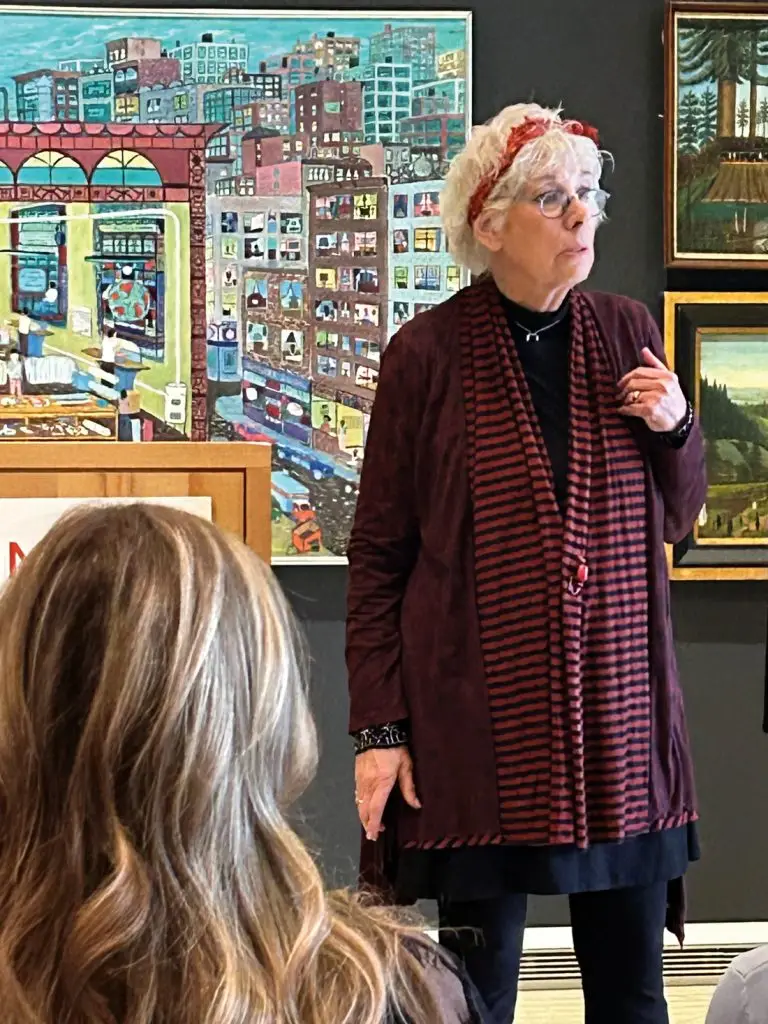
On Friday, April 11, Eff’s research came full circle when she donated three Baltimore screens to the Fenimore Art Museum as the current graduate students from CGP looked on.
“These screens and Elaine’s meticulous scholarship are so much in keeping with the origins of CGP, celebrating American folk culture and the traditions of ordinary people and everyday life. We are all very proud to see Elaine’s years of scholarship culminate in this donation to the Fenimore Art Museum,” said CGP Director Gretchen Sorin.
The donated painted screens show the work of three different master artists over 40-50 years. Eff said that she chose these pieces to show the evolution the art style has undergone, while still retaining its original purpose.
“This is a very practical art form,” she affirmed.
The first painted screens are believed to have originated in London, and some examples have been found at various locations throughout the United States, including in upstate New York. But, it is in Baltimore that the form came into its own. Baltimore’s sidewalks extend right up to the windows of its row houses, providing little privacy for the occupants. Painting the window screens protected privacy by permitting air and light to enter the houses, but keeping insects and peering eyes out. Painted screens are functional as well as beautiful artworks. The earliest Baltimore screens offered domestic scenes that included houses, usually a red-roofed bungalow surrounded by trees, white swans in a placid lake, and colorful flowers. As the number of artists grew, so too did the scenes that they painted.
“[At the time of the formation of the Painted Screen Society], dozens of artists were still active, but worked independently, unaware that each was a part of a community of traditional artists,” according to the Painted Screen Society of Baltimore’s website.
“Over the years the popularity of painted screens ebbed and flowed. First the world wars dealt a blow, then air conditioners, then changing demographics and changing definitions of modernity. Today renovation, replacement windows and the rising costs of custom artwork add to the toll. At the same time, a revolution in crafting and entrepreneurship has found an eager audience of artists and admirers to take the art form into the 21st century as its popularity spreads far beyond Baltimore,” the website reads.
The Painted Screen Society’s mission is to “preserve screen painting and rowhouse arts throughout Baltimore’s neighborhoods” and is responsible for countless works of this type of folk art being in numerous museums and organizations—now including the Fenimore Art Museum.
The specific pieces to join the Fenimore Art Museum’s collection were selected by Fenimore Art Museum and Fenimore Farm and Country Village President and Chief Executive Officer Paul D’Ambrosio and Eff.
“I said, ‘Paul, tell me what you like and what works with your collection,’” Eff explained. “He picked a bunch and, of the ones he picked, I chose the ones that told the most varied story and covered the biggest timeframe.”
Eff added that of the hundred or so pieces being offered to a number of institutions, Fenimore Art Museum got the first pick.
“I wanted them to have something that said ‘Baltimore,’” she said.
“We are deeply honored to accept this collection of painted window screens—iconic symbols of Baltimore’s rowhouse culture and vibrant community creativity—gifted to us by Elaine Eff, a pioneering folklorist and tireless advocate for this unique art form,” said D’Ambrosio.
“This gift is especially meaningful because it is the culmination of Elaine’s graduate thesis, written here at the Cooperstown Graduate Program,” D’Ambrosio continued. “That early research was sparked by none other than the historical painted screens housed in the Fenimore’s own collection—a moment of discovery that lit a spark and grew into a lifelong mission.”
“It was a thrill of a lifetime to see it come full circle, a project that started in Cooperstown 50 years ago…It was one of those moments you see your life working toward come together,” Eff said. “It was a very exciting moment to see the painted screens look so at home.”
“That Elaine’s life’s work has resulted in today’s gift to the Fenimore Art Museum ensures that future generations will have the opportunity to discover this incredible art form,” Sorin said.
Cooperstown Graduate Program Director Gretchen Sorin contributed to this article.