Posthumous Reinstatement Resurrects Rose’s HoF Candidacy
By CHARLIE VASCELLARO
COOPERSTOWN
Even in death, controversy still swirls around Major League Baseball’s all-time hit king, Pete Rose. On May 13, the office of Major League Baseball announced that Rose and other deceased players, including Shoeless Joe Jackson and seven of his teammates on the infamous 1919 Chicago “Black Sox” team, had been removed from its permanently ineligible list.
The Hall of Fame responded to MLB’s announcement with a statement from Chairman of the Board Jane Forbes Clark on Tuesday, May 13 acknowledging that the “Hall of Fame has always maintained that anyone removed from baseball’s permanently ineligible list will become eligible for Hall of Fame consideration.”
The candidacy of Rose, Jackson and the others will be considered by the Hall of Fame’s Historical Overview Committee, which has been tasked with compiling the eight names to be included on the Classic Baseball Era Committee ballot. The committee votes on candidates who made their most significant contributions to the game before 1980 and meets again in December of 2027.
The campaigning, lobbying and debate on Rose’s candidacy will continue for at least two years.
MLB thought it had closed the book on Pete Rose when he was permanently banned from the game in 1989 for breaking Rule 21, prohibiting players and managers from betting on games.
Rose signed an agreement with the Commissioner of Baseball, A. Bartlett Giamatti, placing him on the ineligible list. At a press conference on August 24, 1989, Giamatti made the following statement:
“The banishment for life of Pete Rose from baseball is the sad end of a sorry episode. One of the game’s greatest players has engaged in a variety of acts which have stained the game, and he must now live with the consequences of those acts… The matter of Mr. Rose is now closed. It will be debated and discussed. Let no one think that it did not hurt baseball. That hurt will pass, however, as the great glory of the game asserts itself and a resilient institution goes forward. Let it also be clear that no individual is superior to the game.”
Over the ensuing decades, Rose made several attempts at applying for reinstatement, appealing to Commissioners Fay Vincent, Bud Selig and current Commissioner Rob Manfred, who denied Rose’s two previous applications in 2015 and 2022, but three weeks after meeting with President Trump at the White House on April 17, Manfred lifted the ban and reinstated Rose.
On February 28, six weeks prior to meeting with Manfred, Trump issued a statement saying that he would soon be “pardoning” Rose for his past federal tax crimes and criticized MLB for Rose’s absence from the Hall of Fame.
Manfred’s decision was announced in a letter to the Rose family’s attorney, Jeffrey Lenkov:
“A determination must be made regarding how the phrase ‘permanently ineligible’ should be interpreted in light of the purposes and policies behind Rule 21, which are to: (1) protect the game from individuals who pose a risk to the integrity of the sport by prohibiting the participation of such individuals; and (2) create a deterrent effect that reduces the likelihood of future violations by others. In my view, once an individual has passed away, the purposes of Rule 21 have been served. Obviously, a person no longer with us cannot represent a threat to the integrity of the game. Moreover, it is hard to conceive of a penalty that has more deterrent effect than one that lasts a lifetime with no reprieve. Therefore, I have concluded that permanent ineligibility ends upon the passing of the disciplined individual, and Mr. Rose will be removed from the permanently ineligible list.”
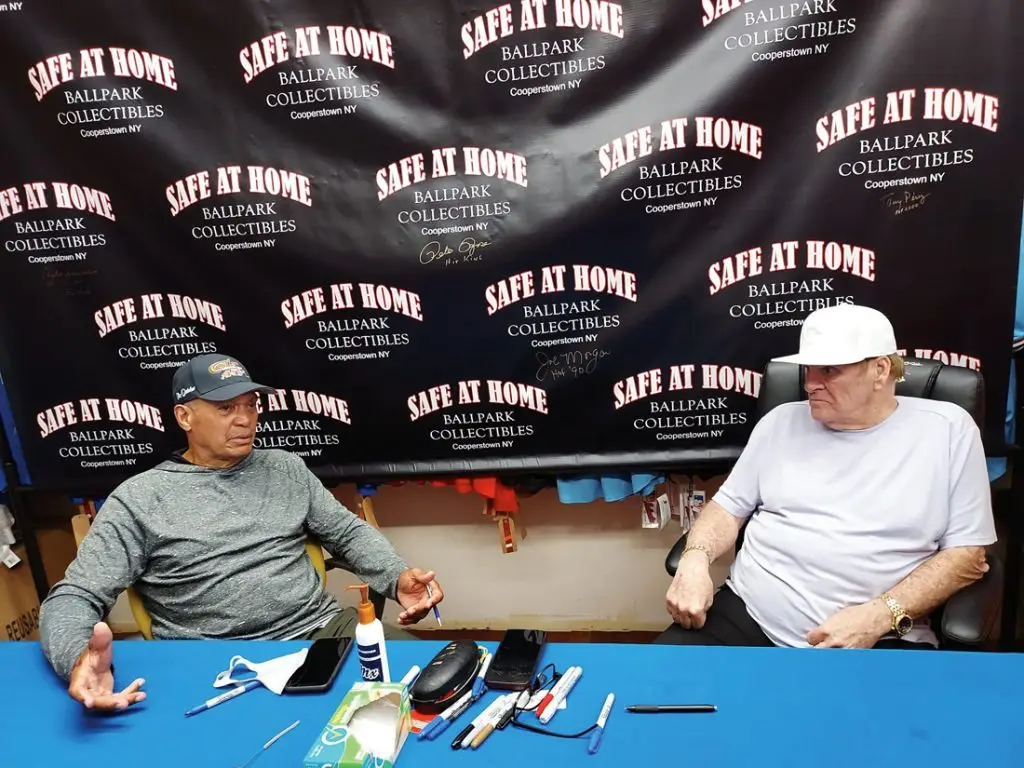
While remaining in exile from Major League Baseball fields and venues for more than 30 years, Pete Rose maintained an enduring presence on Main Street in Cooperstown during the Hall of Fame’s Induction Weekends.
Year after year, fans could find Rose signing autographs, posing for pictures and chatting with his loyal fans in the back of proprietor Andrew Vilacky’s Safe at Home Ballpark Collectibles on Main Street. The shop was known as Pete Rose Ballpark Collectibles from 2001-2005.
Regarding Manfred’s statement, Vilacky said, “Pete was never a threat to baseball. He only spoke positively about the game. He knew and loved the game. He was a genius when it came to baseball. He was a savant…It was baseball’s loss when he was missing from the game.”
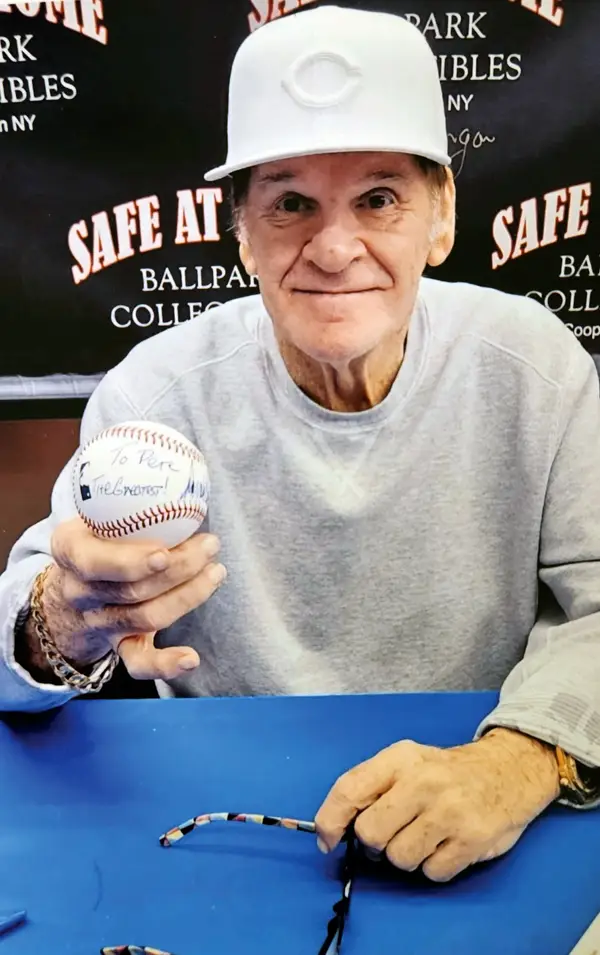
Rose began making regular appearances at the local memorabilia shop during Induction Weekend of 1996, and continued to show up and make his presence known through last year’s ceremony, two months before died at the age of 83 on September 30, 2024.
While Rose was barred from attending Induction Weekend events and activities at the Hall of Fame, The Otesaga Resort Hotel and other official venues, his former Cincinnati “Big Red Machine” teammates, rivals, and members of the Hall of Fame would often stop to visit and say hello.
On many occasions, Rose would share an autograph table at the Safe at Home shop with such luminaries as Reggie Jackson, Tony Perez and Mike Schmidt.
Vilacky remembers, “We had a lot of fun. I don’t know and I can’t tell you what he might have been thinking, but maybe, in the back of his mind, he was showing up so that everyone would see him, and that his situation might be reconsidered.”
“He liked to sit on the bench out in front of the shop after dinner and talk with the fans and let them take pictures,” Vilacky added.
Former teammates, adversaries, fans, and writers are as divided in their opinions on Rose as they are on politics and Trump.
Longtime baseball beat reporter and current columnist for Sportico.com, Barry Bloom, said, “I’m absolutely in favor of it. When Pete died, the first thing I said is that they should reinstate him. He’s dead now, there’s no purpose in having him excluded from MLB anymore.”
“Knowing full well how the Hall of Fame works, by reinstating him in Major League Baseball it would force their hand to vote on him, which is exactly what happened,” Bloom added.
“New York Post” columnist Joel Sherman posted a five-minute video of his analysis of the situation, saying, “The only reason there’s a Commissioner’s Office to make this decision today is because the Commissioner’s Office was created in the aftermath of the 1919 Chicago White Sox scandal… so the Commissioner’s Office was formed and Rule 21 was created. It’s posted in every clubhouse in minor league and Major League Baseball. It’s about not being able to gamble in baseball if you’re a player, coach or manager. Pete Rose played in more Major League Baseball games than anyone else,” said Sherman…” And I don’t know what the right thing to do is because I do think that gambling on the game if you’re involved in the game should be a third rail banishment and forever punishment. But our relationship with gambling and with time healing all wounds has changed over the years, but I think the answer for the committee is that Pete Rose is going to be in the Hall of Fame.
Here in Cooperstown, Rose’s friend Vilacky says the decision to reinstate Rose came a little too late.
He didn’t want to be inducted after he was dead and not here to give a speech. How do you have a celebration without the celebrant?”