
STRIP!
Our Clothes Are Killing Us,
Professor, Student Believe
By JENNIFER HILL • Hometown Oneonta & The Freeman’s Journal
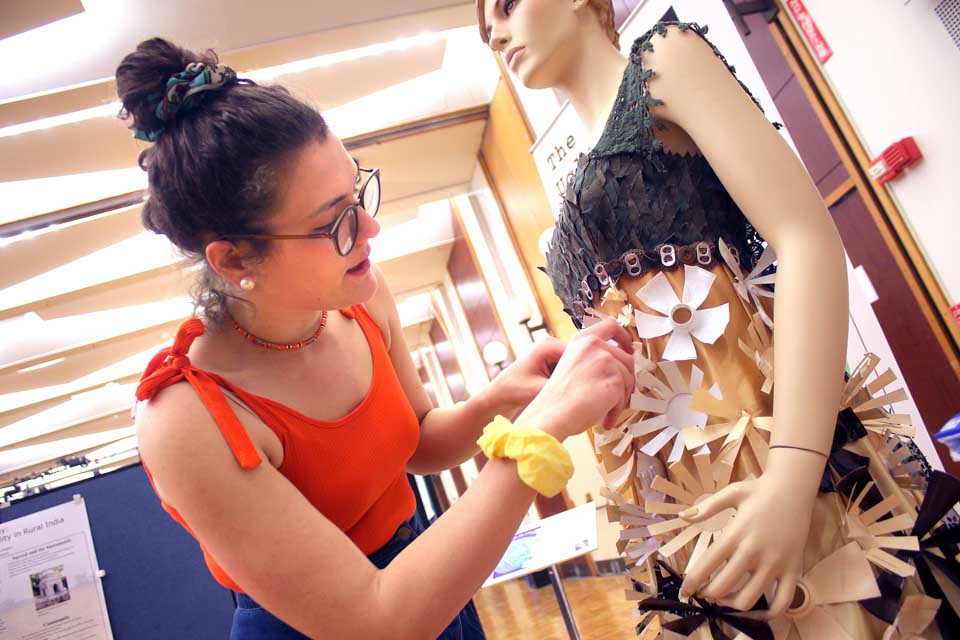
ONEONTA – You might think the mannequin dressed in colorful plastic flowers on the main floor of SUNY Oneonta’s Hunt Student Union is there to advertise cute clothes.
Two posters flanking the mannequin indicate the opposite. The one on the left says, “The Ugly Truths About 80 Billion Garments Produced Annually.” On the right, “What Can We Do?”
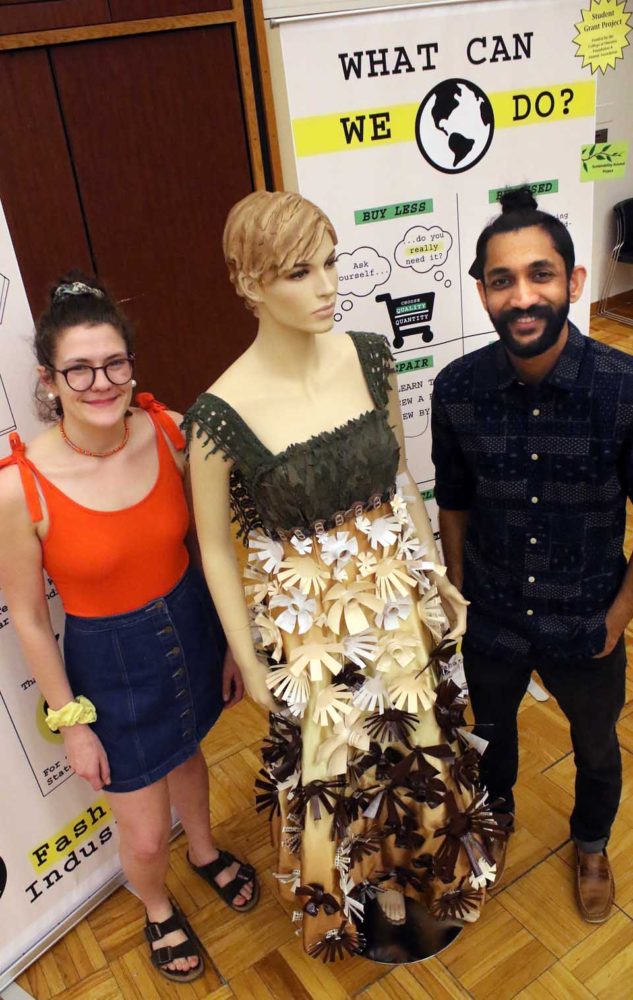
SUNY Oneonta Human Ecology professor Bharath Ramkumar and junior Devin Meaney created the exhibit to tell the bad news about the fashion industry – that it is one of the worst polluters of the environment; and the good news – if we change our habits of using and disposing of textiles, we can reduce its harsh impact.
A second exhibit, in SUNY’s Milne Library, is a mannequin wearing a T-shirt that tells passersby how harmful producing one cotton T-shirt is.
“Cotton is highly water-intensive in making clothes,” Meaney said. “It takes 713 gallons of fresh water, our drinking water, to produce one T-shirt. And you can’t use altered or dyed water.”
“Only .4 percent of fresh water is available for drinking and bathing,” she added. “It is a scarce resource.”
Ramkumar and Meaney created the exhibits because they believe once people know fashion industry’s harmful effects on the environment and people’s health, and what to do about it, they’ll change.
“It’s not that people don’t care, they just don’t know,” Ramkumar said, and Meaney concurred.
Ramkumar didn’t know the full extent of the harm production, consumption and disposal of textiles had on the earth and on people’s health until he began teaching a Quality Analysis of Apparel class at SUNY two years ago as a newly hired faculty member.
“In the class, we focus on the process of making a textile product,” he said. “And that’s when I learned about the negative effects the process, from start to finish, has on the environment and humans.”
“I was just appalled,” he said.
He decided to seek out more sustainable ways to create textiles. Last summer, he went to Northeast India where an indigenous tribe, the Nongthlu, use locally grown plants and centuries-old sustainable practices in cultivating silk.
“My goal was to understand their work and its sustainability,” Ramkumar said, who will publish his findings in the coming months.
For one, Nongthlus do it humanely, feeding the silk worms locally grown tapioca leaves, so they grow big and then spin their cocoons. They allow the worms to metamorphosize into butterflies, then collect their discarded cocoons after the butterflies emerge and fly away.
Mass manufacturers, on the other hand, feed the silkworms mass-produced mulberries and boil the cocoons with the worms still in them to extract the silk, killing the worms in the process.
The Nongthlu also use local plants, such as turmeric, to dye the silk while mass manufacturers use chemicals. The Nongthlu spin the silk into thread and make cloth with their hands, not machines.
Ramkumar’s research and discussions in his Quality Analysis class inspired Devin Meaney to study textiles and environmental sustainability. She is passionate about educating people to stop buying new clothes; instead, they should repair and reuse what they have.
One of the biggest textile culprits is polyester.
“It’s the McDonald’s of the fashion industry,” Ramkumar said. “It’s easy, fast, and very cheap to mass produce. You can mold it into almost whatever you want. And we consume a lot of it.”
But the chemicals in the plastics, he said, can affect people’s neurological ability and fertility and can lead to birth defects.
Other “Ugly Truths” on the poster: Shoes can take 1,000 years to decompose. Only 30 percent of textile waste is recycled. American citizens are throwing out an average of 82 pounds per year, which results in 25 billion pounds of textiles waste per year in landfills.
The two agreed there is no ideal textile, although Meaney thinks hemp comes close.
“It doesn’t take so much water to grow. It’s like linen. So although it’s not as breathable as cotton, it’s still pleasant to wear,” she said. “Now that it’s legal to grow hemp in New York, we will be able to learn more about it.”
She plans to research hemp’s impact on the environment. But whether she finds hemp more environmentally friendly or not, Americans can and should change their fashion consumption.
As the “What Can You Do?” poster recommends:
1) Buy less high-quality or used clothing
2) Repair or repurpose what you have instead of buying new.
3) Recycle, but if you aren’t sure whether your garment is recyclable, throw it away
4) Donate your clothing to organizations like Salvation Army.