

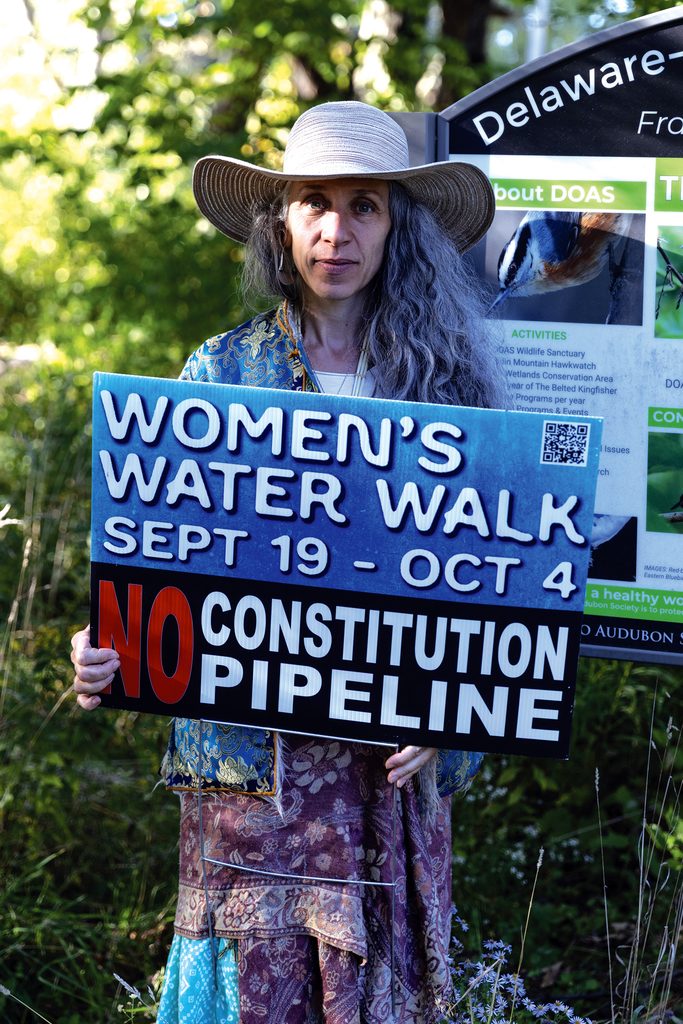
Water Walk Puts Pipeline Concerns Front and Center
By LUCAS BERG
SUNY Institute for Local News
ONEONTA
While songs and prayers filled the Delaware-Otsego Audubon Society bird sanctuary on the afternoon of Thursday, September 24, participants in the Women’s Water Walk brought a renewed environmental fight directly to a community that could feel the consequences.
Oneonta was the sixth stop on a 108-mile walk following the proposed route of the Constitution Pipeline, a natural gas pipeline that would pass through Delaware County and other parts of New York’s Southern Tier and Catskills. For residents gathered at a potluck welcome event on September 24, the walkers’ arrival offered a reminder that a project rejected a decade ago is again under federal consideration.
Participants walked Thursday from a sanctuary in Franklin to the Audubon Society’s property outside Oneonta. They climbed Swart Hollow Road carrying signs, singing and stopping to recognize the waterways they say would be threatened by pipeline construction.
The two-week walk began September 19 at Oquaga Creek State Park and was scheduled to end October 4 at Lily Park in Schoharie. Along the way, participants planned to visit rivers, lakes, and streams, gather water, and hold community meals and discussions. Organizers said the collected water would later be brought to Albany as part of an appeal to state leaders.
Organizers described the journey as both an action against the pipeline and a prayer walk centered on water. Mary Beth McCarthy Yarrow, the mother of organizer Bethany Yarrow and a participant in the walk, said its tone was intentionally welcoming.
“It’s not a protest. It’s a coming together—a celebration in some way, of celebrating the water.”
That sense of celebration was visible as walkers approached the sanctuary with songs, prayers and hymns. Despite the physical demands of the journey, participants greeted supporters and shared food at the welcome event. Organizers said the walk was intended to build awareness before construction on the proposed pipeline could begin rather than respond after environmental harm occurred.
Bethany Yarrow, co-founder and acting director of the Waterfall Unity Alliance, helped organize the walk. The alliance formed in 2015 and joined a coalition of Indigenous leaders, local residents, and environmental organizations opposing the pipeline during its first review.
Yarrow said she began paying renewed attention to the project after hearing President Donald Trump say it could return.
“Trump was in the Oval Office and he said something like, ‘The Constitution Pipeline is coming back.’ Most people are like, ‘Oh, don’t worry, he’s just saying that.’ And I’m like, ‘I don’t think so.’ I was really listening and other people were, too. And it became very clear that the federal government was really pressuring the Williams Companies to restart the pipeline application and it was going to be a fight.”
The Constitution Pipeline was originally proposed as an approximately 124- to 125-mile interstate pipeline carrying natural gas from northeastern Pennsylvania through New York’s Broome, Chenango, Delaware and Schoharie counties. The project received federal approval in 2014, but the New York State Department of Environmental Conservation denied its required Clean Water Act water-quality certification in 2016. The state cited inadequate information about potential effects from stream crossings, erosion, sedimentation and other construction activities.
The project was not built, but Constitution Pipeline Co. petitioned the Federal Energy Regulatory Commission in December 2025 to reissue its federal certificate. FERC released a new environmental assessment in August and concluded that the project, with recommended mitigation measures, would not significantly affect the quality of the human environment. That assessment was part of the federal review and was not a final authorization.
The project would still require state permits before construction could proceed in New York. According to the state DEC, the company withdrew its most recent state water-quality certification application effective November 7, 2025.
Opponents argue that cutting a pipeline corridor through forests, wetlands, farms, and waterways could damage drinking-water sources, trout habitat, and other natural resources that support the region’s economy and quality of life. The pipeline company and supporters have argued that the project would increase access to natural gas, generate construction work, and contribute tax revenue.
Uma Lanzalata, a singer participating in the walk, said the group had encountered both encouragement and opposition.
“We’ve been getting a lot of love. There’s a lot of people who really care. And then we’ve also been met with a lot of ignorance. Just people saying not nice things to us. They’re not incredibly mean. But a lot of times people think that they’re saying nice things to us, and so it’s funny to hear the walkers hearing people saying something and imagining it to be good.”
Lanzalata said one of the walk’s central purposes was to help residents understand why a natural gas pipeline could also become a water issue. Construction along the proposed route would require numerous stream and wetland crossings, a concern that has made water protection a central theme of the revived opposition.
The event brought together Indigenous grandmothers, farmers, faith leaders, artists and other community members. Public figures including environmental advocate Karenna Gore, musician Dar Williams and actor Mark Ruffalo have also expressed support for the initiative.
Yarrow said the issue should not be understood solely through partisan politics. She encouraged residents who could not join the walk to contact elected officials, sign petitions, contribute to organizing costs and speak with their neighbors.
“You can write your officials and say you care. All of them, they really need to hear; they count the phone calls, they count the letters. It’s important that the Republican folks know that they’re constituents. I’ve seen a lot of Republican [homes] with Stop the Pipeline signs. It’s not just a right-left issue, and it should not be. And so for people to have the courage to do that and say ‘no’ on behalf of the land, we all stand in this way.”
Yarrow added, “It’s really important. And it’s important because what they’re saying is that, oh, ‘These communities don’t care. They want these pipelines.’”
For Yarrow, the walk was also an invitation for communities along the route to consider what they want to preserve and build together.
“What kind of communities do we want to live in?” Yarrow asked. “How can we better protect, you know, this and all the things that give us life? There are some people who feel differently and that’s their path. But I think most of us don’t want to destroy life.”
The walk concluded in Schoharie on October 4, with closing ceremonies at Lily Park. For residents around Oneonta, however, the September 24 gathering made clear that the debate is not only about a line on a pipeline map. It is also about the streams, forests, farms and neighboring communities that define the region as home.
This story was created by student reporters through the OnNY Community Media Lab, a program of SUNY Oneonta and the SUNY Institute for Local News.

Very informative and well-written coverage on this important issue. Thank you, Allotsego. With so much of our national heritage and so many of our founding principles being trashed and debased by this vile administration, I’m am grateful to these people for taking a stand and publicizing the threats of this stupid pipeline.