
Citizen Science #34 by Tammy Awtry
The Tale the Heart Tells
And then there were three.
Hi, I’m Tammy, the final member of your new “Citizen Science” team. I’m here to transport you from Trisha’s Tour of the Universe to something closer to home: your heart.
During an average lifetime, the human heart will beat around 3 billion times. Each beat pumps blood throughout the body, delivering oxygen and nutrients and removing waste and carbon dioxide. The functioning of our hearts is so important that at almost every healthcare visit, a medical professional will measure our blood pressure, listen to our heart, or check our pulse. While these indicate how well the heart itself is working, there is another value that tells the story of how an entirely different part of our body is faring. For this value, we shift our focus from the heartbeats themselves to the spaces between.
Heart rate variability, or HRV, is the difference in time between heartbeats. Although we might assume our hearts beat steadily like a metronome, they don’t. The subtle “chaos” in timing gives us clues as to how well our autonomic nervous system is working.
Breaking Down the ANS
The ANS (autonomic nervous system) controls the automatic functions of our bodies, like breathing and our heart beating. It is always working, even when we’re sleeping.
There are two parts to the ANS: the sympathetic and parasympathetic nervous systems.
The sympathetic system is responsible for our fight-or-flight response. When we are stressed or in danger, it acts as a gas pedal. Adrenaline is released into the bloodstream, and our heart rate and breathing increase to deliver more oxygen to our brains and muscles, keeping us alert and ready to respond.
On the other hand, the parasympathetic system acts like the brakes, shifting the body into a rest-and-digest mode. Heart rate and breathing slow. Bodily functions, such as digestion, that stopped while the sympathetic system was in charge, resume. Everything downshifts.
Each heartbeat is affected by the balance between the two systems, making HRV a good indicator of ANS responsiveness and how well our bodies balance stress and rest.
The calming parasympathetic system slows heart rate, stretching the time between each beat. This allows for more variability between beats and results in a higher HRV.
The sympathetic system revs up the heart rate, making the beats come faster and closer together. This decreases HRV.
Higher HRV is a sign that the body is nimble and ready to rapidly respond and adapt. Lower HRV may signal stress, fatigue, illness or that the body is struggling in other ways.
What Affects HRV?
A lot, actually.
Some things we can’t control, like age, sex and genetics.
But other things under our control can nudge our HRV higher. For instance:
Focused breathwork: Controlling our breath is one of the most powerful ways to calm our nervous system and increase HRV. This is done, in a large part, by stimulating the vagal nerves, which are the main nerves of the parasympathetic system. Through our breath, we give the parasympathetic system the reins. There are several different ways to practice focused breathwork. Here are a few:
- Make your exhale longer than your inhale.
- Practice steady, rhythmic breathing of five to six breaths/minute.
- Box breathing: Inhale four counts. Hold for four counts. Exhale four counts. Hold for four counts. (The counts can be increased or decreased; just keep them the same for the pattern.)
- Breathing with sound: Humming or making a sound like “Om” on the exhale deepens the calming effect of the breath.
Sleep: During sleep and periods of restfulness, the parasympathetic system is in charge.
Improving cardiovascular fitness: Keep in mind that overtraining or failing to allow adequate recovery time decreases HRV.
Hydration: Dehydration strains the heart and decreases HRV.
Measuring HRV
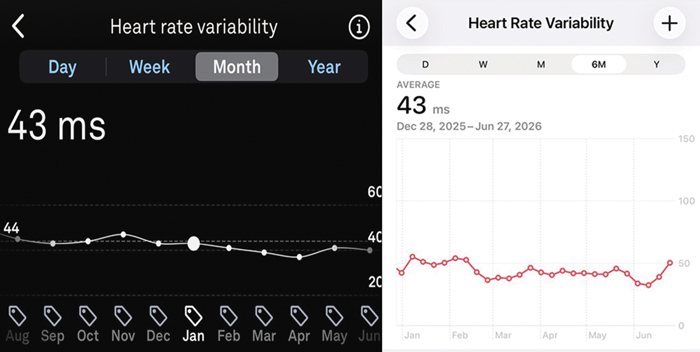
The easiest way to track HRV is with wearable devices like Apple or Garmin watches or the Oura Ring. Medical professionals can measure HRV using an electrocardiogram, but they rarely do. HRV is highly individualistic (values can range from 20 to 200 milliseconds) and changes based on factors like stress, sleep, illness, and exercise. A single reading is not an actionable number for doctors. A low HRV could simply mean medical visits are stressful or that you had a bad night’s sleep.
A more valuable measure is HRV trend over time. A gradual increase or decrease reveals how well your body is balancing stress and recovery, and if changes are needed to support your health.
Whether or not you choose to track HRV is a personal decision. Some people like to see how sleep, exercise or stress affects the body. Others don’t. Either way, the habits that improve HRV can help you feel better and calmer, whether you follow the numbers or not.
Tammy Awtry, PhD, is a science communicator and writer specializing in neuroscience, chemistry, and biology. She has loved science for as long as she can remember and enjoys letting curiosity guide her explorations of the world.