
Field Station a Regional Engine for Research, Education, Stewardship
By JOSHUA YOUNGQUIST
COOPERSTOWN
For more than half a century, SUNY Oneonta’s Biological Field Station has stood as one of the region’s most influential centers for freshwater research, applied environmental science and hands‑on learning. Situated on more than 1,000 acres of protected land and anchored on the shores of Otsego Lake, the BFS has grown into a hub where scientific discovery, community partnerships, and environmental stewardship converge. Its mission has remained remarkably consistent since its founding: to advance research, educate future scientists and serve community needs. Yet the work itself has evolved with changing environmental pressures, new scientific questions and the shifting needs of the region.
Professor Florian Reyda, director of the BFS, describes the organization as both an educational resource and a steward of Otsego Lake and surrounding waters. He said the BFS is widely recognized as an entity that collects scientific information vital to municipalities, conservation groups and watershed organizations. At the same time, it serves as a place where young people can be introduced to field sciences and begin nurturing a relationship with the natural world.
Through decades of pre‑college field trips and a robust internship program, students learn by doing—conducting fieldwork, analyzing samples, writing reports, and presenting findings to community groups. Many interns use the BFS as a springboard to successful careers, supported by a network of partners that includes the New York State Department of Environmental Conservation, SUNY Cobleskill, Cornell, and numerous regional environmental organizations.
Hands‑on learning is central to the BFS philosophy. Students participate in year‑round research, from water‑quality monitoring to ecological surveys, often contributing directly to ongoing projects that support community needs.
Reyda emphasized that students “go through the whole process from soup to nuts,” gaining experience that becomes foundational for graduate school and professional opportunities. Many discover new interests as they work alongside faculty, shifting from one research area to another as curiosity deepens. Reyda’s own research in fish parasitology has led students to help describe new species of fish parasites discovered in Otsego Lake and the Susquehanna River, evidence that even familiar waters hold scientific mysteries waiting to be uncovered.
While the BFS mission has remained steady, its priorities have shifted with environmental conditions. Harmful algal blooms now dominate much of the station’s applied research, with multiple scientists studying bloom dynamics, toxins and related lake parameters. In earlier decades, the focus centered on fish‑population issues, including the ecological impacts of alewife and the successful stocking of walleye to restore balance. Reyda said the needs vary with the times, and the BFS must remain adaptable.
BFS reach extends far beyond Otsego Lake. Through its Master’s in Lake Management program, graduate students conduct intensive studies on lakes across New York State, producing “state of the lake” reports used by local associations and municipalities. These reports provide actionable data for watershed management, conservation planning and environmental restoration. BFS staff also conduct long‑term monitoring on Canadarago Lake, Goodyear Lake and sections of the Susquehanna River. Annual technical reports—publicly available online—give communities access to data that would otherwise be difficult or costly to obtain. The station’s conservation impact is further strengthened by more than 1,000 acres of land protected through conservation easements.
Dr. Tracy Allen, dean of SUNY Oneonta’s School of Sciences, said the BFS represents “the very best of higher education,” combining rigorous science, experiential learning and public service. Students gain professional‑level experience operating field instruments, interpreting environmental data and producing lake‑assessment reports used by real clients. He emphasized that students leave not only with knowledge but with the confidence that comes from conducting authentic scientific work.
Allen’s own academic career has focused on freshwater systems, and he teaches an international field course in Guatemala built on the same experiential model. He said the BFS prepares future environmental leaders who understand both the science and the responsibility of stewardship.
Graduate student Rowan Mentley‑Peters echoed that sentiment, crediting BFS faculty and staff for fostering a community where “iron sharpens iron.”
Access to equipment, mentorship from faculty such as Dr. Alex Sotola and Lt. Col. Paul Lord, and opportunities to collaborate on ongoing projects have shaped his development as a young scientist. He said the BFS provides a place for students to find a sense of purpose, often inspiring them to volunteer on weekends and immerse themselves in research.
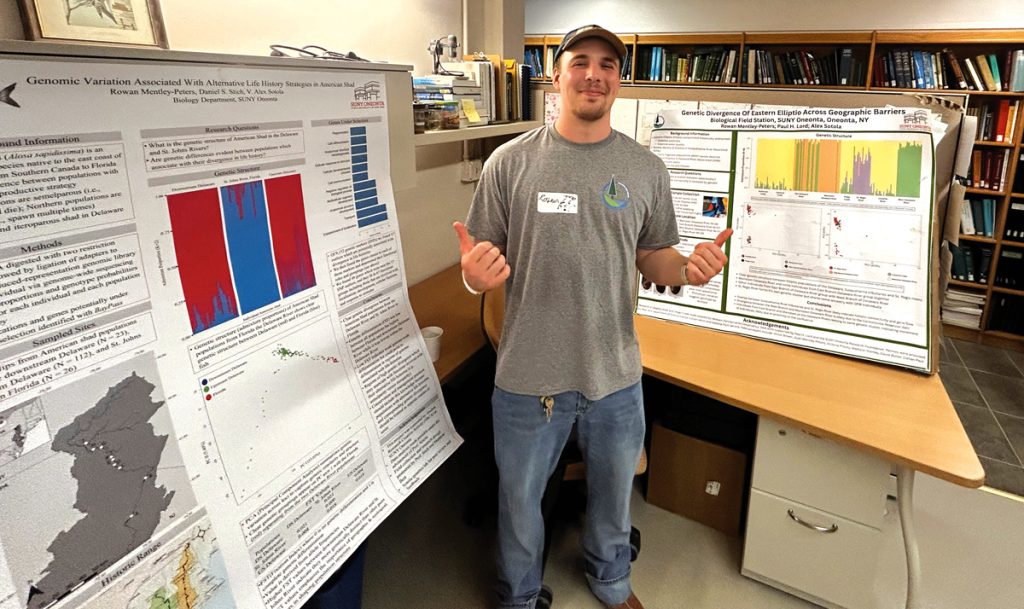
SUNY Oneonta instructors and staff hosted an open house on Thursday, July 30 which showcased the breadth of student research made possible by BFS resources, including a population genetics project led by Mentley-Peters, with coauthors Sotola and Lord. A junior population geneticist in the Sotola Evolutionary Genetics Lab, Mentley-Peters is investigating the genetic divergence of the eastern elliptio, a freshwater mussel whose once dense populations in the Susquehanna River Watershed have collapsed due to habitat disruption and the loss of their host fish, the American eel.
His team surveyed remnant mussel populations in the Unadilla River and Otego Creek, documenting isolated, aging individuals with no evidence of recruitment—a sign of long term reproductive failure. After extracting and analyzing DNA from mussels in both the Susquehanna and Delaware river watersheds, preliminary results suggest the two populations have begun to diverge genetically, underscoring the ecological risks of translocating mussels between watersheds and providing critical insight for future conservation planning.
The project was one of many on display—from underwater drone demonstrations to lake monitoring technology—that illustrated how BFS students use field access, equipment and faculty mentorship to tackle real environmental challenges.
Looking ahead, Reyda said he hopes to see greater participation from regional schools in the BFS field‑trip program, which includes lake excursions, woods walks and pond studies. With climate change, invasive species, and habitat loss affecting ecosystems across the region, he believes environmental education is more important than ever.
“The best place to start is with young people,” Reyda said, noting that early exposure to the natural world can foster lifelong commitments to conservation.
For SUNY Oneonta, the Biological Field Station remains a cornerstone of applied science, community partnership, and environmental stewardship—an institution where rigorous research and transformative student experiences continue to shape the future of freshwater science in Otsego County and beyond.