Frazier’s Rural Book Club Builds Conversation, Connection
By JOSHUA YOUNGQUIST
DELHI
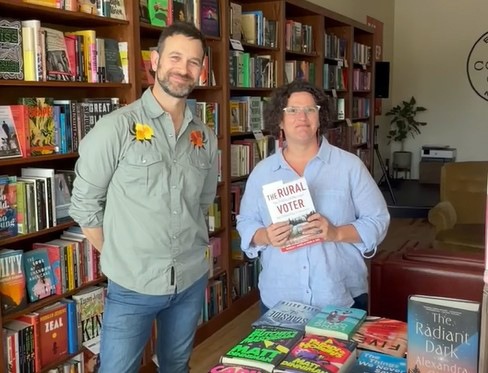
When Michele Frazier launched her Backroads Book Club this summer, she wasn’t trying to create a political forum or a campaign event. She was trying to create a space where rural residents could sit together, talk together and think together; a space rooted in curiosity rather than division. For Frazier, a longtime educator and former SUNY Delhi professor born and raised in Oneonta, the idea grew naturally out of her academic life and her lived experience in rural New York.
“This probably goes back to my academic world,” Frazier said. “I was a professor for 15 years at SUNY Delhi, and for me, these kinds of conversations are important.” The book club began with a question someone asked her early on: “Do rural people read?” The implication struck her.
“That’s the misconception around rural communities,” she said. “We actually are very thoughtful.”
Frazier, a Democrat running for New York State’s 51st Senate District seat, said she often hears people ask how rural communities arrived at this moment politically, socially and economically.
“I wanted to answer that question for myself and for others,” she said.
She began searching for books that explored rural identity and found “The Rural Voter: The Politics of Place and the Disuniting of America,” by Nicholas F. Jacobs and Daniel M. Shea. Shea is an Oneonta High School graduate.
“This is a book that’s about us,” she said. “It doesn’t talk down to rural communities. It assumes that we are thinkers, people who are questioning, who are asking, who are seeking out answers.”
Her goal, she said, is to bridge her academic background with the questions she hears on the campaign trail—“I’m kind of trying to bring together the learner in me, the professor in me and the questions I’ve gotten along the way.”
Frazier believes rural communities are often misunderstood or undervalued.
“I think we have looked down upon rural people,” she said. “It’s been my personal experience, and it’s been the experience of so many people I talk to.”
She said people often react with surprise when they hear about her academic background.
“They’re not actually asking me a question,” she said. “They’re saying something about rural communities.”
Frazier’s Backroads Book Club aims to counter that narrative by creating a space where people can talk with one another, not at one another.
“Talking with means listening to understand, not listening to respond,” she said. “It’s conversation, not speeches.”
Frazier said her rural upbringing shapes how she approaches these conversations.
“I get it,” she said. “I’m driving an hour for my kid to get his medical appointments. I’m helping my mom navigate Medicare changes. We have one choice for Medicare here in Otsego County. That’s different than an urban community.”
Those differences, she said, matter. “Policies have to be different than theirs. Public education doesn’t look the same in urban communities as it does in rural communities.”
She said the book club’s openness, welcoming people from any background or political perspective, is one of its strengths.
“When you have those perspectives come together, more understanding happens,” she said. “We can argue the argument, not the person.”
Frazier said she sees the book club as part of a broader effort to strengthen rural communities by fostering connection.
“I grew up working at my family’s business,” she said. “You learn that you’re talking with people, not at them.” Rural communities, she added, have a deep tradition of showing up for one another. “That is a rural value,” she said. “We take care of each other. We show up.”
Throughout the summer, Frazier has been asking residents what they love about their communities and what they worry might not be here for the next generation.
“The themes are around food, water, trees, farming—the essentials we need,” she said. “New York has been the bread basket. There’s a good chance we’re heading back toward being the bread basket. We have the basic resources required for success: water, land and know‑how.”
Frazier said community itself is another theme she hears repeatedly.
“These communities are serving each other,” she said. “They’re resilient, and they’re concerned that that won’t be there for the next generation.”
Healthcare and education also come up frequently.
“We’re at a serious, critical moment,” Frazier said. “In Sullivan County, they don’t have an OBGYN. I hear story after story of people who didn’t get care and then died of cancer because they didn’t catch it. Or people who have to ride a bus for two hours to get to an appointment.” Housing shortages, she added, make it harder to recruit doctors and teachers. “It’s the whole piece of this together that’s really important.”
As summer winds down, Frazier hopes the book club leaves participants with a deeper appreciation for rural communities.
“I hope it’s a better understanding of rural people and a better vision of them,” she said. “We have some really great things. Maybe our approach should not be to talk down, but talk with.”
Frazier said she would love to continue the program next year.
“It would be so much fun,” she said. “I think it’s a great thing for our community. As a legislator, my goal is to be very accessible, and this is one of the ways to make that happen.”
For now, she’s grateful for the conversations already underway.
“Even if you skim the book,” she said with a laugh, “you still have something. You have a conversation starter. And that’s where the conversation happens.”
Those interested in learning more about the Backroads Book Club can do so at https://www.michelefrazier.com/backroadsbookclub.