
Watershed Committee Reviews Ongoing Wakeboard Boat Concerns, Septic Progress
By JOSHUA YOUNGQUIST
COOPERSTOWN
The Otsego Watershed Supervisory Committee moved through a wide-ranging agenda last week, addressing renewed concerns over wakeboard boat activity, steady progress on septic inspections, ongoing confusion surrounding the Willow Brook dredging project, and questions about the manner in which harmful algal bloom alerts should be shared with the public. The meeting on July 15 underscored how several long-running issues continue to evolve, often in ways that complicate earlier assumptions.
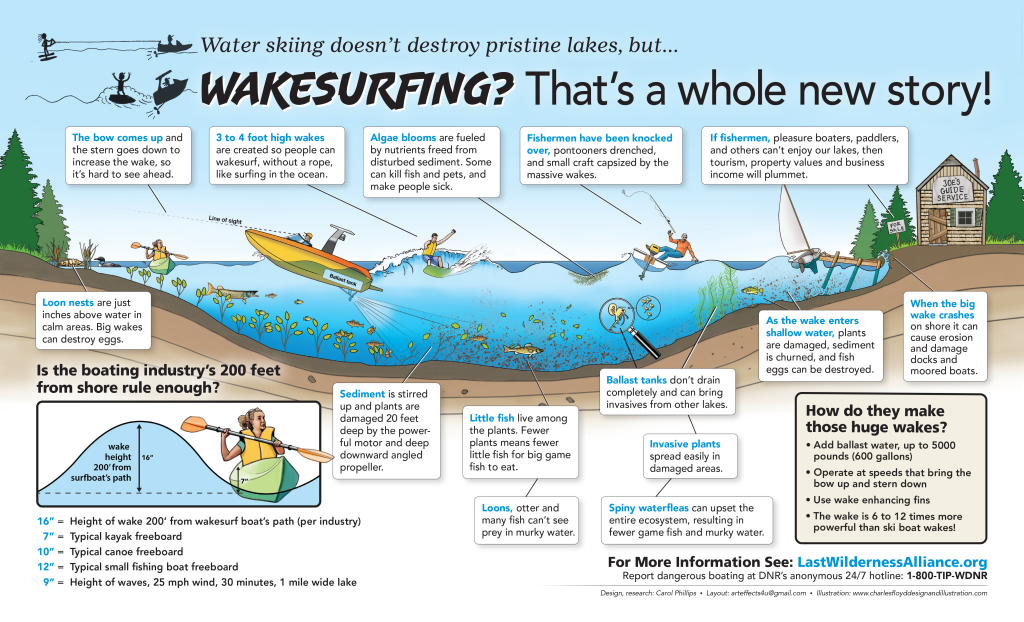
Wakeboard boat activity dominated early discussion, with committee members noting that misinformation continues to circulate on social media. To counter that, Village of Cooperstown staff plan to distribute a verified graphic and explanation through both social media channels and the “Village Voices” newsletter.
The most striking update came from committee member Paul Lord, who described two recent incidents he observed in which wakeboard boats generated unexpectedly large waves despite appearing to operate well beyond the proposed 1,500 foot buffer.
Lord said that on two occasions last week, waves “came barreling in and took our [SUNY Oneonta Biological Field Station] boathouse docks and rocked them up and down.” During the second incident, he said, a wave lifted a 22 foot pontoon boat and shoved one pontoon up onto the dock before it rolled back.
Lord emphasized that the boat responsible was “well outside 1,500 feet,” running between Sunken Island and Peggs Point—an area previously considered a safer mid lake zone for wake activity. Committee members agreed that these incidents complicate earlier assumptions about where wakeboard boats might be safely accommodated. Springfield’s proposed wake zone regulation, which had been expected to come up for a vote this week, was also reported to be on hold.
From wake activity, the committee shifted to septic system inspections, which accounted for a significant portion of the meeting. Fifteen properties were reviewed, and no major issues were reported. Watershed Coordinator Jacob Gillette, who led the inspections, reported there were “no substantial issues with anybody on this list.” Several systems were pumped during inspection, while others showed minimal buildup or low seasonal usage. A few lids or components will need replacement in future years, but nothing was deemed urgent, according to Gillette.
Gillette also presented an update on a new enhanced treatment unit system with phosphorus removal currently being installed at the McAuliffe residence. He explained that the system uses electrically charged plates to remove phosphorus and that a well used home would likely need those plates replaced annually, while seasonal homes may require less frequent maintenance.
Committee members discussed how ETU and aerobic treatment unit systems should be monitored going forward. Annual inspections by certified technicians are required, and homeowners must maintain a three year service contract. Members debated whether technician documentation could replace physical site visits in some cases, particularly for systems that consistently show stable performance.
The meeting then turned to the Willow Brook dredging and sediment removal effort, a topic that has lingered for months without clear direction. OWSC Chair Dr. Bertine McKenna voiced uncertainty, saying, “I remain confused about Willow Brook. Concerned and confused. I don’t know what the next steps are.”
Willow Brook is a small but important tributary originating near Moe Pond, northwest of the Village of Cooperstown. It feeds into Otsego Lake, carrying runoff, nutrients and sediment from the surrounding watershed. In recent years, the brook’s pond/impoundment area has accumulated a significant amount of sediment. This prompted discussions about whether dredging or sediment removal would be best to restore proper flow and reduce nutrient loading. Willow Brook is consistently identified as a high-phosphorus tributary, making it a focus for long-term, lake health management.
Committee members said they are waiting for a Request for Proposals that fits the project, though such RFPs are rare for dredging work of this type. Funding remains a significant challenge. OWSC member Christos Galanopoulos, Otsego County Soil and Water Conservation District manager, noted that the project does not meet typical state grant criteria such as aquatic connectivity or floodplain restoration.
“It’d be a very hard ask to find funding to remove those sediment materials because we’re not improving aquatic connectivity…we’re not doing any of those things,” Galanopoulos said.
Without a clear funding pathway, those present acknowledged that Willow Brook may remain stalled until a suitable RFP or alternative funding source emerges.
The meeting closed with a discussion on HAB alerts and how they are shared with the community. Currently, notifications go to the watershed e-mail list, but members questioned whether they should also be sent to the Otsego County Conservation Association’s broader distribution list to ensure wider reach.
Committee members stated that they would check with OCCA staff about whether emergency notifications could be added to their system. It was also announced that OCCA Program Director Jeff O’Handley has been appointed as that organization’s interim executive director.
It was agreed that broader communication could help ensure that residents—and their pets—are aware of HAB risks, especially during peak summer recreation months. Several noted that HAB alerts often reach only those already engaged with watershed updates, leaving many lake users unaware of potential hazards.
As the meeting concluded, committee members acknowledged that while progress continues on septic inspections and HAB communication, wakeboard boat impacts and the Willow Brook dredging project remain unresolved. Both issues are expected to return to the agenda in the coming weeks as new information becomes available.
The OWSC meets next on Wednesday, August 5. Meetings can be viewed in their entirety at https://www.youtube.com/@villageofcooperstown7215/streams.