
Invasive Species: Pesky Plants by Chris Kjolhede
Inconspicuous, but Not Innocent: Garlic Mustard
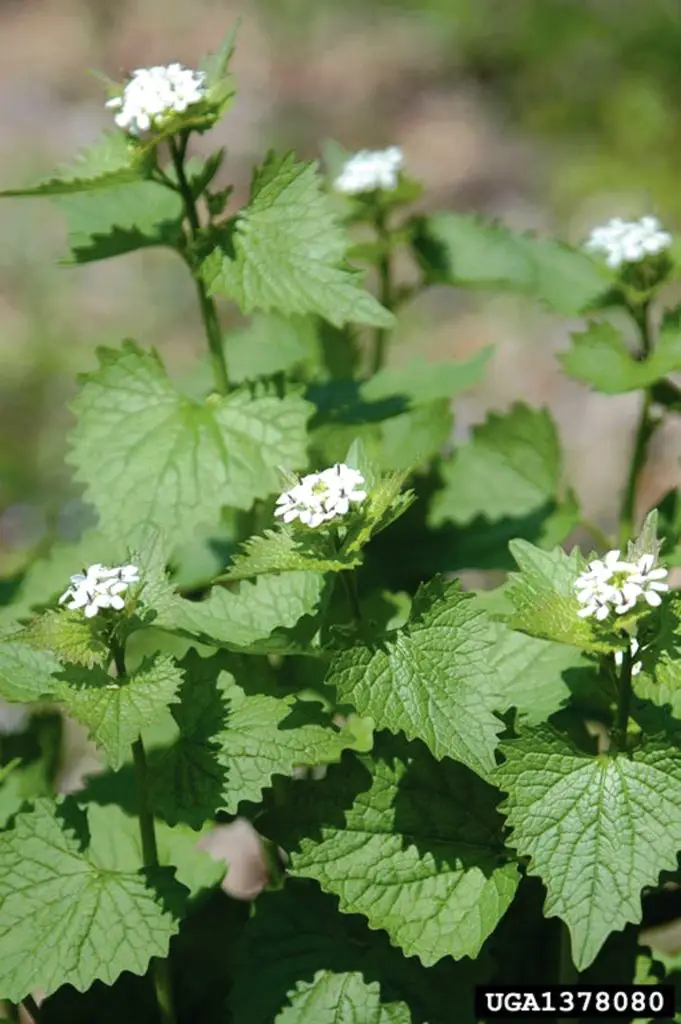
Garlic mustard (Alliaria petiolata) is a biennial plant in the mustard family that blooms in May and June in upstate New York. The first year this plant emerges with low, rounded leaves close to the ground. The second year it has more triangular leaves and sends up a 2-3 foot main stem. Each stem ends with clusters of small, white flowers of four petals. One plant can produce 7,000 seeds. In our area, it typically grows in disturbed, moist soil. It is shade tolerant and is often seen on roadsides and at the edges of forests.
Garlic mustard gets its name from the faint smell of garlic when the leaves are crushed. It is foraged for use as food and as medicine. It contains both vitamins A and C. It is edible and nutritious when young, when the leaves are often used in salads. One should use caution with older leaves, cooking them thoroughly due to a mild toxicity. The leaves have some medicinal properties and have been used as a diuretic, an antiseptic and are reported to stop the itch of insect bites. (Based on personal experience, this may not hold up for the bite of a black fly).
During the mid-1800s, garlic mustard was introduced to North America as an herb with dietary and medicinal uses. This plant originated in Europe and Asia. It has spread in North America from the Northeast to the Midwest and beyond. This particular invasive species emerges in the spring earlier than most native plants, thus outcompeting them for sunlight, moisture and soil nutrients. Additionally, the roots release chemicals that change the soil environment, especially for some fungi that are important for a healthy forest ecosystem. And as noted above, each plant can produce thousands of seeds that increases garlic mustard’s assault on the native environment.
Getting rid of garlic mustard can be a challenge. The single best way to control this invasive species is to physically pull the tall, second-year plants when the ground is moist in the spring and before the flowers go to seed. This process needs to be repeated every spring for several years to stop the spread of garlic mustard. Do not compost plants, as they can still release their seeds. It is best to bag them.
Garlic mustard in our area is an example of a classic invasive plant. It was likely introduced from Europe in the 1800s. It is not known as part of the diet for any native animal. It emerges early in the spring and successfully competes with native plants. And finally, one plant produces thousands of seeds which we know from a biblical context can have a huge impact. And in this case, a bad impact!
Chris Kjolhede, MD, MPH, is an emeritus pediatrician at Bassett Healthcare Network.