

Advertisement. Advertise with us

Invasive Species, Pesky Plants by Chris Kjolhede

Velcro: Inspired by the Common Burdock
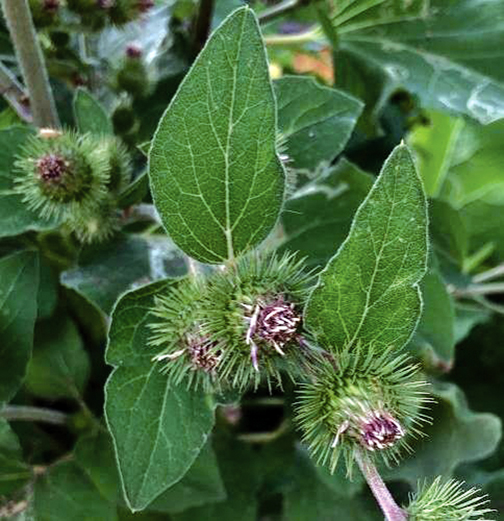
Burdock has some positive uses. Its roots have been used in herbal preparations as a diuretic and for some skin problems. Some East Asian cuisines use the tap root in food preparation. (Photo courtesy of the National Gardening Association)

As one of four brothers within five years of age, we all knew about burdock. Most importantly, we knew how to gather the burrs into baseball-sized clumps and hurl them at each other. These missiles were pretty harmless but clung to sweatshirts, sweaters and long hair. I suspect that our family alone is responsible for a great deal of the spread of “common burdock” in the Midwest where we were raised.

Common burdock, Arctium minus, often locally called “wild rhubarb,” is native to Eurasia as are many of our other local invasive plant species. Burdock was likely an early invasive carried by livestock owned by European immigrants. Sheep’s wool was a likely means of transport. Even today, burdock burrs find their way onto sheep where they diminish the quality and the value of the wool.

Burdock is a biennial. The first year it appears as a floret of heart-shaped leaves low to the ground. Some leaves can be over a foot long. The second year, the plant sends up a stalk as high as five feet with clusters of pink and purple flowers. These mature into the barbed burrs that contain seeds. One plant can produce as many as 15,000 seeds. Burdock can often be found on roadsides, in disturbed soils, and in feed lots and pastures where it crowds out native grasses.

Removing burdock plants can be a three-part process. During the first year of life, when the plant is small, hand pulling may work if the soil is moist. Second-year plants can be removed by severing the taproot with a spade several inches below the soil. I find using a round shovel is most effective since my soil is very rocky. And lastly, flowers and burrs can be cut and burned; do not put them in your compost pile as they may germinate.

Burdock has some positive uses. Its roots have been used in herbal preparations as a diuretic and for some skin problems. Some East Asian cuisines use the tap root in food preparation. The Velcro inspiration, huh? The next time you encounter burdock burrs, look very closely. The end of each of the many tiny spines is curved back on itself, just waiting to affix itself to some fabric or animal fur. This was noted by George de Mestral in 1941, when he examined burrs on him and his dog. Yup! Early Velcro!

Chris Kjolhede, MD, MPH, is an emeritus pediatrician at Bassett Healthcare Network.

Posted

Leave a Reply

Your email address will not be published.


Related Articles

Watershed Committee Reviews Ongoing Wakeboard Boat Concerns, Septic Progress

The Otsego Watershed Supervisory Committee moved through a wide-ranging agenda last week, addressing renewed concerns over wakeboard boat activity, steady progress on septic inspections, ongoing confusion surrounding the Willow Brook dredging project, and questions about the manner in which harmful algal bloom alerts should be shared with the public.…
July 23, 2026

Renaissance Man Bill White Among Baseball Greats To Be Honored

“Bill White’s lifetime of service made him one of the most respected figures in baseball, and the National Baseball Hall of Fame is proud to present him with the Buck O’Neil Lifetime Achievement Award,” said Jane Forbes Clark, chair of the board of the National Baseball Hall of Fame and Museum.…
July 23, 2026

Sixth Ward Prepping for Friday’s Tennis Court Dance

The annual “Sixth Ward Shindig”—set for Friday, July 24 and now in its second year since being revived in 2025—traces its roots back to the 1960s, when neighborhood volunteers organized dances to raise money for community projects.…
July 23, 2026

PUTTING THE COMMUNITY BACK INTO THE NEWSPAPER

For a limited time, subscribers to AllOtsego.com pay a reduced rate ($25.00 for one year) and can choose to have $5.00 of the subscription fee donated toward refurbishment of Otsego County’s Civil War Memorial.

Visit our “subscribe” page to sign up