
Life Sketches by Terry Berkson
An Imposter in Pamplona
(Photo by Terry Berkson)
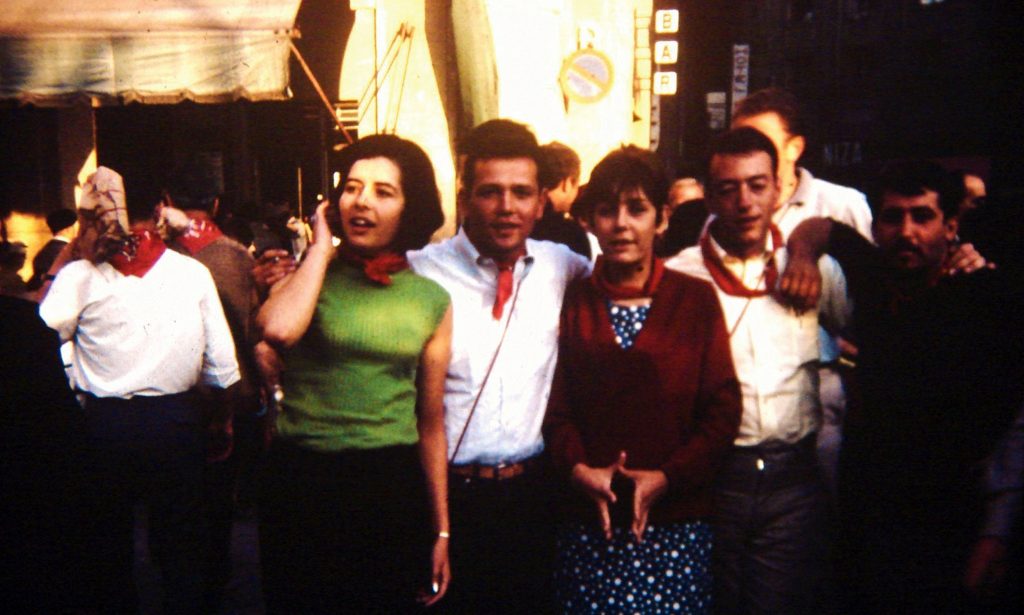
I once made a pilgrimage to Pamplona, the setting for Ernest Hemingway’s “The Sun Also Rises.” The fiesta of San Fermin had just begun and people roamed the streets, dancing with strangers.
There was a girl from Paris, Nicole, staying at my pension. I was attracted to her because she looked like Ava Gardner. A crowd of us from the pension were eating at an outdoor cafe when a bullfighter, Jose Manuel Tinin, sent someone to invite Nicole to join him at his table and she dragged me along.
Here I was, a kid from Brooklyn, in Pamplona sitting with a matador, his entourage and a beautiful woman. In spite of the high spirits, I was feeling a bit insignificant seated across from this rooster Tinin. Maybe it was the rivalry for Nicole or the macho atmosphere, but something brought out the bravado in me and I declared that the next morning I would run in the street before the bulls, carrying Nicole’s shoe, as was the custom. Let’s see the matador top that, I thought. “Ooo la,” Nicole sang.
Later in the afternoon, the arena was full. Tinin was in the ring and, unfortunately, having a good day. A fever of enthusiasm mounted as the bull lowered his head. Then the audience went into a song that had the same melody as “My mother gave me a nickel to buy a pickle.” Finally the bull bit the dust. I wondered, would Ernest say the bull was destroyed or defeated? Tinin was awarded an ear for his efforts. He looked up at Nicole as he paraded below our seats.
Back at the pension, Nicole and the rest of the Frenchies at my table were teasing me about America’s former first lady “disgracefully” cavorting with Aristotle Onassis. At that time, Franco-American relations weren’t that good because Charles De Gaulle was kicking our soldiers out of France. I felt slighted by the Frenchies’ sophisticated air and, to get even, I told them that in response we were sending back the Statue of Liberty—and they believed me. Later, I joined them in the festive activities for the evening, which evolved into cafe hopping late into the night. I worried that the lack of sleep would slow me down the next morning—but then, Papa partied hard in Pamplona. By the time we headed back to the pension, it was almost daylight. Nicole kissed me when we got to her room. Then she put her arm around me and slipped off her sandal and pressed it to my heart before she disappeared behind her door.
A cannon blast announced the beginning of the run. It would take a while for the bulls to make their way through the narrow street to the arena. I said goodbye to Nicole and climbed over the fence. At first the braver men stood pat, waiting for the sight of horns. I hung in there, knowing that’s what Hemingway would have done. Then a wave of runners came at us. The bulls were close behind. I began to run with the others but there were so many in the narrow street that we were bottled up when the first angry bull, eyes wild, came through like a black bowling ball. Another bull charged by, focused on a Basque’s back. It lowered its head, hooked into the man as he screamed in pain and tossed him into the air.
I knew there were four more bulls coming. My head was throbbing from a night of drinking and lack of sleep, and I felt like I was next in line to be gored. With buildings on both sides there was no escape. I thought of throwing away Nicole’s sandal—Tinin the bullfighter could have her.
What would Ernest say if I bailed out now? Maybe I didn’t want him for a hero anymore. “The Great Gatsby” was one of my favorite books. Maybe Fitzgerald would be my hero. I braced myself for the thrust of an angry horn. There were three stocky Basques standing in a doorway. I tackled the men and drove them into a hall. They took the assault good-naturedly but picked me up and tossed me out into the street again as two more bulls rushed by. I scrambled down the street, managing to elude the last two bulls and then the run was over.
That evening at the pension I was a hero, the only one there who had run with the bulls. Nicole kept tugging at my red bandana and planting wet kisses on my cheeks. “My mozer gave me a Nicole!” she sang. There was no mention of the bullfighter Tinin. I didn’t tell them that I thought of throwing away the sandal—and Ernest. I was ashamed for having wavered from my role as a hero, but even Hemingway must have wanted to quit being Hemingway long before he succeeded.
Terry Berkson’s articles have appeared in “New York” magazine, “Automobile” magazine and many others. Reviews on his critically-praised memoir, “Corvette Odyssey,” can be found on TerryBerkson.com.