
Museum Exhibit Evokes Morris During Revolutionary War Era
By TERESA WINCHESTER
MORRIS
“A New Settlement, A New Nation” is the current exhibit at the Morris Historical Museum, 89 Broad Street in Morris. Conceived to commemorate the 250th anniversary of the Declaration of Independence, the exhibit may be seen during regular museum hours—Saturdays from 11 a.m. to 2 p.m. through November 28. Long-time Morris residents and museum founders Stacia Norman and Gary Norman combined talents to mount the exhibit, with Stacia working as curator and Gary as preparator.
“It was Stacia’s brainchild,” Gary said.
Stacia recalled that when a historical society board member suggested doing a commemorative exhibit, she did not initially think the museum had enough materials to put anything together.
“Our collection doesn’t have a wealth of objects from the 18th century, but once I started doing research on early settlement and the Morris family, I realized we could rely on the written record,” Stacia said, adding that accounts sourced were “all from the settlers’ point of view.” Other primary sources also provided models for depicting 18th-century clothing, buildings and even cattle.
Authenticity was an important factor to Stacia in putting the exhibit together.
“Heritage breeds of cattle looked different from cattle today,” Stacia noted, in reference to one of the paintings exhibited.
She also made an effort to ensure that both Native American and colonial dress were accurately represented and even went so far as to grow the corn on exhibit from heirloom seeds.
As part of the museum offerings, four original paintings by Butternut Valley artists depict scenes described in “The Lull Book,” a local history compiled in 1926 by Hilah Violet Eddy. Featured artists are Timothy Atticus of Gilbertsville, Julie Koch and Marilyn Roveland, both of Morris, and Glen Noto of New Lisbon.
“Each artist rose to the challenge of painting in a different medium or style and of treating a subject matter different from what they normally do,” Stacia said.
Atticus, normally an abstract artist, used acrylic on canvas to portray a family forging through the wilderness, headed toward Morris, along what is now known as the Butternut Creek, an ox-drawn cart behind them.
Koch’s acrylic is an early spring rendering of a settler’s cabin, no longer standing. Koch derived her image from “The Lull Book” description of how early settlers built log cabins and from research done by Stacia herself.
Noto used house paint and acrylics on Masonite to portray a 1777 incident during which a company of British soldiers arriving in the area demanded the men of the settlement to vow they would not take up arms against King George III. This painting recalls the style of the well-known American folk artist “Grandma Moses.”
Roveland’s work—acrylic on Masonite—depicts an encounter at the Lull home between settlers and the Oneida and Tuscarora Indians. Roveland generally prefers to work in watercolors.
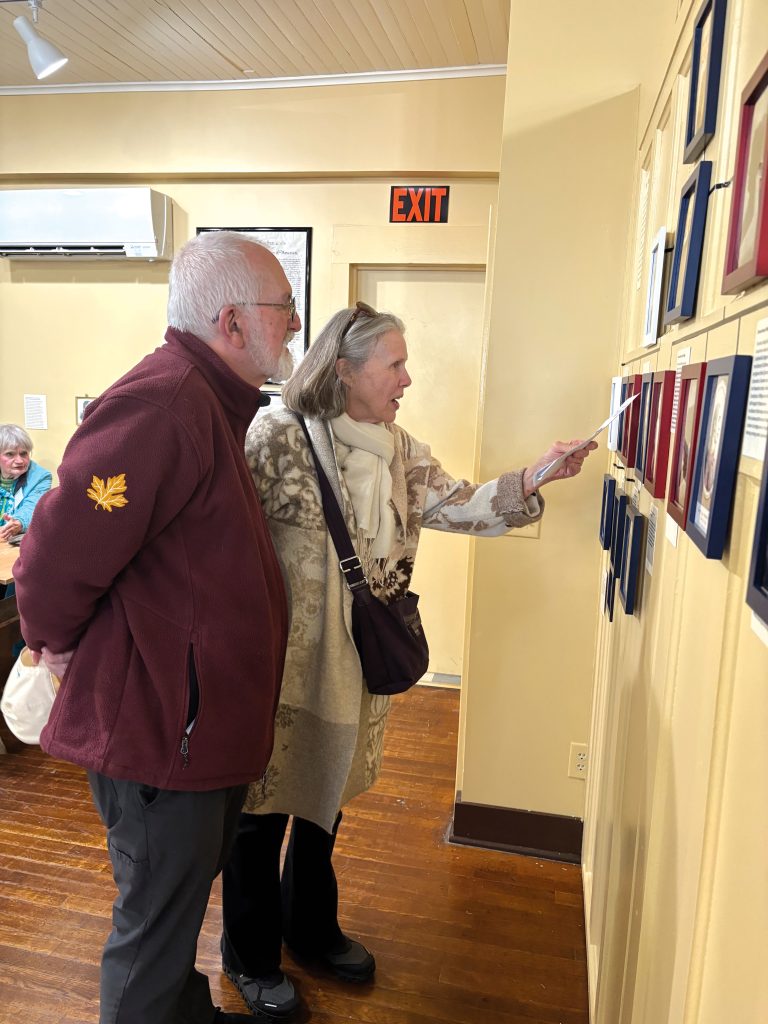
On the wall opposite the paintings are 17 framed portraits and silhouettes, accompanied by brief biographical information, making up the Morris family tree. Besides other early families settling in Morris—the Knapps, the Thurstons and the Lulls—the Morrises were influential during the colonization of New York, as well as New Jersey.
During the Revolutionary War years, loyalties were divided between the Patriots (those supporting independence from England) and the Loyalists (those wishing to remain under English rule). As with the American Civil War, families were often aligned with opposing factions. For the exhibit, frames of the portraits are color-coded—red representing Loyalists, blue Patriots and white unknown loyalties.
One of the framed portraits is of Lewis Morris III, signer of the Declaration of Independence who, before signing, was warned by his brother Staats of potential retaliation by the British.
“Damn the consequences. Give me the pen,” insisted Lewis, whose home, Morrisania, had been destroyed by the British.
Both the town and the village of Morris derive their names from General Jacob Morris, son of Lewis Morris III, who came to the Butternut Valley in 1787 to settle on the tract of land known as the Morris Patent—30,000 acres in what is now Otsego County. Representing his father and his uncle, Jacob came to manage the property and sell off parcels. Upon reaching the Butternut Creek, he declared it “the handsomest navigable creek I ever lay my eyes upon.”
Four females are displayed among the family tree members—one of them Anne Elliott Morris (1752-1848), wife of Lewis Morris IV. She was known as “the Beautiful Rebel” and, as portrayed in the exhibit, wore a bonnet with 13 small plumes to demonstrate her loyalty to the patriot cause.
The wall on which these images are hung was cleverly constructed by Roman Norman (son of Stacia and Gary), using double parlor doors salvaged from a dumpster to temporarily and imperceptibly cover up one side of a piece making up part of the museum’s permanent collection—a double-sided cupboard manufactured by the Benjamin Chair Factory, which operated in Morris from 1856-1942.
Present at the exhibit was Lull family descendant Pat Lull Matteson, who indicated that the Lulls migrated to what is now the United States from Mallorca. The name, she said, was originally spelled “Lully.” Matteson said that she is familiar with her family history and is “proud to be a Lull,” adding that her mother was the last Lull to live in the Village of Morris.
“Gary and Stacia did a wonderful job. I plan to come again,” she said.
Carla Hall, a direct descendant of General Jacob Morris, was present at the event. She currently lives in Morris in a stately home built by the general himself. Taking in the family tree, Hall seemed as impressed as the less-connected visitor.
“It blows my mind how much research they’ve done. It’s the first time I’ve seen the family tree visually depicted. I’m so happy for the residents of Morris—that they can really celebrate and learn about this country in this way. These are the foundation stones on which this country was built,” she said.
Equally pleased with the exhibit was Kathleen Stroh of Morris.
“I’m delighted that we have such incredible, professional curators for this small museum. It’s amazing. I didn’t think I’d learned anything, but I did,” she said.
Rick O’Keefe, who divides his time between Morris and New York City, found the exhibit “exceptional.”
“It makes the history of Morris accessible. It brings us together in these times when people are so divided,” he said.
Other museum activities conducted in conjunction with the 250th anniversary will include summer workshops for cleaning and repairing gravestones of Revolutionary War soldiers. These will take place at Harmony Cemetery, 136 Pegg Road on May 22, June 19, July 11, August 28, and September 19—all from 10 a.m. to noon. Also at Harmony Cemetery, on August 2 from 3-5 p.m., volunteers will recount stories of Revolutionary War soldiers.
For the Butternut Valley Alliance’s annual “On the Trail of Art” open-air art show, to be held July 13-14 at General Jacob Morris State Forest, MHS will mount a display explaining the history of the region, as well as how Revolutionary War gravestones are preserved in Morris.
The last commemorative event, sponsored by the historical society and the Daughters of the American Revolution, will be a Liberty Tea Party, held at the Gatehouse Coffee Shop, 129 Main Street in Morris, on October 8 from 3-5 p.m.
Information on the Morris Historical Society and its activities is available on Facebook at Morris, NY—Historically Speaking or by calling (607) 263-5965.