On Stage: Performing Arts at our Oneonta Campuses by Rachel Frick Cardelle
Love, Chaos, Masks and Rascals
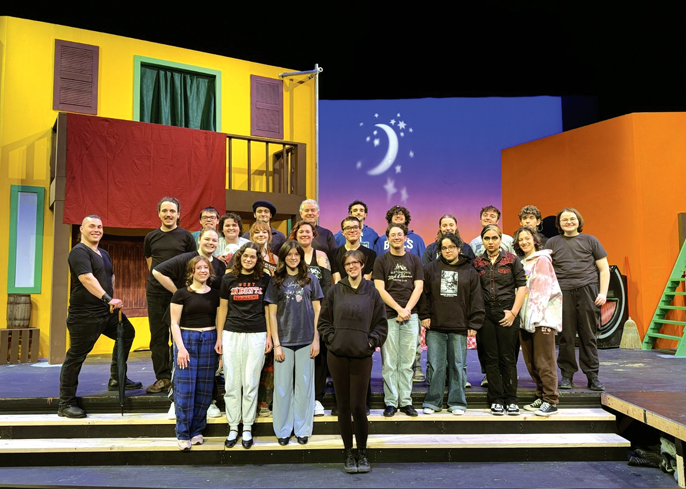
“Scapino,” a show adapted by Jim Dale and Frank Dunlop in 1974 from “Les Fourberies de Scapin,” which was first written and produced by Molière in 1671, comes to SUNY Oneonta’s Goodrich Theatre from November 13-16. Directed by Kiara Pipino, the show features a cast of SUNY O students and visiting guest artist Mace Perlman. The plot to this comedy is pretty simple: two young men in love, two disapproving fathers, and one wily servant who spins outrageous schedules. Not to mention the almost half-dozen mischief-making rascals who run around the stage and audience, causing mayhem.
Mace Perlman, who began his theatrical training with two years under Marcel Marceau, is an actor, director, and movement coach whose 40-year career is deeply rooted in physical theatre and commedia dell’arte. Mace shared an evening of commedia dell’arte recently at Hartwick’s Slade Theatre, thanks to a partnership between the two colleges in which the two theater departments coordinate funding and guest artists to the enrichment of their students and our community. Not a bad deal if you’re us! I took the opportunity to interview Kiara, Mace, and most of the cast of “Scapino,” exploring with them both the art of commedia dell’arte and how they had adapted the adaptation for their own production of “Scapino.”
So what in tarnation is commedia dell’arte? Fortunately, I had Mace (“Argante”) to explain that to us.
“I’ve been kind of fascinated by this material [commedia dell’arte] for four decades. ‘Commedia dell’arte’… art in the sense of skill, like the Artful Dodger, these were actors who were professionals. I think that’s a really important thing that in the 1500s in Italy, you had actors going out and earning their living by making theater. So as Kiara points out, they traveled all over Europe… Shakespeare was hugely influenced by these characters. And their roots go back to Plautus in the Roman comedy, back to Greece. It’s a very universal form of theater, and it’s a very deep and ancient form of theater that involves masks. But to define commedia, it’s kind of like a sort of vaudeville. These were the forerunners of everything from the Marx Brothers to Chaplin to Bugs Bunny and Looney Tunes to Seinfeld. You know, you can see these characters as archetypes all over the place in opera,” Mace said.
As we talked, the group began to explore some of the ways the comedy in this production was being enhanced. Masks are a huge part of commedia dell’arte. While Dale and Dunlop’s production did not include the traditional masks (in a strict sense, their production wasn’t commedia dell’arte, rather a vaudeville interpretation), the “Zannis” in this production do. [Zannis, according to my online research and from watching a rehearsal of this play, are stock servant characters, who are part clown, part buffoon, and jacks-of-all-trades who spend a lot of time playing practical jokes and adding to the general chaos on stage.] The cast shared with me the advantages of the Zannis using the masks.
Evi Sevastakis (“Zanni”) began, “So all of us Zannis have these beautiful masks with long noses. Kiara and Mace have been drilling into us from the very first time we put them on, that wherever we’re looking, the audience will also look. So that advances the plot of the show, and it helps people stay in focus on the correct characters. … The masks show off very tiny movements, so wherever the nose is pointing is where the focus will be. That’s been really fun to play around with, because the Zannis don’t ever speak; we rely solely on our body movements and these unintelligible noises to portray and emphasize what’s happening in the show.”
“The costume designer, Beth, she deliberately looked at traditional commedia, what actors were wearing for our character archetypes and deliberately infused that into the costumes. Scapino, he’s got like a harlequin outfit. The older gentlemen, they’ve got their opposing outfits. And then she adapted them to modern wear. It’s very clever,” Jess Mulholland (“Head Zanni”) continued.
“The set and the costumes and the lighting kind of enhance the comedy. When the audience sits down, the first thing they see is the set,” Kara Durkin (stage manager) went on. “The first thing they see is the colors. That’s the first thing you see before you even see any actors. Before you can really understand the characters by watching the show and listening to the dialog, you’re looking at their costumes. Even if you, the audience member, don’t understand what you’re looking at, your brain knows what kind of character they are because of what they’re wearing … before you can even mentally comprehend and process and gather the story in bits and pieces, their costume is a direct representation of who they are as a person.”
Aaron Pondolfino (Zanni) got really excited about the set.
“It’s built to enhance the antics,” Pondolfino said. “The whole having the stage extended into the audience as we did, having part of it lowered to create a beach, having the multiple different balconies and their access ways—as a character that moves around a lot, constantly running around, looking around, doing crazy stuff—it really helps to have lots of layers and motions and places to hide and stand and watch.”
“It’s a playground, right?” Mace interjected. “I mean, we’ve got a fire escape pole, for gosh sakes, I knew that this was going to be an amazing production when I saw that was in the set!”
“I think the fun part about it is that there’s chaos,” Madison Green (Zanni) agreed. “We do a lot of practice, and we go through all these rehearsals, like practicing and training, because the chaos does need to be controlled, but it is still just so much fun. There’s parts where people are running through the aisles and through the audience members. There’s running all over the stage; it’s really upbeat and chaotic. And I’m hoping that the audience themselves have so much fun watching us have fun, because this show is just so chaotic!”
As the discussion moved toward favorite moments of comedy and chaos in the show, Alex Dinardi (Ottavio) jumped in, “One of my favorite bits is a bit that me and Bri added into the show, where two of the characters, Scapino and Leandro, are running through the audience, and we, WWE-style, go, ‘LET’S GET READY TO RUMBLE!’ And then we describe what they’re doing. But it is just one of my favorite bits, because it’s a creativity moment that me and Bri had together.”
Sean McGrane (Syl-vestro), inspired by the discussion of how the cast had adapted the play to make it their own, shared, “I’m playing Sylvester. And Sylvester has to scare Argante into keeping his son married. So we came up with a bit to have me play the Terminator. In the script, there’s a lot of British sayings and other stuff I had to try to change around. And Kiara gave me the freedom to do that. And Mace is always encouraging us to play; it’s one of my favorite bits in the show.”
Leah Spence (Nurse/Dramaturg) reflected on how different this ability to add and change things in the show is from the last SUNY O production she was in.
“Literally, we closed “Fire Bugs,” struck that set, and walked over to [“Scapino”] rehearsal,” Spence recalled. “It was coming from a place where you have to be so precise, it was a Greek chorus, to somewhere we were encouraged to play and experiment, and the shape of the show was changing. That was just a completely different world. … I love that theater can be so many things at the same time, because it’s completely different worlds.”
“I hope that people get to see how much creativity Kiara has given us for the show. She laid it out in front of us and said, ‘Go at it!’ … At least I’ve never had this type of freedom before. So, I hope people get to see our creative minds all melding together into one beautiful mush,” Briana Bonnell (Carlo) added.
Which brought us back to a discussion of the show itself and the art of commedia dell’arte.
“That’s the one thing about commedia, it’s a company effort. There was no playwright in commedia dell’arte. You rely on the cast you have, and then you rely on what they’re willing to share and how much they’re willing to have fun. This is not the show where I can tell my actors, that’s your line, make it work! They have to find their way into it. And if something needs to be changed, you can,” Kiara explained.
“It’s a team sport, for sure!” agreed Mace.
“So, if I could say, the best thing I’ve done for this show was casting it!” Kiara bragged.
I’ll leave it there. I think there is an underlying wisdom in Kiara’s brag: The smartest thing I can do is make sure I surround myself in work and life with the right people. In writing a column where I get to spend time with really fun and interesting Hartwick College and SUNY Oneonta students, faculty, and visiting artists, all of whom seem to love what they are doing, I think I am doing at least as well as Kiara in the casting department!
If you decide you want an evening of high-energy slapstick, blending vaudeville and commedia dell’arte, you can watch “Scapino,” directed by Kiara Pipino, at SUNY Oneonta’s Goodrich Theatre, November 13-15 at 7:30 p.m. or November 16 at 2 p.m. Tickets are free with a SUNY Oneonta student ID, and $5.00 for general admission.
Rachel Frick Cardelle covers performing arts at SUNY Oneonta and Hartwick College.