
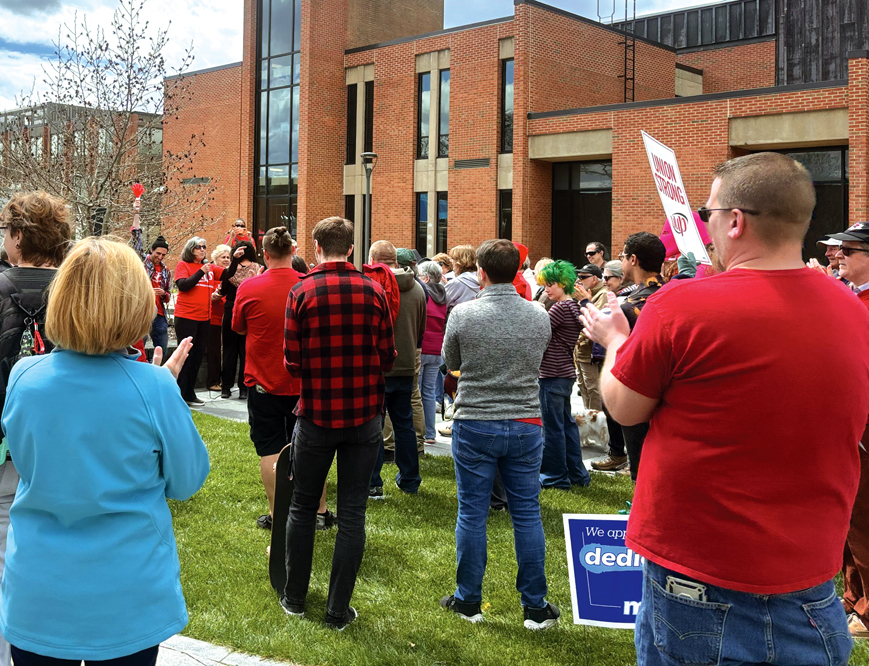
SUNY Faculty, Staff Advocate for State Contract at May Day Rally
By ERIC SANTOMAURO-STENZEL
ONEONTA
Amidst statewide contract negotiations for SUNY faculty and staff, around a hundred members of the SUNY Oneonta and local community gathered on campus to celebrate May Day (also known as International Workers’ Day) and advocate for improved working conditions and compensation. The demonstration’s focus also included calls to tax the rich; fund education rather than the U.S. war with Iran and the Trump administration’s deportation agenda; and “defend academic freedom, free and fair elections, and democracy itself.”
The May 1 rally was organized by campus locals of the United University Professions, which represents around 900 faculty and professional staff; the Civil Service Employees Association, which represents around 220 employees ranging from custodial to clerical staff; and the liberal activist group CooperstownOneonta Indivisible. It came as part of a national day of action with the May Day Strong coalition, a network of hundreds of groups across the country holding similar demonstrations.
Ethan Fox, who is the political outreach coordinator for UUP Oneonta and has worked as a service desk coordinator at SUNY Oneonta for the past several years, told AllOtsego that the “state’s coming up against the wire” and that fellow union members are “itching for an on time contract.”
Their current statewide contract is set to expire July 1.
In parallel, CSEA is in negotiations for a new contract after their old one expired in March. The groups aimed to stand in solidarity with one another at the rally.
Jennifer Regg, the president of CSEA Local 635 at the university and who is on a large negotiating team meeting with state officials, told AllOtsego that it was good to collaborate because “we enjoy the same things, and want to see the same things for people.”
Each said that compensation is a sticking point. Regg spoke about the pressures of inflation, healthcare, housing, utilities, gas, childcare and more.
“I mean, a lot of our members have second jobs just to make ends meet. It’s really difficult in this day and age for anybody,” Regg added.
Fox said that some adjunct faculty faced the same struggles.
Regg said the CSEA negotiations have been ongoing since January with regular meetings and that “things are going well.”
One of the priorities for UUP, Fox said, is artificial intelligence protections and guardrails, particularly ensuring that AI “does not have a role with hiring, firing, and disciplinary action.” Compensation increases, particularly for more precarious faculty, “more formal guidelines around telework,” and protecting retiree benefits are also objectives.
At SUNY Oneonta, staff are pushing to prevent professors from being spread thin and to reduce reliance on low-pay adjunct professors.
UUP Officer of Contingents, Professor Melissa Lavin, who has taught at the university since 2013, wrote to AllOtsego that, “Adjunctification and contingency are exploitative employment forms in higher education,” with worse pay and less job security than tenured or tenure-track professors.
Lavin said that UUP is working to offer lecturer lines to adjuncts with a certain number of classes, and simultaneously to elevate extra service pay for full-time faculty.
“As it is now, full-timers are directly competing against adjuncts for work at our campus. At the state level, we hope for a contract that builds upon the gains of the last one, given adjuncts lag in every measure of worker compensation and dignity,” Lavin wrote.
Lavin also pointed to efforts to return professors to three courses for both semesters, rather than having one semester with four classes. Having four classes “forces the professoriate into quantity over quality scenarios as we must navigate research, advising, and other service requirements.” Lavin said, “The union has made encouraging gains, as we work alongside management to implement a 3-3 trial across four departments for the 2026–2027 academic year. As the pilot departments go, so goes the campus!”