
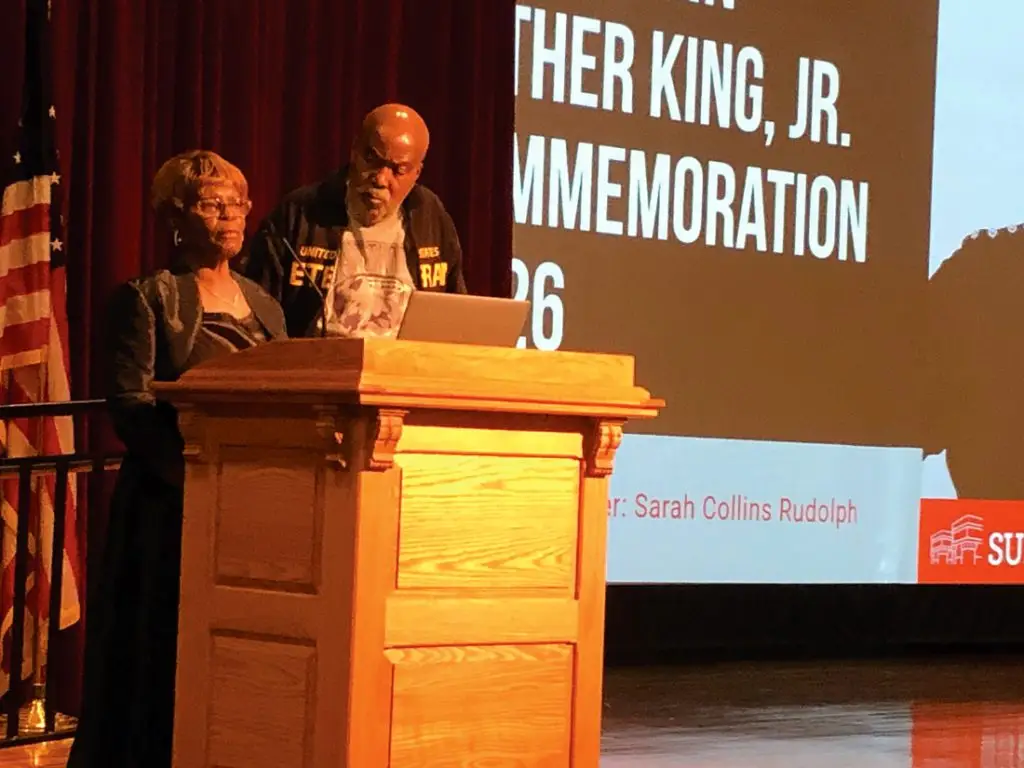
Survivor of 1963 Bombing Speaks at SUNY Oneonta
By MONICA CALZOLARI
ONEONTA
In 1963, Sarah Collins Rudolph was 12 years old. She and her sister, along with three other girls, were in the basement of the 16th Street Baptist Church in Birmingham, Alabama when 19 sticks of dynamite exploded, killing four of the children. Sarah survived. Her sister, Addie Mae Collins, age 14, died.
Rudolph shared this traumatic experience with nearly 150 guests in the Hunt Ballroom at SUNY Oneonta on February 19. She was the keynote speaker at the college’s event commemorating Dr. Martin Luther King Jr. The gathering, originally scheduled in January, had been postponed due to inclement weather.
The Office of Diversity, Equity, Inclusion and Belonging at Hartwick College co-sponsored this community breakfast along with five entities from SUNY Oneonta. Bernadette Tiapo, PhD, vice president for equity and inclusion and equal opportunity and compliance, opened and ended the program.
Rudolph has spent decades sharing her story with audiences to honor the lives of the sister and friends she lost, she said. She shared her path to forgiving the bombers and her belief that “love can overcome hate.”
According to Rudolph, the group of “white supremacists” who planted the dynamite were well-known in that community. It took nine years before one stood trial in June 1977, she said.
One of the bombers, Robert Chambliss, carried the nickname “Dynamite Bob” and treated the attack “like a joke,” she added.
“The church was a key civil rights meeting place and had been a frequent target of bomb threats,” according to the FBI website.
Members of the Ku Klux Klan were suspected of this crime. FBI reports say Chambliss received life in prison in 1977. It took until the 1990s to convict two other members of the KKK for the church bombing.
Rudolph was angry about losing her sister and being blinded in one eye by the debris from the explosion.
“Church was supposed to be a safe place,” she said.
She “did not get any [mental health] counseling,” she said, when she got out of the hospital after her eyes had been operated on.
Martin Luther King Jr. came to console Rudolph’s mother when she was still in the hospital and he also visited the 16th Street Baptist Church. He taught marchers to pray before they marched in protest. King convinced Rudolph’s brother not to take revenge.
Rudolph shared that in 1963, Blacks could be arrested for drinking water from white water fountains. She said Blacks were not allowed to try on shoes, so her mother traced their feet and bought the sizes she hoped would fit them.
Governor George Wallace wanted to keep Alabama segregated, Rudolph explained. The police commissioner drove through town in a tank. The police sprayed Black people with high-pressure water hoses and let German shepherds attack them, she said.
The police even put a 4-year-old boy in jail.
“I went around for a long time angry,” Rudolph continued. “I would not talk about the bombing. I was too traumatized and too nervous.”
A pastor in the church “laid his hands” upon her and gave her a blessing.
“God took away all of my fear,” she said. “I know God is real.”
When Rudolph forgave, she said, she started feeling much better.
“I give him all the credit. He healed me. God spared my life.”
Rudolph has not received “any restitution” for her injuries.
“Kennedy tried to sign the Civil Rights bill into law, but they killed him,” she said.
John F. Kennedy was assassinated on November 22, 1963. Rudolph survived the bombing of the 16th Street Baptist Church on September 15, 1963. The Civil Rights Act—prohibiting discrimination in public places, providing for the integration of schools and other public facilities, and making employment discrimination illegal—was signed into law by President Lyndon Jonson on July 2, 1964. Martin Luther King Jr. was assassinated four years later, on April 4, 1968 in Memphis, Tennessee.
Editor’s Note: Read the winning entries from this year’s SUNY Oneonta “Legacy of Dr. Martin Luther King Jr.” essay contest here.