
The Partial Observer by Charlie Deichman-Caswell
Can Otsego’s Birds Survive Proposed Manocherian Development?
Developers have submitted sketch plans for a proposed project on the 1,525 acres of farmland, forested hills, and wetlands on the western slope of Otsego Lake in the Towns of Otsego and Springfield. The most recent sketch plans include 126 buildable lots, increasing dwellings due to 23 two-family lots. Developers of the Lake Otsego Properties subdivision on Fraydun Manocherian-owned land estimate that 55 acres will be deforested.
Impacted Habitat and Species
The impacted area is heavily forested, a healthy mix of deciduous maples, hickories, birches and oaks, and conifers like white pine and spruce. Looking closer, eastern newts meander among roots, ferns, trilliums and thistles, sifting the rich soil. Wetlands run through these forests, providing habitat for reptiles and amphibians while protecting water quality and controlling floodwaters. The land is lush with flowering plants, crawling with insects—a buffet for songbirds. The ecological value of this area is illustrated by the presence of conservation easements flanking the impacted property on all sides.
In 2002, a General Environmental Impact Statement identified 120 species of birds as breeding, or probably breeding, in Otsego County. Thirteen were listed as “threatened,” or of “special concern.”
The most current species distribution data is provided by eBird via the Cornell Lab of Ornithology, in collaboration with the National Audubon Society. The nearest eBird hotspots, near the Lake View Motel and Glimmerglass State Park, highlight a total of 188 recorded species. In a given month, birdwatchers may find black-crowned night heron, the American woodcock, bobolink, cerulean warbler and New York’s state bird, the eastern bluebird, in addition to resident belted kingfishers, tufted titmice, and pileated woodpeckers.
An eclectic community of species breed in the area. According to Breeding Bird Atlas data, the three-kilometer swath of land encompassing the impacted area possibly contains 115 breeding species, with 49 species confirmed.
Migration Pathways
Otsego County lies directly within the Atlantic Flyway, one of the largest migration pathways in the country. Between mid-April and mid-May, a flood of birds sweeps overhead. On May 17, 2026, Cornell’s BirdCast logged nearly five and a half million birds passing through Otsego County in a single night. The National Audubon Society’s Migration Explorer identifies 123 tagged bird species as passing through the area around Otsego Lake annually, with some traveling as far as Argentina. Snow geese, ospreys, and canvasback ducks will make the long journey to the upper reaches of Alaska and Canada; an arctic tern, boasting the longest migration on earth, was tagged passing through Cooperstown on its flight from Quebec to the Falkland Islands.
The Cornell Lab found that the country has lost nearly three billion birds since 1970, largely due to the loss of key migratory stopover areas—mainly in the Great Plains. Otsego County is not untouched in this crisis, and our environment should be prioritized given new developments such as Lake Otsego Properties.
A Birdwatching Sanctuary
On July 13, a nondescript summer morning, I packed my binoculars and drove along County Highway 80 until I reached a grassy overlook. Here I met another birdwatcher, and we passed slowly along Thurston Hill Road, making note of the usual suspects; kestrels fought the wind, crows shouted from the fields, and common yellowthroats asked in melodic refrain, “Which is it? Which is it? Which is it?” The sun was already high at nine o’clock and the morning fog was burned away.
Crawling up a dirt road, we were skirted on our left by a flowering meadow and, to our right, wetland habitat below a mixed forest. Goldfinches zipped by, and a gray catbird. There were chipping sparrows with their rust-colored hairdos, eastern towhees calling for us to “drink your tea!” A northern yellow warbler settled in a bush, while an indigo bunting offered a flash of color in the treetops. This species-rich valley lies within the proposed development area. I tried to imagine the dirt road paved, the ground dug up for entry to a neighborhood, and I struggled to imagine the logistics of it. The land is covered in wetland and steep slopes. More concerning yet, it is saturated with sound and color, insects, and, yes, birds. It is difficult to imagine a scenario in which they are unharmed.
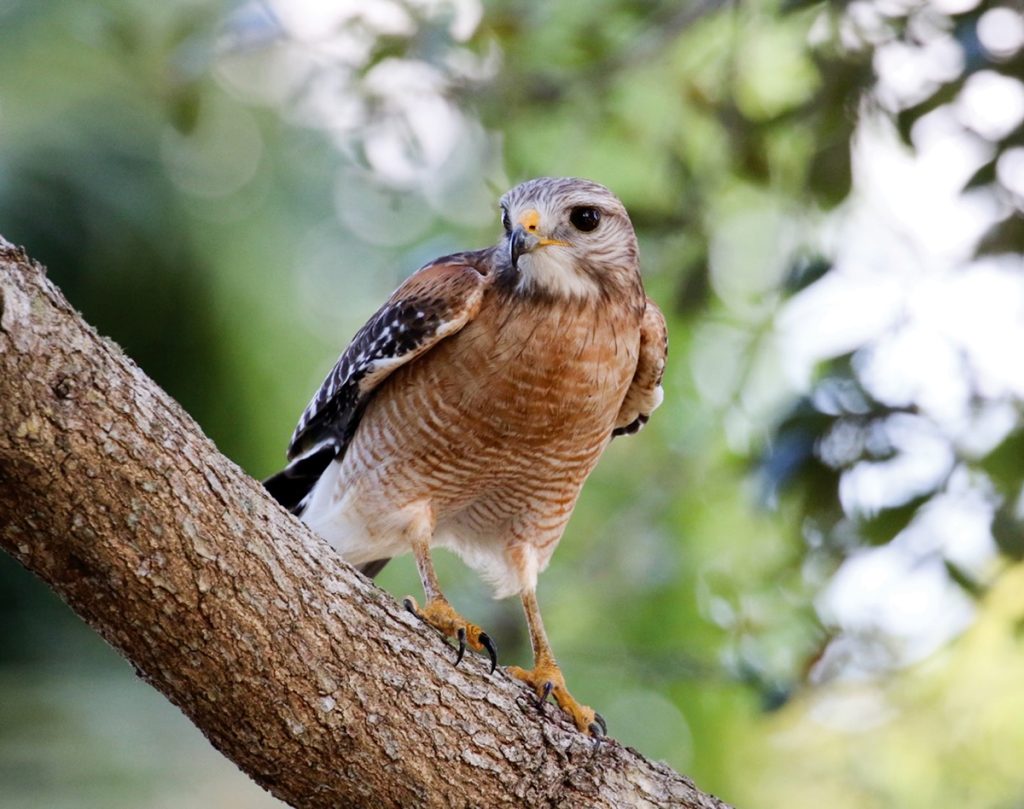
The rest of our morning provided further evidence of the impacted area’s ecological significance. July is a quiet month for birdwatching, and yet we logged more than 30 species within an hour. There were wood thrushes, chestnut-sided warblers, an ovenbird, and a scarlet tanager, incandescent in its fiery plumage. We had barely traveled a half-mile when the car slammed to a halt. A red-shouldered hawk soared above us, tracing figure-eights in a clear sky. Rarely seen in the area and listed as a “species of concern” in New York, the hawk’s sudden appearance illustrated the constant surprise and joy brought by a flourishing ecosystem.
We continued our tour of the impacted habitat. Turning left onto Red House Hill Road, we stopped at a wetland area dense with cattails, flanked by birches and maples. Here we were greeted by a euphony of birdsong: the varied and forceful tunes of the American redstart; the dual-toned call of the wood thrush; the urgent whistle of the indigo bunting. This was the most diverse avian environment we visited that morning. In that specific area, the Lake Otsego Properties development has proposed five single-family units.
Further north, at another impacted area along McRorie and Buddle roads, we stopped to admire a nesting osprey with its chick, and its wetland neighbors, the great blue herons.
Along the wetland was evidence of heavy machinery. There was a grassy hill where a broad-winged hawk had been released. Nearby we admired a dense brush where, every spring, the American woodcock returns to perform its iconic mating ritual. Partly due to its stout figure, its comically large eyes and nonexistent neck, and to its reedy, explosive “peent!” call, the American woodcock has garnered international fame. Here, in the woodcock’s home and stage, Lake Otsego Properties foresees 46 multi-family dwellings, with five single-family lots across the road.
Potential Impacts
Breeding Bird Atlas data reveals the presence of several threatened species in the three-kilometer area containing the proposed development. The peregrine falcon and golden eagle are endangered in New York; pied-billed grebe, northern harrier and the American tree sparrow are “threatened;” other “species of concern” include the osprey, common loon, sharp-shinned hawk, horned lark, Cooper’s hawk, and red-shouldered hawk.
The Delaware-Otsego Audubon Society has identified the following species as “Audubon priority species,” whose populations are declining and are targeted for conservation efforts: American kestrel, wood thrush, eastern meadowlark, American black duck, rose-breasted grosbeak, chimney swift, northern harrier, bobolink, blackpoll warbler, brant, black-billed cuckoo, willow flycatcher, northern yellow warbler, yellow-billed cuckoo, golden eagle, American woodcock, prairie warbler, scarlet tanager, and lesser yellowlegs.
When birds suffer, the rest of the ecosystem suffers, too. Native flora like the serviceberry and black cherry rely upon wood thrushes, cedar waxwings and other birds for seed dispersal. Hummingbirds pollenate flowers, and others fall prey to foxes and weasels.
Finally, birds play a central role in managing insect populations, by which they protect our forests and fields. Any attempt to support these populations is undermined by the destruction of habitat along the lakeshore. Given the confirmed presence of several of these species within the Lake Otsego Properties development area, conservationists have reason for concern. The revised project plan would inevitably impact these species and perhaps drive them out entirely. This is not only a loss for birdwatchers, but a loss for everyone. To lose a hawk, a bunting or a woodcock is to diminish the ecological value of the land itself.
What Can Be Done?
The important work of protecting Otsego County’s birds is conducted by groups like the Delaware-Otsego Audubon Society, the New York State Ornithological Association, the Otsego County Conservation Association, Butternut Valley Alliance, the Otsego Land Trust, and Otsego 2000. If you are interested in avian conservation efforts, consider supporting these groups.
Finally, a real impact can be made by simply watching and listening. Conservation efforts are largely informed by data from citizen science projects like eBird. By birdwatching around Otsego County, engaging with your local Audubon Society and uploading checklists to eBird or similar platforms, you can assist scientists and conservation organizations in their important work.
Charlie Deichman-Caswell is serving an environmental stewardship internship at Otsego 2000 this summer before pursuing a graduate degree in environmental policy and regulation in the fall.