

Invasive Species: Pesky Plants by Justin Williams
All Tied Up in Knotweed
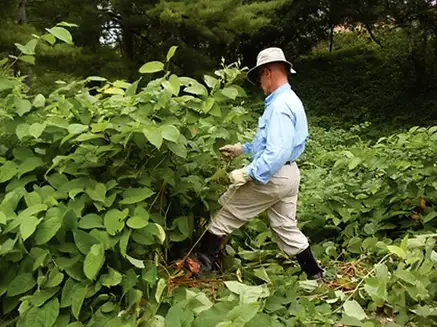
You may have noticed dense thickets growing along local streambanks and ditches. Those fast-growing clusters are likely Japanese knotweed (Reynoutria japonica), an invasive species that outcompetes native plants with rapid growth.
Japanese knotweed has bamboo-like stems, simple, alternate, heart-shaped leaves, and grows quickly. It flourishes along riverbanks, streams and ditches. While the white flower clusters are attractive, the plant’s aggressive nature can cause considerable harm to our ecosystem and infrastructure.
Once sold through seed and plant catalogs, knotweed quickly became a problem. Japanese knotweed spreads rapidly by underground rhizomes, growing up to 4 inches per day, and can regenerate from broken stems as short as an inch. Knotweed thrives in disturbed areas and can spread rapidly, creating thick stands that crowd out native plant communities.
Japanese knotweed can tolerate deep shade, high temperatures, high soil salinity and drought. The robust root system can penetrate concrete, asphalt and even building foundations, leading to costly repairs.
This invasive plant spreads rapidly if it is mowed or cut with weed trimmers. Pieces can re-sprout, spreading rather than controlling the plant. Rhizomes and fragments left in the ground can regenerate and spread infestations.
The entire root system must be removed to prevent the rhizomes from re-sprouting. Digging out small clumps can prevent new colonies from being established. Herbicides can help control Japanese knotweed, but only if applied to freshly-cut stems or to foliage.
Chemical control can be harmful if improperly applied to other plants and animals and especially if close to waterways. Before using chemicals to control any invasive plant, check with the local environmental or natural resources management agency or the local Cornell Cooperative Extension office to find out what chemicals are legal for use.
As with most invasive plants, Japanese knotweed can quickly inhabit disturbed ecosystems. One of the best ways to prevent its colonization is to ensure that disturbed habitats are rehabilitated with native vegetation before knotweed can invade.
For further information, visit nyis.info/species/japanese-knotweed/.
Justin Williams is the agricultural specialist and public lands manager for the Otsego Land Trust.


just a thought….see if a florist could utilize.make wreathed n such.
does it have any nutritional values.. make a pain into a gain$$