On Stage: Performing Arts on Our Oneonta Campuses by Rachel Frick Cardelle
‘The Firebugs:’ A Dark Comedy About Setting Your House on Fire
The Firebugs,” directed by John McCaslin-Doyle and written by Swiss author Max Frisch, comes to SUNY Oneonta’s stage this week. The show, first performed as a radio play in 1953 and then as a stage play in 1958, is a dark comedy about the ways we all can too easily look away when danger and destruction creep too close to home.
When I first heard the name of this play, it brought back one of my strongest childhood memories. I must have been 5 years old, playing with my friend Laurie behind our farmhouse in upstate New York. Her older brother, Stevie, came running to us with a treasure trove: a box of matches. He wanted to show us how to build a fire.
We collected a bunch of twigs and some hay from the barn and hid between our hedge and the house. We did think to have two plastic pails of water to douse the fire. Since the game became building bigger and bigger fires, dousing them and starting again, this experiment quickly spun out-of-control. The three of us formed a fireman’s brigade between the fire and the hose on the other side of the house, scurrying to put out the growing flames using our plastic pails. I remember when my babysitter, Sandy, came out on the porch and asked me, as I flew by with the blue pail of water, what was happening. “Nothing!” I assured her.
Long story short, Sandy didn’t buy it, quickly assessed the situation, and put the fire out before we burned my house down. When my father got home, among other things, I learned the term “firebug.” It was a painful lesson. So that’s why, when I opened the script for “The Firebugs,” I expected to read a story about some young scamps, or troubled teens. That’s not what this show is about.
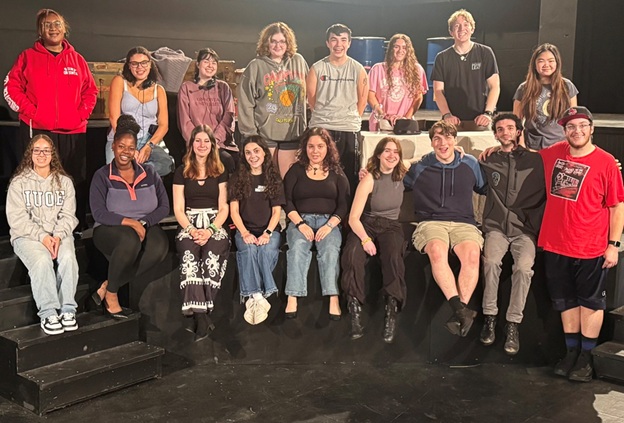
After reading “The Firebugs” script, then watching a rehearsal in which the cast was just coming off-book, I got to spend an hour in the Green Room chatting with some of the cast and crew.
Anyone who goes out of their way to read this column about theater probably knows exactly what “off-book” and “Green Room” mean. But having just spent an hour and a half of my life on a composting webinar—purportedly for beginners/intermediates that used so many industry terms and acronyms that I was left wondering if English was really my native tongue or if I had forgotten some vital fact about my childhood—I’ll take a moment to explain.
Off-book is when an actor has his/her lines memorized and no longer uses his/her script during rehearsal, and the Green Room is the (usually soundproof) waiting room actors hang out in while they’re waiting to go onstage.
I began by asking the director, John, why he chose this play at this time.
“Theater is political in many ways, and it was time to do something that actually responded to the era that we’re in,” John began. “This is a play that is a retort to the Nuremberg Trial principles… So the idea [in the play] is what happens to an organized system of civilization if accountability is removed, if people in charge are not accountable for their actions, or people who take those actions and make them a reality [are not accountable]… What happens when you remove [accountability].”
With this as a background, the cast and crew talked about the challenges the actors faced as they went off-book and began to focus on aspects of their roles other than having their lines memorized.
Arlee, who plays an intimidating arsonist (Schmidt), addressed her most glaring challenge.
“Schmidt is supposed to be this big, hulking guy. I am five foot three. So, a lot of being scary comes out of just being very painfully close to everybody doing things that are relatively out of the ordinary in a normal situation. So just the eye contact, staring directly at you, or looking into your ear. A lot of it just comes out of odd behaviors that I choose to portray.”
“I watch a lot of Seinfeld. So, a lot of my inspiration for my character came from Cosmo Kramer,” Sean, who plays another arsonist, said. “The Biedermanns and their maid, they don’t suspect that [my character] is doing anything wrong. They’re thinking, ‘Oh, he’s just a silly guy.’ And then where I have to be more serious, I have to flip a switch and be tough.”
Ava, who plays a monkey, admitted that even though this is the second time she has been cast as a monkey, it is a challenging role to play.
“Today, in rehearsal, I’m going to play around more with being like a monkey. In the previous show, my monkey movements were blocked. But now John is giving me more creative freedom, so I’ll get to have fun with it.”
Rita talked about the difficulty in portraying two very different characters.
“One is the widow, and the other is the head of the firefighters. The widow is disempowered, kind of distraught the whole time, at the mercy of the Biedermanns, while the leader of the firefighters is issuing orders. It feels like I’m splitting, being two personalities, which is very interesting, because some of the scenes are back-to-back.”
Like Rita, Lindsey was focused on her two roles, but for her there is more continuity, bringing a different kind of challenge.
“In the first act, I am a servant to the Biedermanns, and that’s where my loyalties lie. And then, after the intermission, I become the girlfriend of the devil. To an extent, I become a servant to him, so [I work on] trying to find ways of tying those two together so they still feel like the same person.”
Sophia, the stage manager, observed that due to how this play is written—including having a Greek chorus aspect—the actors really have to get their lines just right for the play to keep moving forward without anything significant being missed.
“For every show, but I feel for this one specifically, you all really rely on each other for your cues so your lines make sense, and it’s really hard for you guys to pick up and keep going if someone messes up,” Sophia said, referring to cast members.
Shane and Leah, who play the Biedermanns—the couple who unwittingly play host to the arsonists—reflected on their characters’ inability to see what is happening right under their own roof.
“I’ve put a lot of thought into this,” Shane reflected. “I think [Gottlieb Biedermann’s] just trying to do the right thing and he’s trying to kind of stay true to himself while also losing himself throughout the whole show, and just losing his sanity.”
“I still think that Biedermann’s trying to do good. He’s trying to find the best in people. He believes in the good in man, but he’s made mistakes, and he’s done some crappy things,” Shane said.
Leah, who plays Babette Biedermann, jumped in.
“I think it’s just funny, because you ask any actor, and we’re going to justify our character a little bit, because we’re not allowed to hate him. That’s the number one rule; if you start hating your character, you can’t play him. That is my biggest problem with Babette. I’m like, ‘Girl, just say something!’ But I realize if I judge her, I’m not going to play her story,” Leah said. “And everyone thinks they’re right in their story. Even if they’re wrong, they’re part of this bigger story we’re telling. If you’re playing the Wicked Witch of the West and you’re in fifth grade, you’re not allowed to think she’s evil or else you won’t play her right.”
As far as the message the cast and crew want the audience to walk away with, a full description requires far more space than I can do justice to here. I think Jaren put it most succinctly when she said, “There’s this one quote that I’ve seen when I’ve taken the bus in New York City. It says, ‘If you see something, say something.’ So that’s what I would use as a warning, because, if you see something that you know is bad, then you need to say something, so that way it doesn’t happen again in the future.”
Going back to my personal experience with almost burning my own house down, I remember how furious (or maybe scared?) my father was. When I tried to defend myself by throwing Stevie (sorry, Stevie) under the bus, my dad made it clear that if I ever was aware of activity that I knew was wrong, I had to stop it. In “The Firebugs,” the Biedermanns aren’t lucky enough to have my father (or my babysitter, Sandy) living with them, and they pay the price for allowing denial and politeness to get in the way of what is right.
As director John put it, “This play starts with the cardinal thing you do not do in a theater—you do not light a match.”
So, if you want to see a dark comedy that reflects upon some of the moral and political issues we struggle with today, “The Firebugs” will be just your cup of tea. And don’t worry about that lit match John mentioned. I’ll be sure the theater has a couple of small plastic pails in case things get out of control.
“The Firebugs,” directed by John McCaslin-Doyle, plays at SUNY Oneonta’s Hamblin Theater with shows at 7:30 p.m. Thursday, October 2 through Saturday, October 4, and at 2 p.m. on Sunday, October 5. Tickets are free with a SUNY Oneonta student ID and $5.00 for general admission.
Next up: Hartwick College presents “Ride the Cyclone,” November 7-9 and 11-13.