
On Stage: Performing Arts at our Oneonta Campuses by Rachel Frick Cardelle
The Marx Brothers Win, Hands Down
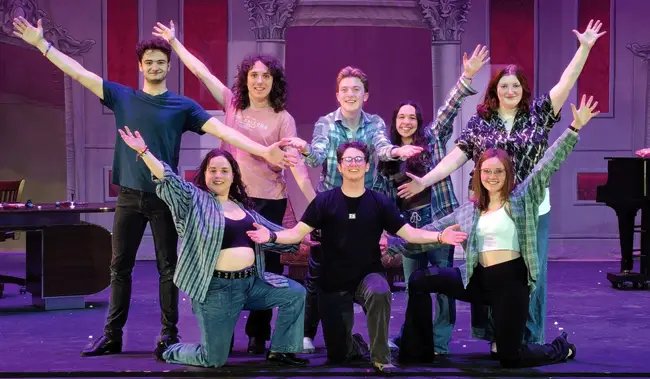
“A Day in Hollywood, A Night in Ukraine,” directed by John McCaslin-Doyle, shows at SUNY Oneonta’s Goodrich Theatre from April 29 through May 2. With book and lyrics by Dick Vosburgh and music by Frank Lazarus, the musical premiered in London’s West End in 1979 before transferring to Broadway in 1980, where it enjoyed a successful run and multiple Tony Award wins. Structured as a theatrical double feature, the show pairs a nostalgic tribute to 1930s Hollywood (the first act) with a wildly comic, Marx Brothers-style farce (the second act).
I watched a full rehearsal of “A Day in Hollywood, A Night in Ukraine” just before tech week started. More than a night of entertainment, the musical offered me a showcase of versatility, timing and theatrical range. Structured as a double feature, the show first invited me into a tribute to the polished glamour of 1930s Hollywood before pivoting in the second act into a whirlwind of heightened farce inspired by the comedy of the Marx Brothers.
After the rehearsal, I sat down with four of the eight cast members to talk about the show. I had grown up watching the Marx Brothers any chance I could get, often at the theater (since this was a time before even videos!) at whichever college my parents were working for at the time. I absolutely loved the films. Nothing seemed funnier to me than the combination of Groucho, Chico and Harpo, mostly because nothing was. And please don’t bring up the Three Stooges. I’ve had that argument with a number of (male) people in my life, including the one I live with, whose name I won’t mention in order not to embarrass him in front of anyone he knows who might be reading this. Because clearly the Marx Brothers were, are, and always will be funnier, and more clever and talented, than any number of Stooges. If the Stooges make you laugh more than the Marx Brothers, that has to do with your taste. Just like some of the books I enjoy reading aren’t particularly well written, but I still really enjoy them. You won’t hear me arguing that “Twilight” is a better written book than Bram Stoker’s “Dracula” just because I read the former in a binge session one weekend, and the latter made me fall asleep every time I tried to read it. I know that’s about my questionable taste, and that “Dracula” is a literary classic. When it comes to the Marx Brothers, they are like a literary classic (one that won’t put you to sleep) and the Stooges, well, they’re not. (Okay, yes, the Marx Brothers are a topic I can get a little…over the top about. But that doesn’t mean I’m wrong!)
It helps to know before going to see this musical what Groucho, Chico, and Harpo Marx and Margaret Dumont bring to a Marx Brother comedy, so in case you haven’t seen one of their films…Well, find time to do that, because not only are they free on YouTube, they’re classics (see paragraph above!). But, in case that doesn’t happen before going to this show, I’ll give you a quick primer. Groucho is the verbal ringleader. He’s quick with wordplay, puns and double entendres, always breaking social norms and gleefully getting into intellectual mischief. He ends up wooing (and insulting) Margaret Dumont in the seven films she joins them in. She is the straight-faced anchor of the group, a dignified presence amid the madness. She never seems to understand the insults that Groucho throws her way, nor that chaos is raining down around her. Chico plays the streetwise trickster, a charming schemer who likes to sew confusion. He fills the gap between Groucho’s very verbal, intellectual humor and Harpo’s silent anarchy. Harpo never speaks, but is the most unpredictable presence on stage. With a childlike innocence he uses pure physical comedy and visual gags. Rules don’t get broken by Harpo; rules don’t exist in Harpo’s world.
Anyhow, like I said (sorry, I got distracted), I sat down with four of the cast members to interview them. In the first act of the play, a salute to 1930s film musicals, the cast members are called upon to sing and dance. In the second act, these four cast members enact roles based on three of the Marx Brothers and Margaret Dumont. So, the first thing I asked was whether any of them had seen a Marx Brothers movie before this musical came into their lives. One, Leah (who plays the character based on Harpo), had, but not in a conventional way.
“I used to watch them in Russian when I was visiting my grandparents in Moscow in the second grade,” she began. “I didn’t realize it was an American comedy at first, but then a couple of years ago, I was scrolling on TikTok, and I found a Harpo Marx compilation of him doing faces. Then we [the cast and director] ended up watching “Horse Feathers” all together … before we started rehearsing. And it made me fall in love with it all over again, but now knowing it was American!”
The other three had not seen a Marx Brothers film before they started watching them for this show, which had me asking them if there were moments in the show they thought today’s audience would respond to differently than when the Marx Brothers were performing. During the rehearsal I had just watched, there had been other students watching for the first time (a “test” audience) and the four actors felt there had been moments of comedy that those students weren’t sure they could laugh at.
“They were so scared to laugh at the fat jokes!” Leah laughed.
“I mean, for me, I knew what I was getting into, and I’m comfortable with it,” said Alli, who plays Madam Pavlenko and is the target of many of the body shaming jokes. “This is the role I auditioned for, and I had read the script. It’s not something that I would have auditioned for if I wasn’t comfortable with it. It’s not hurtful to me, but I hope that the audience feels comfortable laughing at it!”
“Coming from the one who is saying all of these really controversial jokes, this goes back to the delivery,” continued Tanner, who plays the Groucho character. “I’m hoping that our audiences can appreciate the cleverness of the jokes more than the content in this situation, because I think there’s a real genius in these jokes, and that’s what makes them funny.”
“The [Marx Brothers] movies have a very crude sense of humor. They’re specific to the time,” Ethan shared. “I hope that the audience still enjoys it, because as someone who had never seen a Marx Brothers movie before the production started, I watched them, and I thought they were hilarious… The energy of the movies and the comedic timing of them is very timeless. We get a huge kick out of it!”
After the interview was over, I was talking to John, the director, on my way out of the building. He pointed out to me the irony of this conversation I had with the students. One of the musical numbers in the first act includes the entire eight-person cast singing the 1930 Hollywood Production Code, word for word. The audience learns that the code included a prohibition on saying “damn,” “hell,” “louse,” or even “goose” in a vulgar sense. As modern audience members we hear this code, especially sung as a musical number with tap dancing, as antiquated and silly. Yet, now, even if a joke is clever and funny, there will be concern about whether it should be prohibited, equally likely to cause shocked gasps as laughs from the audience.
I had a lot to think about when I got home. I don’t even have the space to tell you about the rest of the conversation I got to have with the students, about prepping to play these iconic characters, the difference between learning in the classroom and learning from their stage experience, the hardest part of playing roles that include singing, dancing, and acting…
One thing we didn’t talk about were the Stooges versus the Marx Brothers, but I feel sure they’d agree with me. I hope you get the chance to enjoy this play and, if you do, feel free to laugh because the Marx Brothers and this cast deserve it!
You can watch “A Day in Hollywood, A Night in Ukraine,” directed by John McCaslin-Doyle with book and lyrics by Dick Vosburgh, music by Frank Lazarus, at SUNY Oneonta’s Goodrich Theatre, April 29–May 1at 7:30 p.m. and May 2 at 2 p.m. Tickets are $10.00 general admission and free with a SUNY Oneonta student ID, and can be purchased at the Hunt Union Information Desk, online, or at the box office in the Fine Arts Center one hour before the show.
Rachel Frick Cardelle covers performing arts at SUNY Oneonta and Hartwick College.