
On Stage: Performing Arts at Our Oneonta Campuses
‘Proof:’ Mathematics, Mental Illness and the Changing Times
“Proof,” written by David Auburn and directed by Nikoo Mamdoohi, comes to Hartwick College’s Lab Theatre this week. In 2001, this play won both the Pulitzer Prize for Drama and the Tony Award for Best Play, a rare and prestigious double win. With only four characters, the play moves back and forth in time in a nonlinear storytelling style, blending past and present.
The play revolves around a young woman, Catherine, whose father, Robert, a brilliant, famous mathematician, has died after descending into mental illness. Catherine struggles with the idea that she may have inherited not just her father’s genius, but his mental health issues. The other characters include Claire, Catherine’s older, practical sister who has become concerned about Catherine’s future with the passing of their father, and Hal, one of Robert’s proteges, who has found a groundbreaking mathematical proof among Robert’s notebooks. Hal (and Claire) assume the proof was Robert’s, while Catherine claims that it is her proof.
A standard part of the curriculum still, I learned about mathematical proofs 45 years ago in my high school geometry class. I don’t know about you, but I fell completely in love with mathematical proofs and their deductive reasoning process, a reasoning process that requires going from a general principle and proceeding one logical step at a time to a specific conclusion. It felt so powerful to move from step to step to get to a fact, a certainty, an answer that could not be debated. It is a high I’ve been chasing ever since, in debates that I have had with others, as well as arguments that I have in my own head as I try to figure out the right thing to do in any given situation. The vast majority of these debates and arguments, however, have proven far messier than the mathematical proofs were all those years ago. In “Proof,” this messiness becomes a running theme as Catherine seeks to convince Hal and Claire the discovered mathematical proof is hers. In seeking to prove the proof Hal found is hers, Catherine also seeks proof of her own sanity, and she, Hal, and Claire struggle to work through emotional proofs of trust and love…a very messy business.
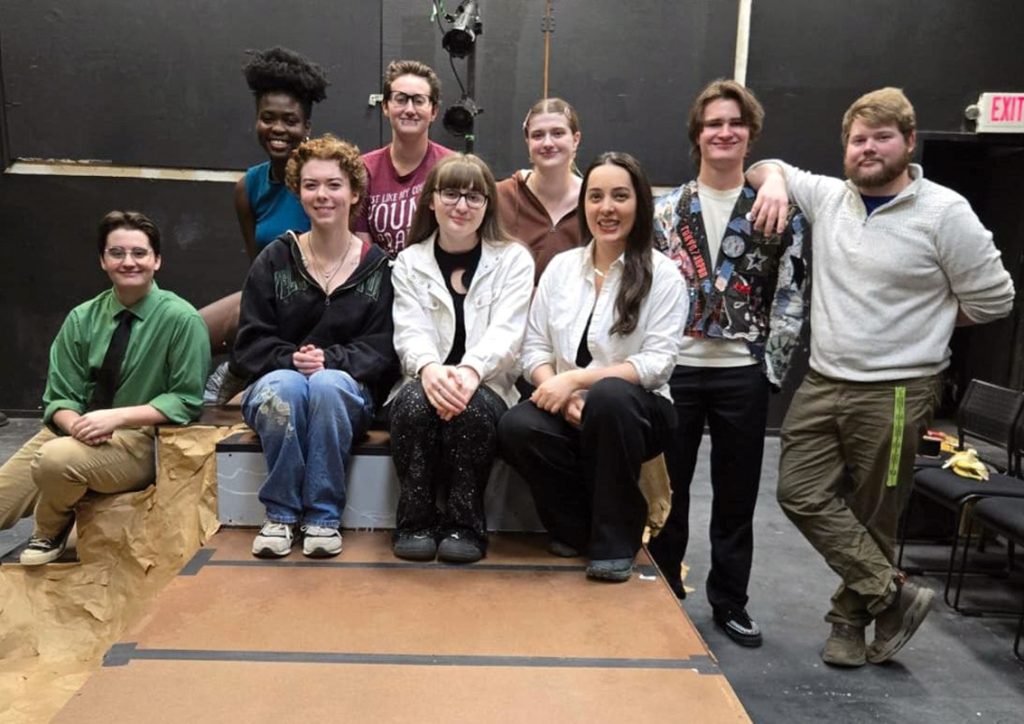
The Hartwick College production of “Proof” is being staged in the round (sort of), with audience on either side of a simple, narrow set. Two of the students I interviewed, Vaughn (stage manager) and Rheana (Catherine), are using this production as part of their senior thesis and so have been very engaged in multiple aspects of the show. For Vaughn, that has meant getting deeply into the technical aspects of the show, while Rheana has delved in the dramaturgy. Along with the other four students present, they talked about different aspects of the production and the director’s intentions.
“I wanted to point out one of the biggest parts of the show,” Vaughn began. “She’s (the director) making us act out more of the psychological aspect of the play rather than the physical aspect. And that’s why our set is pretty simplistic, to say the least, compared to when you look up other productions of ‘Proof.’ Ours is very open-minded,” Vaughn began.
Indicating the partially finished stage set we were sitting beside, Rheana continued, “What you see right now is not how it’ll look. This is all going to be painted white, and then that papier-mâché part is supposed to be crinkly notebook paper and stuff like that. And Nikoo’s (Mamdoohi, director) intention with it was for us to be looking at the inside of Catherine’s mind. And one of the things that she stressed over and over again in production meetings is how abstract everything is…she wants the audience to never fully think they know what’s going on, or if they do think they know what’s going on, we then immediately do something that makes them question…wait, what? There’s this whole sense of who do I trust? We don’t get any of that clarity until the very end. We’ve been focusing on that a lot. Visually with the set, but also with how the lights are going to be, and with what sound cues we’re using, just a lot of confusion, but purposeful confusion, to really take them (the audience) on this back-and-forth journey as they’re watching the show.”
“I hope [the audience] notices about how they are on two different sides of the set, and the set is in the middle. It’s very unconventional, but I think it’s a really interesting idea,” Alison (Claire) shared. “And something that we’ve really had to work on is talking to both sides, but it’s been really fun to do that. How we’re doing this show, it’s a very abstract take on what is going on in every scene.”
The students shared other aspects of how the director’s intentions for this production of “Proof” impacted not just the sets, lights, and audio, but also the rehearsal process for this intimate and emotionally intense play.
“For the first few weeks of rehearsals, we didn’t really tackle the script much. Nikoo had us focus a lot on building up our relationship as an ensemble. We did a lot of exercises that made us aware of each other’s presence, and how to cover for each other on-stage and off-stage,” Hailey (Robert) told me. “We did one particular exercise where we went up on stage and interviewed each other and answered the questions in character. And it made us think a lot about what was going on before the script, in between the scenes, as the characters were growing up, and in the gap between the flashback scenes and the present scenes.”
So given all this thought and careful preparation being put into the production, I was curious what the students hoped the audience would take away from the play.
“I’m hoping the audience will walk away with a sense of understanding toward mental health and health issues leading into their future lives,” Vaughn stated, to strong agreement from the others there.
That led to a discussion about the growing acknowledgement of the importance of mental health in our society. Part of that discussion included how differently the older generation (me, in that room) has approached the topic (“keep a stiff upper lip”) from how the younger generation (them) interacts more openly with it, and how the play handles the topic.
“I can understand where that older mentality comes from, because there wasn’t necessarily a widespread understanding of mental health, nor the resources that we have today,” Echo (Hal) posited. “It’s talked about so much, you can look up so much just on your phone on a whim. And there’s a lot of counseling and resources and medications out there that can really help people regulate their emotions and live better lives. I feel like there’s a lot more support, and people can be a lot more open about it with friends and family members. I think that is a positive.”
“I feel the show, as described earlier, is a lot about mental health and hopefully at the end of the show the audience will do some introspection,” Xander (assistant stage manager) said. He continued, saying he hoped audience members had a “wow!” moment and “…understand the meaning of self, their self-trust, and their connection with others better.”
As I listened to these young people share their perspectives on the play, it occurred to me how much different art forms, like plays, do give us a real chance to come together as a community and find new ways to think and communicate about vital issues, like mental health. (Sometimes those exchanges can be a wee bit painful, of course. Like during this discussion when one of them commented that some of the language in the play is “dated” because it was written so long ago, and I realized that when it was written in 2000, none of the students I was interviewing were born yet. In 2000, I already had more than 15 years in the workplace and three kids.) The times I connect with art—performance, visual, musical, or otherwise—it can be because it helps me to shake up my understanding of a topic, and look at it in a fresh way, or it allows me to finally clarify some of my thoughts and I get that “wow!” moment.
I am looking forward to seeing Hartwick’s final production of “Proof.” I am interested in finding out during the full performance whether the play’s themes and characters bring me a little closer to answers to some of the proofs I have been working on for a lifetime in the areas of trust, my own sanity, and love. Unlike in my high school geometry class, I don’t expect to reach any final, solid answers, but I know regardless it will be an evening well spent enjoying more of the arts that our local community offers.
You can watch “Proof,” written by David Auburn and directed by Nikoo Mamdoohi, at the Lab Theater in the Bresee Hall basement on the Hartwick College campus, April 15-17 at 8 p.m. and April 18 at 2 p.m. To reserve tickets, call (607) 431-4227 or e-mail theatre@hartwick.edu.
Next up: “A Day in Hollywood, A Night in Ukraine,” book and lyrics by Dick Vosburgh, music by Frank Lazarus, and directed by John McCaslin-Doyle, at SUNY Oneonta’s Goodrich Theatre, April 29 through May 2.
Rachel Frick Cardelle covers performing arts at SUNY Oneonta and Hartwick College.